

SSI Freediving: Courses, Certification Levels and What to Expect
Holding your breath underwater sounds simple until you actually try to do it properly.
At first, most people focus on one thing:
How long can I stay down?
Then you take a real freediving course and discover there is much more going on.
Relaxation matters. Equalization matters. Technique matters. Your position in the water matters. How you recover at the surface matters. And knowing what to do when your buddy needs help matters considerably more than adding another ten seconds to your personal record.
That is where SSI freediving training comes in.
SSI, or Scuba Schools International, offers a structured freediving education system that begins with introductory pool-based training and progresses through recreational open-water certification, advanced depth training and eventually performance-level freediving.
As of 2026, SSI’s main recreational pathway includes Basic Freediver, Pool Freediver, Freediver, Advanced Freediver and Performance Freediver, alongside specialty programs for divers who want to explore particular techniques or disciplines. Divessi Training
And no, you do not need to arrive capable of diving 40 meters.
That would rather defeat the purpose of training.
What Is SSI Freediving?
SSI freediving is the freediving education system developed by Scuba Schools International.
Instead of learning through random breath-hold attempts or copying techniques from social media, students progress through structured theory, confined-water sessions, open-water training and safety exercises.
Depending on the level, training can include:
- Breathing and relaxation
- Freediving physiology
- Static apnea
- Dynamic apnea
- Duck diving
- Finning technique
- Streamlining
- Equalization
- Free immersion
- Constant weight diving
- Surface recovery
- Buddy procedures
- Rescue skills
- Training planning
- Freefall
- Advanced equalization
- Performance preparation
The point is not simply to make you dive deeper.
SSI describes its recreational certifications as preparing freedivers to practice safely and autonomously with an equally or more qualified buddy, within environments and depths appropriate to their training. Divessi Training
That buddy part is important.
Getting certified does not unlock solo freediving mode.
What Does SSI Stand For?
SSI stands for Scuba Schools International.
Despite the word Scuba in the name, SSI has developed training systems covering several underwater disciplines, including scuba diving, freediving and mermaid programs.
SSI courses use digital educational materials and certification records through the MySSI system. Students create a profile and can access course materials, certifications and logged sessions through the website or MySSI app. Divessi
This can be particularly convenient for travelers.
Your certification card does not need to live in the mysterious drawer where physical dive cards historically went to disappear.
SSI Freediving Levels Explained
The SSI pathway is progressive.
You do not jump directly into performance freediving because you once stayed underwater for a surprisingly long time in a hotel pool.
Each level adds experience and skills.
| SSI Level | Minimum Age | Suggested Duration | Maximum Training Depth | Main Purpose |
|---|---|---|---|---|
| Basic Freediver | 10 | 6–8 hours | 5 m confined water | Introductory experience |
| Pool Freediver | 12 | 12–14 hours | 5 m confined water | Pool-based certification |
| Freediver | 12 | 16–20 hours | 20 m | Entry-level open-water certification |
| Advanced Freediver | 15 | 24–30 hours | 30 m | Greater efficiency, depth and independence |
| Performance Freediver | 18 | 32–40 hours | 40 m | Highest non-professional SSI freediving course |
These are training limits, not promises that every student will reach the maximum depth. Certification depends on completing the required knowledge, skills and performance standards rather than simply attending the scheduled classes. Divessi Training
SSI Basic Freediver
The SSI Basic Freediver program is designed as an introduction to recreational freediving in a pool or confined-water environment.
It is technically a recognition program rather than the full SSI Freediver certification.
SSI currently sets:
- Minimum age: 10
- Recommended duration: 6–8 hours
- Maximum depth: 5 meters
- Environment: pool or confined water
The program introduces the skills and knowledge needed to participate safely under professional supervision. Divessi Training
This can make sense if you are curious about freediving but not ready to commit to open-water certification.
Think of it as:
I want to understand what freediving actually feels like.
Not:
I have decided my new personality is descending vertically into the ocean.
Yet.
SSI Pool Freediver
The SSI Pool Freediver certification goes further while still keeping training inside pool or confined-water environments.
SSI currently recommends approximately 12–14 hours of training, with a minimum age of 12 and a maximum confined-water depth of five meters. Students complete academic work, a breathing session and at least two pool/confined-water sessions. Divessi Training
This route can appeal to people interested in:
- Static apnea
- Dynamic apnea
- Pool training
- Breath-hold technique
- Freediving fitness
- Learning safety without immediately moving into depth
Certified Pool Freedivers can practice independently with an equally or more qualified buddy in appropriate pool/confined-water environments within the scope of their training. Divessi Training
SSI also allows Pool Freediver students to upgrade later to the full Freediver certification by completing the required open-water sessions. Divessi Training
SSI Freediver: The Main Beginner Certification
For most people searching SSI freediving certification, this is the course they mean.
The SSI Freediver program is the main entry-level open-water certification.
Current SSI standards list:
- Minimum age: 12
- Six academic sessions
- Two pool/confined-water sessions
- Two open-water sessions
- Recommended duration: 16–20 hours
- Maximum training depth: 20 meters / 65 feet
- No previous freediving certification required
Students must also be fit to swim and complete the required course assessments. Divessi
This is where freediving starts becoming much more than breath-holding practice.
You begin taking what you learned in controlled water and applying it vertically.
What Do You Learn in SSI Freediver?
The exact lesson sequence follows SSI’s training materials and instructor standards, but entry-level freediving education revolves around several core areas.
Breathing and Relaxation
Beginners learn that freediving preparation is not about aggressively inhaling and exhaling as much as possible.
Relaxation becomes a skill.
You begin noticing:
- Shoulder tension
- Jaw tension
- Breathing patterns
- Mental stress
- Unnecessary movement
The calmer you become, the less energy you generally waste.
Static Apnea
Static apnea involves holding your breath while remaining still at the surface under appropriate supervision.
This helps introduce:
- Relaxation
- Breath-hold sensations
- Buddy supervision
- Recovery procedures
It is not a competition with the person beside you.
Especially on day one.
Dynamic Apnea
Dynamic apnea involves swimming horizontally underwater in a pool or confined-water environment.
This develops:
- Streamlining
- Fin technique
- Efficiency
- Body position
It is one thing to hold your breath while lying still.
It is another to move efficiently while doing it.
Open-Water Depth Training
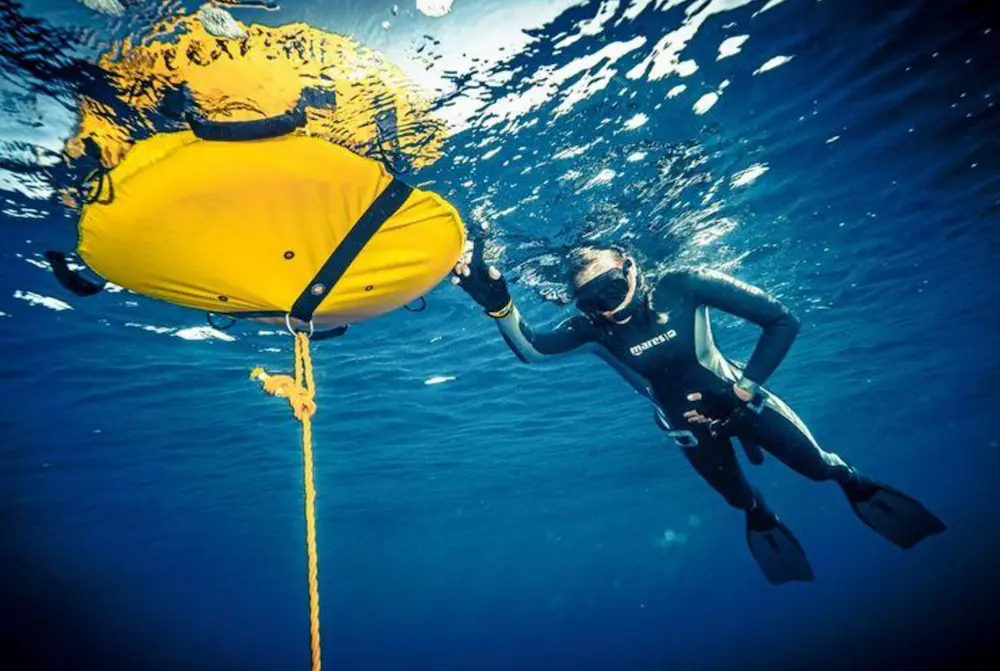
Students then apply freediving techniques vertically using a line and buoy system.
Skills may include:
- Duck diving
- Constant weight
- Free immersion
- Equalization
- Turns
- Controlled ascent
- Surface recovery
- Buddy safety
This is often the point where freediving finally begins to feel like the activity that made you curious in the first place.
Blue water below you.
One breath.
Down you go.
How Deep Can You Go With SSI Freediver?
The current maximum training depth for SSI Freediver is 20 meters / 65 feet. For students aged 12–14, SSI limits open-water training to a maximum of 12 meters. Divessi
That does not mean everyone should immediately aim for 20 meters.
Depth depends on:
- Equalization
- Relaxation
- Technique
- Comfort
- Physical condition
- Instructor assessment
- Environmental conditions
Some students progress quickly.
Others need extra time at shallower depths.
Neither situation means the course is going badly.
A comfortable 12-meter dive with good technique is far more useful than an ugly 20-meter dive achieved by fighting your body the entire way.
SSI Advanced Freediver
Once the fundamentals become comfortable, SSI Advanced Freediver moves toward greater efficiency, deeper diving and more sophisticated technique.
Current SSI standards list:
- Minimum age: 15
- SSI Freediver or recognized equivalent required
- At least six logged freediving sessions
- Three academic sessions
- Two pool/confined-water sessions
- Four open-water sessions
- Suggested duration: 24–30 hours
- Maximum training depth: 30 meters / 100 feet Divessi
At this level, the conversation begins changing from:
How do I descend?
to:
How do I descend efficiently?
What Do You Learn in SSI Advanced Freediver?
SSI specifically highlights skills such as freefall, improved equalization and planning safe freediving sessions within Advanced Freediver training. Divessi
Frenzel Equalization
As dives become deeper, equalization technique becomes increasingly important.
Many freedivers transition toward Frenzel equalization, which can be more efficient than techniques relying heavily on chest pressure.
Equalization often becomes the factor that limits beginner depth long before breath-hold time does.
Your lungs may feel perfectly fine.
Your ears have submitted a formal complaint.
Listen to them.
Freefall
At sufficient depth, increased pressure compresses air spaces and changes buoyancy.
Eventually, a diver can become negatively buoyant enough to stop kicking and allow gravity to carry them downward.
This is known as freefall.
Done correctly, it can feel remarkably peaceful.
For many freedivers, this is the point where the sport begins feeling less like swimming downward and more like actually diving.
Improved Dive Planning
Advanced training also places greater emphasis on organizing sessions, buddy systems and understanding how depth changes safety demands.
The goal is not only becoming a deeper diver.
It is becoming a more competent one.
SSI Performance Freediver
At the top of SSI’s non-professional pathway is Performance Freediver.
This is not a beginner course with a more impressive name.
Current prerequisites include:
- Minimum age: 18
- Advanced Freediver or recognized equivalent
- At least 30 logged freediving sessions
The course currently includes:
- Four academic sessions
- Two pool/confined-water sessions
- Five open-water sessions
- Approximately 32–40 hours of training
- Maximum training depth of 40 meters / 130 feet Divessi
SSI describes Performance Freediver as its highest non-professional freediving program. Divessi
What Makes Performance Freediver Different?
At this stage, training becomes much more performance-focused.
SSI’s current program includes topics such as:
- Advanced pressure physiology
- Performance preparation
- Mouth-fill equalization
- Equipment configuration
- Advanced safety systems
- FRC diving within defined training parameters
- Coaching principles
- Greater efficiency at depth Divessi
This is training for people who already freedive regularly.
If you have never learned Frenzel and have three total freediving sessions in your logbook, Performance Freediver is not your next weekend activity.
There are several useful steps in between.
SSI Freediving Specialties
SSI also offers specialty programs that let divers work on specific areas instead of only moving vertically through certification levels.
Current SSI training materials feature specialties including:
Monofin
Monofin training teaches efficient swimming using both legs together through a single fin.
The movement is very different from standard bifin kicking and requires specific technique through the core and body.
No-Fins Freediving
No-fins training removes the propulsion advantage of fins entirely.
This places greater emphasis on swimming technique and body efficiency.
Training Techniques
The SSI Training Techniques specialty focuses on understanding personal strengths and weaknesses and developing more structured freediving training. Divessi
These specialties can be useful because not every freediver’s next goal is simply:
Go five meters deeper.
Some want better technique.
Some love pool disciplines.
Some want to compete.
Some just discovered monofin swimming and have decided being human was overrated.
SSI Specialty Freediver, Progressive Freediver and Master Freediver
Here is one slightly confusing part of the SSI system.
Specialty Freediver, Progressive Freediver and Master Freediver are recognition ratings, rather than simply the next three depth courses after Performance Freediver.
SSI awards recognition as divers complete specialty programs and log additional freediving experience. Divessi
That distinction matters when researching courses.
Advanced Freediver is an actual training program.
Master Freediver is an SSI recognition rating earned through a combination of training and experience.
They are not interchangeable names.
How Fit Do You Need to Be for SSI Freediving?
You do not need to be an elite athlete.
You do need basic water competence.
SSI’s current water-fitness standards use different swimming assessments according to program level. Its published evaluation specifies:
- Basic Freediver: 25 m swim
- Pool Freediver / Freediver / Advanced Freediver: 100 m swim
- Performance Freediver: 400 m swim
without swimming or buoyancy aids. Divessi Training
The purpose is not to see who is fastest.
It is to establish that the participant has an appropriate baseline of comfort and competence in water.
Freediving becomes considerably less relaxing if basic swimming is already stressful.
Do You Need to Be Good at Holding Your Breath?
No.
That is something you are learning.
People often postpone freediving because they test themselves at home, last 35 seconds and conclude:
Apparently I am biologically incompatible with freediving.
That is not how it works.
Untrained breath-holding and trained freediving are very different experiences.
Technique, relaxation, movement efficiency and mental comfort all affect how a dive feels.
Your starting breath-hold time is not a prediction of how good a freediver you can become.
SSI Freediving Safety Training
One of the biggest reasons to take a certification course is safety.
Freediving involves the possibility of hypoxia, loss of motor control and blackout.
This is why legitimate courses spend time teaching buddy procedures and rescue rather than simply helping students chase personal records.
SSI’s certifications are built around diving with an equally or more qualified buddy rather than freediving alone. Divessi Training
Training can include:
- Proper supervision
- Surface protocols
- Recognizing problems
- Rescue technique
- Airway management
- Recovery procedures
- Safe session planning
The ability to rescue your buddy matters more than whether you can descend another three meters.
That is not the glamorous part of freediving.
It is the important part.
Can You Freedive Alone After SSI Certification?
No.
Certification does not make solo freediving safe.
SSI explicitly describes autonomous freediving in terms of diving with an equally or more qualified buddy within the conditions and depths of your training. Divessi Training
So “autonomous” does not mean:
Congratulations, you may now disappear into the ocean by yourself.
It means you no longer require direct instructor supervision when diving within the limits of your certification—but the buddy system remains fundamental.
SSI Freediving Equipment
Your exact equipment depends on the course and environment, but common freediving equipment includes:
- Low-volume mask
- Snorkel
- Freediving fins
- Wetsuit
- Weight belt
- Appropriate weights
- Dive computer
- Freediving buoy
- Line
- Bottom weight
- Lanyard where required
Beginners do not necessarily need to buy everything first.
Rental equipment is useful while discovering:
- What fin stiffness works for you
- Which mask actually fits your face
- What wetsuit thickness you need
- Whether you prefer bifins or eventually want a monofin
There is no prize for arriving at your first freediving class with more equipment than your instructor.
How Long Does SSI Freediving Certification Take?
SSI publishes course duration in recommended training hours rather than simply promising that every course takes exactly two or three days.
That is sensible because student progress varies.
The current recommendations are approximately:
| Course | Suggested Training Time |
|---|---|
| Basic Freediver | 6–8 hours |
| Pool Freediver | 12–14 hours |
| Freediver | 16–20 hours |
| Advanced Freediver | 24–30 hours |
| Performance Freediver | 32–40 hours |
Training centers may distribute those hours differently.
A vacation-based course may be concentrated into several days.
A local school might spread sessions across multiple weekends.
Certification should depend on completing the requirements, not simply the calendar reaching Sunday afternoon.
How Much Does an SSI Freediving Course Cost?
SSI does not publish one universal worldwide course price.
Its own training information explains that costs are determined by the selected training center and may be packaged differently. Components can include:
- Digital training materials
- Academic tuition
- Pool/confined-water training
- Open-water sessions
- Certification fees Divessi
Your total cost may also depend on:
- Equipment rental
- Boat fees
- Pool entry
- Cenote or park entrance
- Transportation
- Additional training sessions
This means comparing two prices only makes sense after checking what each one actually includes.
A cheaper course stops looking cheap when equipment, entry and open-water fees appear separately later.
SSI Freediving vs. AIDA
SSI and AIDA both provide structured freediving education, but the naming systems differ.
SSI’s own equivalency chart currently places its major programs alongside recognized certifications from AIDA and other agencies.
For example, SSI lists:
| SSI | AIDA |
|---|---|
| Pool Freediver | AIDA 2 Pool |
| Freediver | AIDA 2 |
| Advanced Freediver | AIDA 3 |
| Performance Freediver | AIDA 4 |
That does not mean the curricula are identical in every detail.
It means SSI recognizes these levels for training-equivalency purposes.
For most recreational divers, the instructor and quality of training matter more than becoming emotionally attached to one logo before you have even taken your first course.
SSI Freediving vs. PADI Freediving
Both organizations offer internationally recognized underwater training systems, but their course structures and names are different.
SSI organizes its main open-water progression around Freediver, Advanced Freediver and Performance Freediver.
PADI uses its own freediving pathway and requirements.
If you already hold a certification from another recognized agency and want to cross into SSI, do not assume you must automatically restart at the beginning. SSI maintains equivalency standards for recognized training organizations. Divessi Training
The training center can evaluate your existing qualification and tell you which course fits next.
Is SSI Freediving Certification Recognized Internationally?
SSI operates an international training system with centers in destinations around the world, and certifications are stored digitally through MySSI. SSI also maintains formal equivalency tables for certifications from multiple other recognized freediving agencies. Divessi Training
Practically, however, whenever you arrive at a new freediving center, expect the operator to consider more than the name on your card.
They may also ask about:
- Recent experience
- Logged dives
- Maximum comfortable depth
- Time since your last training
- Current equalization ability
- Local conditions
A certification proves training.
It does not prove that you practiced yesterday.
SSI Freediving in a Pool
Pool training gives beginners a controlled environment.
No waves.
No current.
No boat movement.
You can focus on:
- Breathing
- Relaxation
- Static apnea
- Dynamic apnea
- Streamlining
- Buddy skills
SSI even offers the dedicated Pool Freediver certification for people who want to remain within confined-water disciplines before moving into open water. Divessi Training
For many people, this removes a lot of unnecessary stress at the beginning.
You can learn what your body is doing before adding the ocean’s opinions.
SSI Freediving in the Ocean
Open water changes the experience completely.
Now you have:
- Depth
- Waves
- Current
- Visibility changes
- A vertical line
- Greater pressure changes
This is where equalization and relaxation become especially important.
The ocean also provides the thing that attracts many people to freediving in the first place:
The feeling of actually descending into open water.
A swimming pool teaches skills.
The ocean gives those skills somewhere to go.
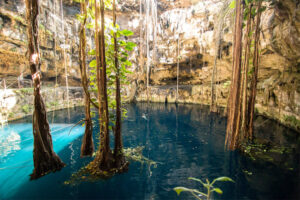
Freediving in Cenotes
Mexico adds another training environment:
cenotes.
Selected cenotes can offer:
- Clear freshwater
- Calm surface conditions
- Excellent visibility
- Vertical depth
- Dramatic rock formations
- Protected environments away from ocean waves
They can be excellent locations for practicing vertical freediving when used appropriately and under qualified supervision.
MExplor currently offers cenote freediving training focused on relaxation, equalization, descent technique, turns and vertical water skills. MExplor Travel
And visually, there is a slight improvement over staring at swimming-pool tiles.
SSI Freediving in Mexico
Mexico is particularly attractive for freediving training because one trip can include very different environments.
The Mexican Caribbean offers:
- Pools
- Caribbean open water
- Cenotes
- Reef environments
- Freediving excursions
- Underwater photography
- Snorkeling
- Scuba diving
That allows travelers to combine formal training with the reason they probably wanted to learn freediving in the first place:
Actually exploring underwater.
Is SSI the Only Freediving Certification Option in Mexico?
No.
This is important if you specifically want to train with MExplor.
MExplor’s current public course listings primarily show AIDA certifications, including AIDA 1 and AIDA 3, alongside general freediving and cenote training. Its broader certification guide also explains that certification structures differ between training organizations. MExplor Travel
So if the letters SSI specifically matter to you, confirm the certifying agency with the center before booking.
If your goal is simply to receive recognized freediving instruction while traveling in Mexico, it makes sense to compare:
- Agency
- Instructor
- Course level
- Training environment
- Included equipment
- Number of sessions
- Safety standards
- Total price
The logo is only one part of that decision.

What Is the Best SSI Freediving Course for a Beginner?
For most people who want full recreational open-water training:
SSI Freediver is the natural starting point.
Choose Basic Freediver if you primarily want a short introduction.
Choose Pool Freediver if you want structured pool training without open-water depth.
Choose Freediver if you want the full beginner experience with both confined and open water.
A simple way to think about it:
| Your Goal | Best Starting Point |
|---|---|
| “I just want to try freediving.” | Basic Freediver |
| “I want pool/apnea training.” | Pool Freediver |
| “I want to become a certified open-water freediver.” | Freediver |
| “I already have Freediver and want 30 m training.” | Advanced Freediver |
| “I already train seriously and want performance-level skills.” | Performance Freediver |
How to Choose an SSI Freediving Instructor
Do not choose entirely based on course price.
The instructor will have a much greater impact on your experience than a small difference in cost.
Look for someone who:
- Explains safety clearly
- Does not pressure students to reach depth
- Adjusts training to individual progress
- Understands equalization
- Gives useful technique feedback
- Runs organized buddy procedures
- Creates enough recovery time
- Makes it comfortable to say “I don’t want to go deeper”
A good freediving instructor does not make you feel brave.
They make you feel informed.
What Should You Ask Before Booking?
A few questions can prevent surprises:
Which exact SSI certification will I receive?
How many pool and open-water sessions are included?
Is equipment included?
Are entry or boat fees included?
Where does the depth training happen?
How many students are in the group?
What happens if I cannot complete a depth requirement during the scheduled course?
Are additional sessions available?
What medical paperwork is required?
What certification agency is actually issuing the card?
That final question matters especially if you found the course through an article about SSI freediving.
Do not assume.
Best Time to Take a Freediving Course in the Mexican Caribbean
Training can happen throughout much of the year, but conditions vary.
| Period | What to Expect |
|---|---|
| December–April | Popular dry-season travel period with comfortable weather |
| May–June | Warmer water and transition toward summer |
| July–August | Hotter weather and warm Caribbean conditions |
| September–October | Greater tropical-weather variability |
| November | Transition toward the drier tourism season |
| Year-round | Pool and selected cenote training can remain possible |
Ocean sessions always depend on current conditions.
One advantage of training in the Riviera Maya is the variety of environments available.
If the sea decides it has other plans, a suitable cenote or pool may sometimes provide an alternative depending on the course requirements.
What Happens After SSI Freediver?
Get experience.
This part is easy to overlook because certifications make progression look like a staircase:
Freediver.
Advanced.
Performance.
Done.
Real freediving does not work that way.
SSI itself requires logged sessions before entering its higher-level courses: six sessions before Advanced Freediver and thirty before Performance Freediver. Divessi
That requirement exists for a reason.
You need time to practice:
- Equalization
- Finning
- Buddy safety
- Relaxation
- Turns
- Surface recovery
- Different conditions
Your next course should build on experience.
It should not replace it.
Frequently Asked Questions About SSI Freediving
What is SSI freediving?
SSI freediving is the breath-hold diving training system offered by Scuba Schools International. It includes introductory, pool, open-water, advanced and performance certifications as well as specialty programs. Divessi
What is the first SSI freediving certification?
SSI offers Basic Freediver as an introductory recognition program and Pool Freediver for confined-water certification. For full entry-level open-water certification, the main course is SSI Freediver. Divessi Training
How deep is SSI Freediver?
The SSI Freediver course currently has a maximum open-water training depth of 20 meters / 65 feet. Students aged 12–14 are limited to 12 meters. Divessi Training
How deep is SSI Advanced Freediver?
SSI Advanced Freediver currently has a maximum training depth of 30 meters / 100 feet. Divessi
How deep is SSI Performance Freediver?
SSI Performance Freediver currently trains to a maximum of 40 meters / 130 feet and is SSI’s highest non-professional freediving program. Divessi
How old do you need to be for SSI Freediver?
The minimum age for SSI Freediver is currently 12 years old. Different age limits apply to other programs, with Advanced Freediver beginning at 15 and Performance Freediver at 18. Divessi
Do you need previous experience for SSI Freediver?
No previous certification is required for SSI Freediver, although students must meet the applicable water-fitness requirements. Divessi
How long does SSI Freediver take?
SSI currently recommends approximately 16–20 hours for its Freediver program. Training schedules vary by center and student progression. Divessi
Is SSI Freediver equivalent to AIDA?
SSI’s current equivalency chart recognizes AIDA 2 alongside SSI Freediver, AIDA 3 alongside Advanced Freediver and AIDA 4 alongside Performance Freediver. Divessi Training
Can I freedive alone after getting SSI certified?
No. SSI certifications describe autonomous freediving with an equally or more qualified buddy, not solo freediving. Divessi Training
Do SSI freediving certifications expire?
Your certification record remains part of your SSI profile, but training and comfort can decline when you stop practicing. After a long break, refresher training is a sensible choice before returning to depth.
Does MExplor offer SSI freediving?
MExplor’s currently published certification products show AIDA courses and general freediving training rather than specifically advertised SSI courses. Travelers who specifically need an SSI certification should confirm the certifying agency before booking. MExplor Travel
SSI Freediving Is About More Than Depth
It is easy to look at the SSI pathway and see numbers.
20 meters.
30 meters.
40 meters.
But those numbers are not really the point.
Good freediving progression happens when a diver becomes calmer, safer and more efficient.
Equalization becomes easier.
Movement becomes cleaner.
You stop wasting energy.
You become a better buddy.
You understand when to continue a dive and when to turn around.
Eventually, deeper diving may follow.
That is very different from forcing yourself toward a number because the certification table says it exists.
The best SSI freediving course is therefore not the one that gets you deepest as quickly as possible.
It is the one that gives you the skills to keep exploring safely long after the course ends.
Learn Freediving in Mexico With MExplor
If your goal is to combine formal freediving training with an actual underwater adventure, MExplor offers freediving certification and training in the Mexican Caribbean, including pool, open-water and cenote experiences. Its current public certification options include AIDA courses rather than specifically advertised SSI certification. MExplor Travel
That makes the region especially interesting if you care less about collecting a particular agency logo and more about learning the skills in environments you actually want to explore.
Train in controlled water.
Develop your technique.
Take those skills into a cenote or the Caribbean.
Then use freediving for what it was meant for:
exploring more of the underwater world on a single breath.
Contact MExplor to discuss your current freediving level, certification goals and available training options in Mexico.
Also you are interested
Covid test in Cancun & Riviera Maya
COVID test in Cancun Get your COVID test in Cancun & Riviera Maya PCR COVID test Want to get your COVID test in Cancun ?
Los 21 mejores cenotes de Valladolid Mexico
Mejores cenotes de Valladolid Mexico Cenotes de Valladolid Mexico Toda la península de Yucatán está salpicada de cenotes, unos hermosos pozos de agua naturales que
Freediving Classes Near Me: How to Choose the Right Course
Searching for “freediving classes near me” is often the first step toward discovering an entirely different way to experience the underwater world. Freediving does not
