

Arpon Spearfishing: An Underwater Fishing Adventure in the Riviera Maya
Most fishing trips begin with a boat, a rod and a fair amount of sitting.
Spearfishing takes a very different approach.
Instead of waiting for a fish to find your bait, you put on a mask, snorkel and fins, enter the water and become part of the underwater environment yourself. You have to dive quietly, control your breathing, identify the right species and make decisions before you ever use the speargun.
That combination of freediving, fishing and underwater exploration is what makes Arpon Spearfishing such an interesting experience for adventurous travelers visiting Mexico’s Riviera Maya.
There is also a specific operator behind the keyword. Arpon Spearfishing is based in Puerto Aventuras and currently offers boat-based spearfishing experiences for both beginners and experienced spearfishers around the Riviera Maya, including access from areas such as Playa del Carmen, Tulum, Cancún and Cozumel. Its current offerings include guided reef and blue-water trips as well as a two-day spearfishing course that begins with freediving fundamentals before moving into spearfishing techniques.
If you have never tried it, do not picture someone simply jumping off a boat with a spear.
Good spearfishing begins with water confidence, breath control, species identification, safety and a healthy respect for the fact that you are entering somebody else’s ecosystem.
What Is Arpon Spearfishing?
The Spanish word arpón means harpoon or spear, so the name fits the activity rather well.
Modern recreational spearfishing usually involves either a speargun or another legal spearing device while diving underwater. In Mexico, recreational underwater fishing is regulated separately from ordinary rod-and-line fishing, including rules about how the activity can be conducted.
At Arpon Spearfishing, the experience is based around guided boat trips in the Mexican Caribbean.
According to the operator’s current information, its trips provide equipment including spearguns, masks, snorkels, wetsuits, fins, weights and gloves, along with a professional guide and the required fishing permit for participants.
That makes the activity accessible to travelers who are curious about spearfishing but do not want to arrive in Mexico with an entire freediving equipment bag.
Which is useful, because long freediving fins are not exactly known for fitting discreetly beneath an airplane seat.
What Makes Spearfishing Different From Regular Fishing?
Both activities involve catching fish.
Almost everything else feels different.
With traditional fishing, you may troll from a boat, cast from shore or drop bait into deeper water. The fish does not necessarily know you are there until it takes the bait.
With spearfishing, you see the environment before making a decision.
You have to identify the species, estimate its size and determine whether it can legally and responsibly be taken.
DAN points out an important difference: there is effectively no traditional catch-and-release process after a fish has been speared. That makes correct species identification and good decision-making especially important.
| Traditional Fishing | Spearfishing |
|---|---|
| Usually uses rod, reel and bait or lures | Uses legal spearfishing equipment |
| Can remain on a boat or shore | Requires entering the water |
| Fish may be released after hooking | Decision must be made before taking the fish |
| Less physically demanding in many cases | Combines swimming, diving and breath holding |
| Visibility underwater is less important | Clear water makes a major difference |
| Often focuses primarily on the catch | Strong underwater-exploration component |
Spearfishing therefore feels less like waiting and more like searching.
You are reading reef structure, watching fish behavior and moving through the water.
Arpon Spearfishing in the Riviera Maya
The Mexican Caribbean is a natural setting for the activity because warm tropical water, reef environments and good visibility can make underwater exploration comfortable throughout much of the year.
Arpon Spearfishing operates from Puerto Aventuras, a marina community between Playa del Carmen and Tulum.
The company currently states that all its spearfishing excursions leave by boat rather than directly from shore, with half-day trips lasting about four hours and full-day excursions lasting around eight hours.
That boat access is useful because different species and underwater environments can require moving away from the immediate coastline.
Instead of simply swimming out from the beach and hoping something interesting appears, a guide can choose an area according to water conditions, experience level and the kind of diving planned for the day.
Reef Spearfishing vs. Blue Water Spearfishing
One of the first distinctions you will encounter is between reef spearfishing and blue water spearfishing.
They can feel like completely different sports.
Reef Spearfishing
Reef spearfishing takes place around underwater structure.
You may be diving around reefs, rocky areas, ledges or other habitat where fish naturally gather.
The experience combines hunting with underwater observation because you are watching fish move through a complicated environment.
Reef diving may involve species such as snapper, jacks, grouper and other reef-associated fish where legally permitted and in season.
It is also a visually interesting environment.
One moment you are concentrating on a potential catch.
The next, a turtle cruises past and reminds you that the reef has absolutely no interest in your fishing agenda.
Blue Water Spearfishing
Blue-water spearfishing moves away from reef structure and into more open water.
The environment can feel very different because you may not have a visible bottom beneath you.
Target species can also be larger pelagic fish such as wahoo or mahi-mahi where conditions, regulations and seasons permit.
For an experienced diver, that open-blue environment can be exhilarating.
For someone who has never been comfortable looking down and seeing nothing except increasingly dark blue water, it can also provide a very rapid introduction to the concept of humility.
Beginners should develop solid freediving and water skills before progressing into more demanding conditions.
Do You Need Freediving Experience for Arpon Spearfishing?
Not necessarily, but freediving skills matter enormously.
Spearfishing on breath hold requires you to descend, move efficiently underwater and return safely to the surface while also paying attention to equipment and the environment.
That is why Arpon Spearfishing’s current course structure begins with freediving instruction before introducing spearfishing techniques. Its first day covers subjects including the dive reflex, equalization, breathing techniques and freediving risks before students practice spearfishing skills on the second day.
That order makes sense.
Learning to operate a speargun before you can comfortably equalize or control yourself underwater is doing things backwards.
Why Freediving Training Matters Before Spearfishing
Freediving looks peaceful.
Physiologically, quite a lot is happening.
When you hold your breath underwater, your oxygen supply is finite. Physical activity consumes oxygen, and the risk of hypoxic blackout becomes particularly important during ascent and around the surface.
Spearfishing adds another distraction.
You are watching fish.
You are carrying equipment.
You may be swimming against current.
You may become focused on a target and stay down longer than originally intended.
DAN specifically warns that repetitive freediving during spearfishing can contribute to exhaustion and blackout risk. It identifies poor weighting and inadequate buddy supervision among major contributing factors in serious incidents.
Good spearfishing is therefore not about seeing how long you can stay underwater.
It is about knowing when to leave.
Never Spearfish Alone
The most important rule is simple.
Do not spearfish alone.
The buddy system matters because a freediver can experience loss of motor control or blackout near the surface.
DAN emphasizes that freedivers should be directly supervised by a trained buddy rather than relying on someone simply watching from a boat.
Spearfishing makes this especially important because hunters can easily become separated when each person starts concentrating on fish.
DAN recommends maintaining close buddy contact and ensuring everyone involved knows rescue procedures.
Your buddy is not simply the person who happens to have booked the excursion with you.
They are part of your safety system.
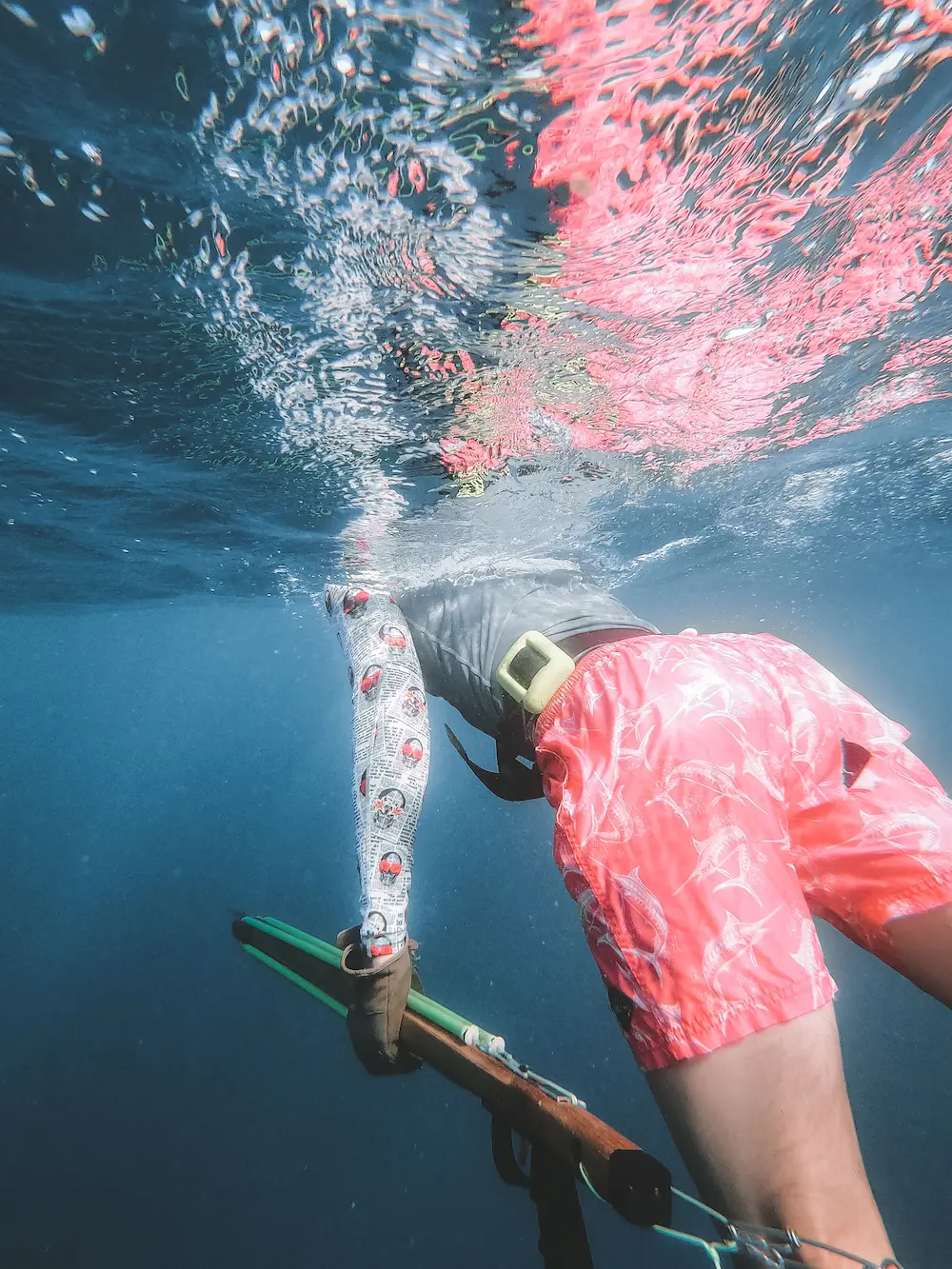
What Equipment Do You Need for Spearfishing?
A typical freediving spearfishing setup may include:
Low-volume mask
Snorkel
Long freediving fins
Wetsuit
Weight belt
Gloves
Speargun
Float and dive flag where appropriate
Fish-handling equipment used under local rules
Cutting tool for emergencies
Beginners do not necessarily need to purchase everything.
Arpon Spearfishing currently states that equipment such as spearguns, masks, wetsuits, snorkels, fins, gloves and weights is provided during its guided experiences.
That is a practical way to experiment with the sport before investing in equipment.
It also lets you discover whether you actually enjoy long freediving fins before purchasing a pair roughly the length of a small child.
Understanding the Speargun
A speargun is not simply fishing equipment.
It is capable of causing serious injury.
DAN advises divers never to point one at anything they do not intend to take and emphasizes maintaining awareness of other divers and the surrounding environment whenever a speargun is loaded.
Beginners should learn:
Safe loading and unloading
Muzzle awareness
How to move with the equipment
How the shooting line behaves
How to avoid entanglement
When not to take a shot
How to keep distance from other divers
A guided introduction is far preferable to discovering these things through trial and error.
Underwater is not the place to become inventive with weapon safety.
Mexican Spearfishing Rules Tourists Should Know
If you plan on Arpon Spearfishing in Mexico, regulations deserve attention before you enter the water.
Mexican recreational fishing rules recognize underwater sport fishing, but they place specific restrictions on how it can be practiced.
Current official guidance states that recreational underwater fishing requires an individual fishing permit.
Mexican rules also state that underwater recreational fishing must be performed through breath-hold diving rather than using scuba tanks. FONMAR currently lists one band, spring or pneumatic spear per sport fisher as permitted for underwater fishing and prohibits scuba tanks, hooks, gaff-type devices and light-attraction equipment for this activity.
You must also follow:
Closed seasons
Minimum sizes where applicable
Species protections
Local marine-protected-area rules
Catch limits
Distance restrictions around swimmers and other fishing operations
Spearfishing regulations can differ by area and can change, so always verify the rules for the exact destination before fishing.
A reputable local guide should already be paying close attention to them.
Mexican Spearfishing Catch Limits
Under FONMAR’s published rules for underwater recreational fishing, the maximum underwater catch is generally five fish per fisher per day, subject to additional species-specific restrictions, minimum sizes and closed seasons.
That does not mean the goal should automatically be catching five fish.
Responsible spearfishing is selective.
One of its potential advantages is precisely that the diver can see the fish before making a decision.
You can identify the species.
You can evaluate size.
And you can decide not to take it.
Sometimes the best decision made during a spearfishing trip is doing absolutely nothing.
Species You May Encounter in the Riviera Maya
The Mexican Caribbean supports a wide variety of tropical fish.
The exact species available for legal harvest depends on season, location and current fishing regulations.
Arpon’s current information lists potential species in its operating area such as:
Wahoo
Mahi-mahi
Amberjack
Spanish mackerel
Barracuda
Jacks
Snapper
Pompano
Grouper species where legally available
Not everything you see underwater should be considered a target.
Some species may be protected, closed to harvest, inside a restricted zone or simply inappropriate to take at that time.
Correct fish identification is therefore one of the most important skills a new spearfisher develops.
Marine Life Beyond the Catch
One reason spearfishing appeals to divers is that a fishing trip becomes an underwater wildlife experience at the same time.
The Riviera Maya’s waters can contain far more than target fish.
Depending on location and season, you may encounter:
Sea turtles
Rays
Reef fish
Barracuda
Jacks
Moray eels
Dolphins
Schools of tropical fish
Coral formations
Arpon describes encounters with turtles, dolphins and other marine animals as part of the wider experience in the region.
Treat those encounters as exactly that: encounters.
Wildlife should not be chased, touched or manipulated for photographs.
Spearfishing responsibly means knowing the difference between an animal you are legally harvesting and everything else sharing the water with you.
What Does a Beginner Spearfishing Trip Feel Like?
For most beginners, the first surprise is how much of the experience has nothing to do with firing a speargun.
You enter the water.
Adjust your equipment.
Breathe.
Look down.
Dive.
Equalize.
Observe.
Surface.
Recover.
Then repeat.
At first, simply moving efficiently may occupy most of your attention.
The reef seems to move faster than expected.
Fish appear extremely aware of your existence.
Your fins feel enormous.
Eventually your breathing settles and you begin noticing behavior.
That is when the experience starts becoming interesting.
You are no longer simply swimming around looking for a fish.
You are learning how to move quietly through an environment that notices every bad decision you make.
What Skills Should Beginners Learn First?
Before worrying about catching anything, focus on the fundamentals.
A beginner should develop:
Comfortable snorkeling
Efficient finning
Duck diving
Equalization
Relaxation
Safe weighting
Recovery breathing
Buddy procedures
Species identification
Basic equipment safety
These skills may sound less exciting than landing a large fish.
They are also the reason you are more likely to have a good second trip.
Equalization While Spearfishing
Equalization is essential whenever you descend.
Pressure increases quickly in the first few meters, and your middle ears need to be equalized as you go down.
Beginners sometimes wait until they feel discomfort.
That is too late.
Equalize early and frequently.
If your ears will not equalize, ascend slightly or end the dive.
Never force yourself deeper through pain.
A fish is not worth an ear injury.
There will be another fish.
Your ears are considerably harder to replace.
How Deep Do You Need to Dive for Spearfishing?
Not as deep as social media may make you think.
Spearfishing can take place at a range of depths depending on target species, environment and diver experience.
Beginners should not choose depth based on what experienced freedivers are doing online.
A shallow reef where you are calm, controlled and properly supervised is far more useful than a deeper dive where all your attention goes toward reaching the bottom.
Depth should develop as your freediving skills improve.
It should never become the price of participating.
Reef Spearfishing Techniques for Beginners
Reef spearfishing is generally about patience and observation rather than racing after fish.
Trying to chase a healthy reef fish is often an excellent way to discover that the fish is better at being a fish than you are.
Instead, experienced divers learn to move calmly, reduce unnecessary movement and observe how fish react to the environment.
For beginners, the bigger lesson is not a particular hunting trick.
It is learning to slow down.
Every frantic kick uses oxygen and makes you considerably more obvious underwater.
Good freediving technique improves the entire experience.
Why Visibility Matters for Spearfishing
Clear water is not just beautiful.
It is useful.
Good visibility makes it easier to:
Identify species
Estimate fish size
Maintain awareness of your buddy
Avoid reef contact
Understand underwater structure
Track equipment
Evaluate conditions
This is one reason tropical destinations can be appealing for first-time spearfishers.
Being able to see what is around you makes the environment much less intimidating.
It also makes the trip considerably more enjoyable when there is nothing legal or appropriate to catch.
You still get an underwater adventure.
Best Time for Arpon Spearfishing in the Riviera Maya
Spearfishing can be practiced through much of the year, but conditions and species change seasonally.
The most important factors are usually:
| Condition | Why It Matters |
|---|---|
| Visibility | Helps identification and safe diving |
| Wind | Affects surface conditions and boat travel |
| Current | Influences effort and dive planning |
| Water temperature | Changes comfort and fish activity |
| Season | Influences species availability |
| Weather | Determines whether the trip can operate safely |
Arpon currently promotes year-round spearfishing from Puerto Aventuras, with available species changing during the year.
Rather than choosing a month only because someone online caught a particular fish then, ask the guide what conditions and species are realistic during your travel dates.
Fish rarely consult SEO articles before planning their season.
Caribbean Water Temperatures and Exposure Protection
One advantage of the Riviera Maya is relatively warm tropical water.
That does not mean a wetsuit is unnecessary.
Repeated freediving sessions involve spending long periods immersed, and even warm water can gradually cool the body.
A wetsuit also provides protection from sun exposure at the surface and minor contact with equipment.
The appropriate thickness depends on season, water temperature and your individual cold tolerance.
Your guide can recommend the right setup.
Spearfishing and Sharks
The topic inevitably appears.
Yes, sharks live in oceans.
No, seeing one does not automatically mean a dramatic documentary soundtrack should begin playing.
Spearfishing can create circumstances that attract predators because injured fish produce movement and scent in the water.
DAN advises spearfishers to remain aware of predators such as sharks and seals that may attempt to take a catch.
If predators become interested, follow your guide’s instructions and prioritize leaving the situation safely over keeping the fish.
You bought dinner.
The shark did not agree to that arrangement.
Sustainable Spearfishing
Spearfishing can be highly selective when it is practiced responsibly.
Unlike some fishing methods where unwanted species may be caught accidentally, a trained spearfisher sees the target before deciding whether to act.
That creates the opportunity to choose:
Correct species
Appropriate size
Appropriate number
Mature individuals where regulations allow
Only fish that will actually be used
But selectivity only works when the diver has good identification skills and respects regulations.
Shooting first and checking the species later defeats the entire idea.
Responsible spearfishing should aim to take what will be consumed rather than treating the ocean like a scoreboard.
From Ocean to Dinner
One of the most memorable aspects of a fishing experience is eating what you caught.
Arpon Spearfishing currently offers participants the option of having their fresh catch prepared at a restaurant in Puerto Aventuras as part of the experience, subject of course to the catch being legal and suitable for retention.
That gives the day a satisfying progression.
You begin on the water.
You learn where your food came from.
You participate in harvesting it.
Then several hours later, it appears on the table.
For travelers who are used to seeing fish only after it arrives neatly portioned at a restaurant, the experience creates a very different relationship with seafood.
Half-Day vs. Full-Day Spearfishing Trips
Arpon currently lists both half-day and full-day experiences, with approximately four and eight hours respectively.
| Half-Day Spearfishing | Full-Day Spearfishing |
|---|---|
| Good introduction | More time to explore different areas |
| Easier for beginners | Better for experienced spearfishers |
| Less physically demanding | Greater physical demands |
| Fits easily into a vacation | Can reach more distant locations |
| Useful for testing the experience | Better when spearfishing is a trip priority |
For your first experience, longer is not automatically better.
Freediving repeatedly is physically demanding.
Four enjoyable hours are considerably better than eight hours spent wondering when someone will finally take you back to the marina.
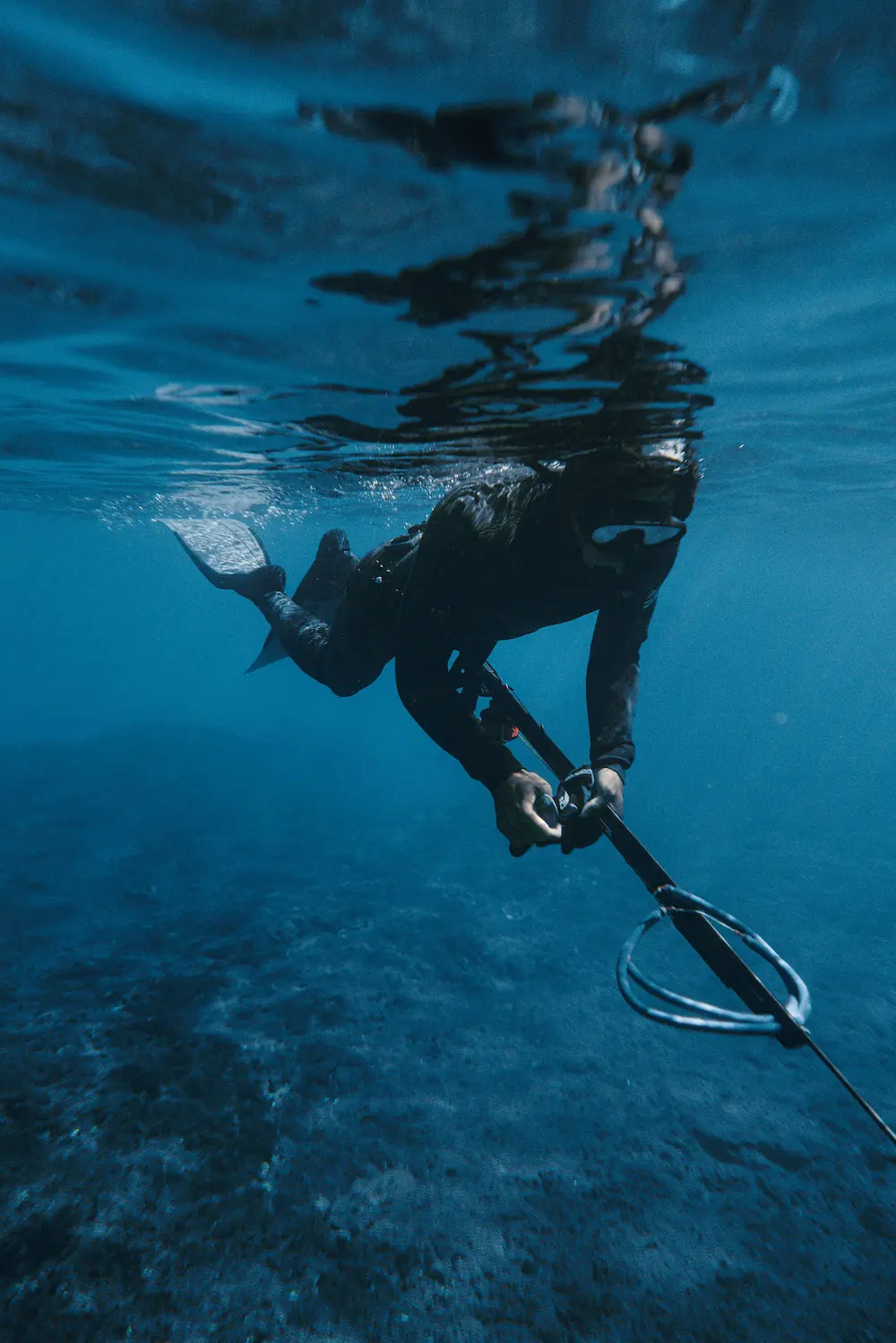
Spearfishing Course vs. Guided Trip
A guided trip and a course are not the same thing.
If you are already comfortable freediving and understand equipment safety, a guided experience may be appropriate.
If you are completely new to the activity, structured instruction is much more valuable.
Arpon’s current two-day course separates freediving instruction on day one from spearfishing technique on day two, allowing beginners to build water skills before combining them with a speargun.
That approach makes sense for anyone who plans to continue the activity beyond a single vacation.
Learning good habits at the beginning is much easier than correcting bad ones later.
What Should You Bring on an Arpon Spearfishing Trip?
If equipment is provided, your personal packing list can stay relatively simple.
Bring:
Swimsuit
Towel
Reef-conscious sunscreen for surface use
Hat
Sunglasses
Water-resistant bag
Change of clothes
Motion-sickness medication if appropriate
Camera for surface photos
Any personal equipment you strongly prefer using
If you already own freediving gear, ask whether bringing your own mask or fins makes sense.
A familiar mask can be particularly useful.
Few things disrupt relaxation faster than spending every surface interval draining seawater from your nose.
Is Arpon Spearfishing Good for Beginners?
It can be, provided the experience is structured around beginner ability.
Arpon specifically markets its Riviera Maya experiences to both beginner and experienced spearfishers and offers dedicated training for people who want to develop the necessary freediving and hunting skills.
A beginner should expect the guide to prioritize:
Water comfort
Equipment safety
Freediving fundamentals
Fish identification
Legal harvest
Conservative dive limits
Buddy procedures
You should never feel pressured to dive deeper or stay underwater longer simply to catch something.
The fish does not know how much you paid for the tour.
Can Non-Spearfishers Join?
This depends on the specific trip and operator arrangements, so it is worth checking before booking.
For couples or groups where only some travelers want to spearfish, a broader marine adventure can sometimes make more sense than forcing everyone into the same activity.
That is where customizable travel itineraries become useful.
One traveler may want to hunt fish.
Another may prefer snorkeling, underwater photography or diving.
There is no tourism law requiring everyone in a relationship to suddenly develop identical hobbies.
Frequently Asked Questions About Arpon Spearfishing
What is Arpon Spearfishing?
Arpon Spearfishing is a spearfishing operator based in Puerto Aventuras in Mexico’s Riviera Maya. It currently offers guided reef and blue-water spearfishing experiences as well as a two-day training course.
Where is Arpon Spearfishing located?
The company is based in Puerto Aventuras, south of Playa del Carmen. It promotes trips for travelers staying around the Riviera Maya, including Playa del Carmen, Tulum, Cancún and surrounding destinations.
Do you need freediving experience to spearfish?
Not always, but basic freediving competence is extremely valuable. Beginners should learn breath-hold safety, equalization, weighting and buddy procedures before focusing on catching fish.
Can you spearfish with scuba equipment in Mexico?
Mexican recreational underwater fishing rules require the activity to be conducted while breath-hold diving. FONMAR specifically lists scuba tanks as prohibited equipment for recreational underwater fishing.
Do tourists need a spearfishing permit in Mexico?
Yes. CONAPESCA states that recreational underwater fishing requires an individual sport-fishing permit.
How many fish can you catch while spearfishing in Mexico?
FONMAR’s underwater recreational fishing rules generally establish a maximum of five fish per fisher per day, while species-specific limits, minimum sizes, closed seasons and protected areas can impose further restrictions.
Is equipment included with Arpon Spearfishing?
The operator currently states that it provides equipment including spearguns, masks, wetsuits, snorkels, gloves, weights and fins.
How long are the trips?
Arpon’s current FAQ lists approximately four hours for a half-day excursion and eight hours for a full-day trip.
Can beginners take a spearfishing course?
Yes. Arpon currently offers a course beginning with freediving fundamentals before progressing to spearfishing technique, equipment use and practical training.
Is spearfishing dangerous?
Spearfishing introduces risks associated with both freediving and spearing equipment. Hypoxic blackout, entanglement, poor weighting, environmental conditions and equipment injuries are among the concerns. Formal training and a vigilant trained buddy significantly reduce avoidable risk.
Arpon Spearfishing Is Fishing With a Completely Different Perspective
You can spend years fishing without ever seeing the world where the fish actually live.
Spearfishing changes that.
You see the reef.
You learn how fish move.
You begin noticing current, visibility, depth and your own breathing.
You also learn very quickly that being comfortable underwater is more important than being aggressive.
That is what makes Arpon Spearfishing appealing as an adventure experience in the Riviera Maya. It combines fishing with freediving and underwater exploration, while the Caribbean setting gives you plenty to look at even when you never take a shot.
For beginners, professional instruction matters. For experienced spearfishers, local knowledge matters. And for everyone, regulations and respect for the marine environment matter.
If you want spearfishing to become one part of a broader Mexican Caribbean adventure, a MExplor Custom Camp can build an itinerary around the experiences you actually want, combining activities such as spearfishing, freediving, snorkeling, diving, photography and other marine adventures.
Because sometimes the best fishing story begins by leaving the fishing rod on land.
