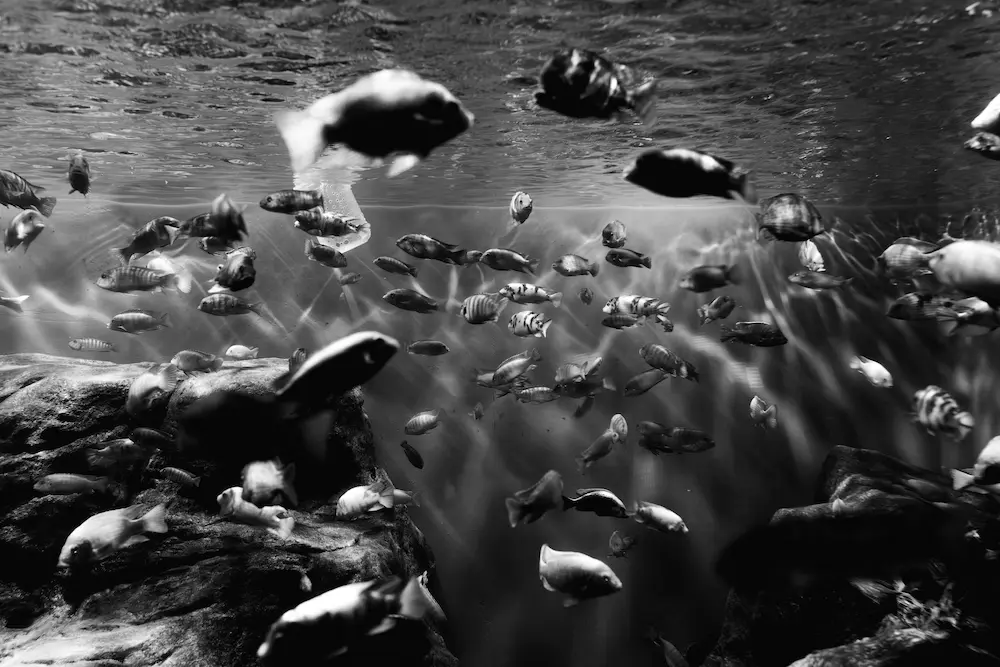
Black and White Photography Underwater: How to Create Images With Depth, Mood and Drama
When most people think about underwater photography, they imagine color first.
Turquoise water. Orange fish. Sunlit coral. Tropical blues everywhere.
So at first glance, black and white photography underwater sounds a little backwards — almost like you are removing the very thing that makes the ocean visually exciting.
But that is exactly why it works.
Once color disappears, the viewer starts paying attention to everything else: shape, contrast, texture, movement, light, shadow, negative space, and the emotional feeling of the image. Suddenly, an underwater photo is not just “pretty.” It becomes moody, cinematic, elegant, mysterious, or dramatic.
For photographers who want to create something more artistic than the standard colorful reef snapshot, black and white underwater images can open up a completely different creative world. They work especially well for marine life, freedivers, silhouettes, wrecks, cenotes, bubbles, and scenes where the play of light matters more than color.
This guide covers what photographers actually want to know about black and white photography underwater: why it works, what to shoot, where to shoot, what gear helps, how to compose stronger images, when conditions matter most, and how to edit images so they feel intentional rather than simply desaturated.
What Is Black and White Photography Underwater?
Black and white photography underwater is exactly what it sounds like: underwater images created or edited without color, using tones that range from deep black to bright white and everything in between.
The point is not simply to remove color because a photo looked dull in blue water.
The point is to create a photograph where contrast, light, shape, and storytelling become the main visual elements.
That distinction matters.
A weak color image does not automatically become a strong black and white image just because you remove the blues and greens. Good monochrome underwater photography works because the photographer sees in tonal relationships: bright against dark, subject against background, soft gradients against hard edges, and movement against stillness.
In other words, black and white underwater photography is less about what the water looks like and more about what the scene feels like.
Why Black and White Photography Underwater Works So Well
Underwater environments are naturally full of visual drama.
You have shafts of light, suspended particles, flowing fabric, bubbles, silhouettes, marine life, reflections, rock formations, and a sense of space that often feels dreamlike or mysterious. Color can be beautiful, but it can also compete for attention. Black and white simplifies the scene and directs the eye to what matters most.
That is why black and white photography underwater often feels more emotional than color photography. The image becomes less about documenting exactly what the scene looked like and more about interpreting it artistically.
It can also solve a common underwater photography problem: messy or weak color. Underwater light absorbs color quickly, especially reds and warm tones. Unless you are working with very clear water, artificial light, or close subjects, color can sometimes look flat or overly blue. Converting the image to black and white can turn those limitations into style.
Sometimes the ocean gives you a masterpiece.
Sometimes it gives you low contrast, drifting particles, and a blue soup.
A thoughtful black and white conversion can rescue the mood beautifully.
The Main Benefits of Black and White Photography Underwater
There are practical and artistic reasons photographers love this style.
It emphasizes shape and form
Without color, the eye notices outlines, fins, bodies, coral structures, rock formations, and the geometry of the scene much more clearly.
It creates a timeless look
Black and white photography often feels classic, editorial, and less trend-driven. Underwater images in monochrome can feel almost cinematic.
It helps simplify busy scenes
Reefs and underwater environments can get visually chaotic. Black and white removes one layer of complexity and helps you create a more focused image.
It can make imperfect color less distracting
Not every underwater session gives you vibrant tropical color. In some cases, monochrome gives the image more power than a half-hearted attempt at “fixing” bad color.
It adds mood
If you want your image to feel mysterious, elegant, dramatic, or contemplative, black and white photography underwater can do that beautifully.
Best Subjects for Black and White Photography Underwater
Not every underwater subject benefits equally from black and white. Some scenes rely heavily on color for impact. Others become stronger once color is removed.
Here are some of the best subjects for black and white photography underwater.
| Subject | Why It Works Well in Black and White |
|---|---|
| Freedivers | Strong silhouettes, body lines, elegance and motion |
| Scuba divers | Bubbles, gear shapes, scale and dramatic composition |
| Cenotes | Light beams, rock formations and contrast |
| Wrecks | Texture, mystery and structure |
| Silhouettes | Strong graphic impact |
| Marine mammals | Smooth shapes and emotional presence |
| Sharks and rays | Clean lines and dramatic movement |
| Underwater portraits | Artistic and fashion-like look |
| Bubbles | Beautiful highlights and texture |
| Caves and caverns | Depth, shadow and atmosphere |
Scenes with clear structure usually perform best.
If the image depends entirely on the bright colors of reef fish or coral, black and white may not be the most effective choice. But if your subject has shape, movement, texture, or strong lighting, monochrome can be stunning.
Black and White Photography Underwater and Marine Life
Marine life can look incredible in monochrome when the species has a strong visual form.
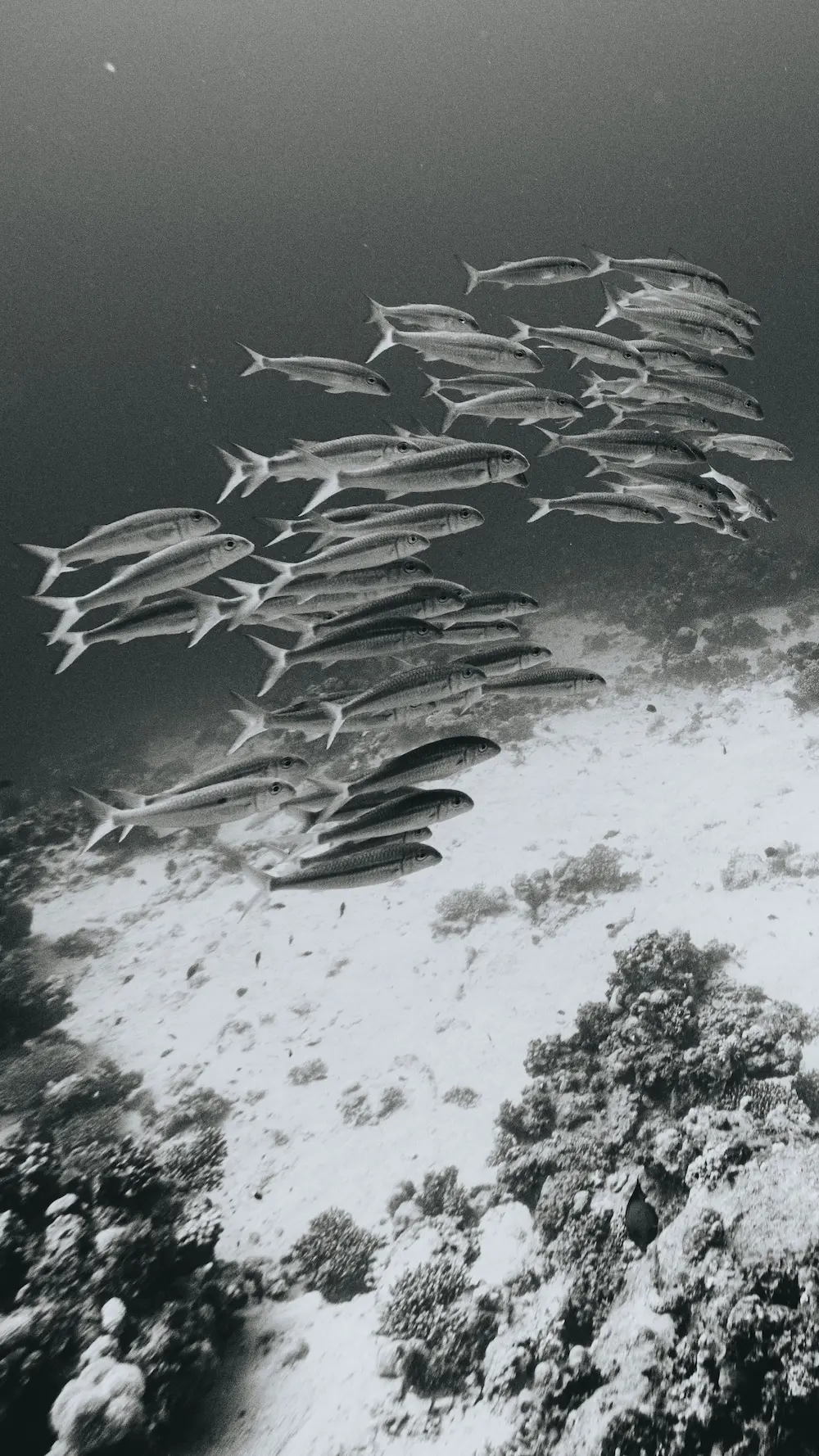
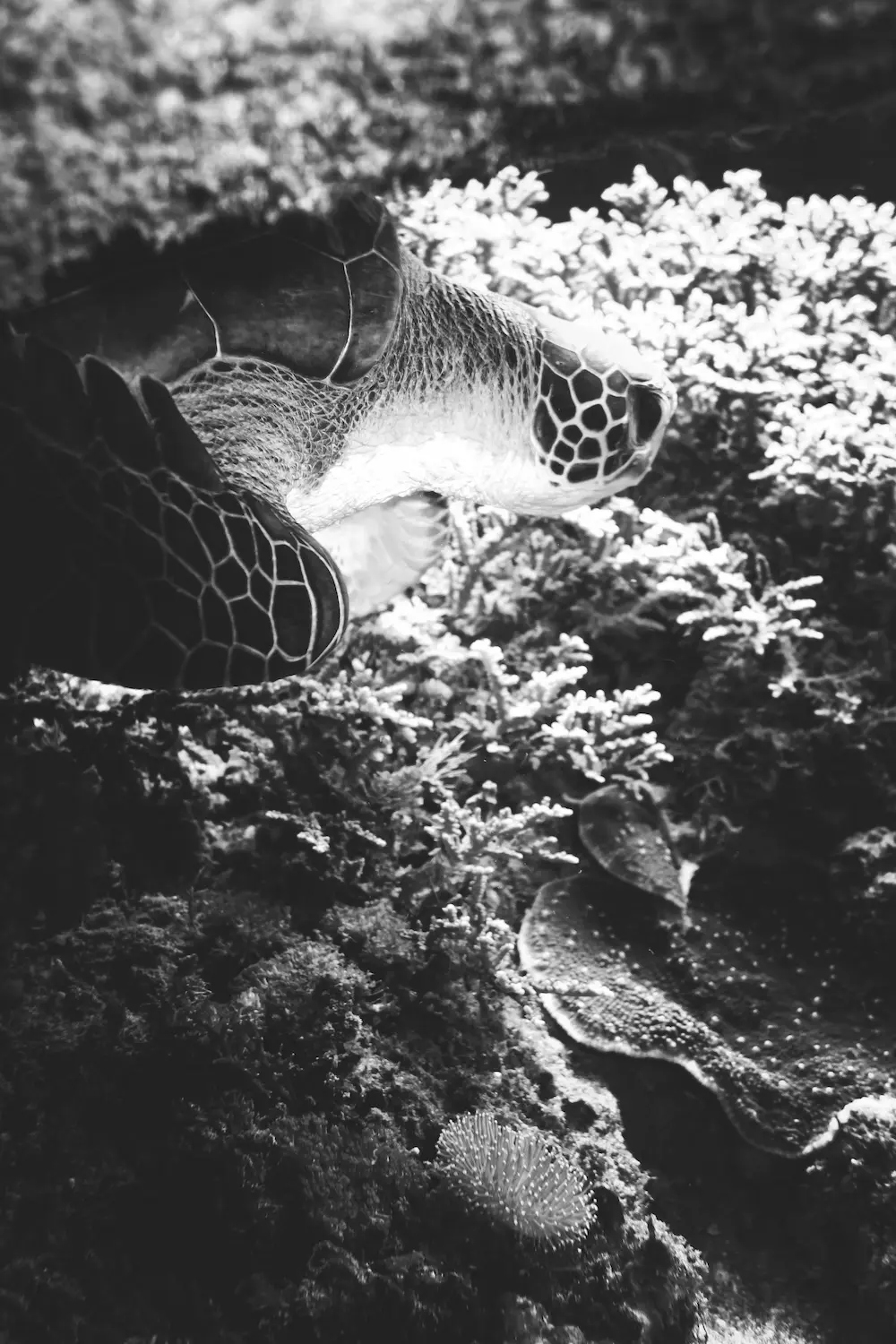
Sharks, rays, turtles, dolphins, large fish, schooling fish, and marine mammals often work especially well because their shapes remain recognizable and powerful without color. High-contrast scenes with open water backgrounds can look elegant and dramatic.
The trick is to think less about “how colorful is this animal?” and more about “does this animal have visual presence?”
A turtle gliding through a shaft of light can look beautiful in black and white.
A school of fish creating patterns in open water can look almost abstract.
A shark entering the frame from darkness can look cinematic.
Meanwhile, a tiny brightly colored reef fish that depends on its vivid color palette may lose some of its charm in monochrome.
This is why black and white photography underwater asks you to think like an artist, not just a recorder of marine life.
Why Cenotes Are Perfect for Black and White Photography Underwater
If there is one environment where black and white photography underwater really shines, it is the cenote.
Cenotes already have a naturally dramatic look. They offer clear freshwater, rock formations, partial darkness, dramatic openings, textured cave walls, and those famous shafts of light that seem almost designed for monochrome photography.
In black and white, all of that becomes even more graphic.
The light beams become brighter.
The rock textures become stronger.
The contrast between open space and darkness becomes more powerful.
Freedivers and swimmers in cenotes also create beautiful compositions because the human body adds scale and movement to an otherwise silent, still environment.
A cenote image in black and white often feels less like a travel photo and more like fine art.
Ocean vs. Cenote: Which Is Better for Black and White Photography Underwater?
Both environments can work, but they produce different moods.
| Environment | Best For | Visual Character |
|---|---|---|
| Ocean | Marine life, divers, open water scenes | Clean, spacious, fluid |
| Cenote | Light beams, portraits, freedivers, dramatic composition | Moody, textured, cinematic |
| Pool | Controlled portrait shoots, fabric movement | Clean and stylized |
| Wreck or cave | Texture, history, silhouettes | Dark, dramatic, atmospheric |
Ocean photography
The ocean is great when you want marine life, divers, bubbles, large scenes, or a feeling of open space. Strong natural light and negative space can work beautifully in monochrome.
Cenote photography
Cenotes are ideal for contrast, mood, texture, and artistic compositions. If your style leans dramatic or editorial, cenotes are hard to beat.
Pool photography
Pools are useful for artistic underwater portraits, bridal photography, fashion-style shoots, and controlled experiments with movement or fabric.
Best Conditions for Black and White Photography Underwater
Because black and white emphasizes contrast, conditions matter.
You do not necessarily need the brightest, clearest tropical day imaginable, but you do need scenes where light and subject separation help the composition.
What to look for
- Clear enough water for shape definition
- Light beams or directional light
- Strong separation between subject and background
- Silhouettes
- Clean negative space
- Textures such as rock, bubbles, wrecks, or ripples
- Subjects with recognizable form
Conditions that help
- Morning light for softer beams and cleaner conditions
- Midday light in cenotes when sunbeams are strongest
- Calm water for clearer compositions
- Lower sediment when shooting in freshwater environments
- Controlled positioning of the subject
Ironically, not every underwater image needs bright tropical color to work. Some of the strongest black and white photography underwater comes from scenes with a slightly darker, moodier atmosphere.
Gear for Black and White Photography Underwater
You do not necessarily need a wildly specialized setup just because you plan to shoot in monochrome. The fundamentals of underwater photography still apply.
Useful gear may include:
- Mirrorless or DSLR camera in an underwater housing
- Action camera for simpler underwater travel content
- Wide-angle lens for divers, cenotes, or larger scenes
- Standard lens for portraits or tighter subjects
- Dome port for wide scenes
- Strobes or video lights when appropriate
- Freediving or scuba support depending on the environment
- Redundant safety systems and proper underwater handling
That said, black and white underwater photography often works especially well with wide compositions. Wide-angle scenes let you capture the environment, the subject, and the light all at once.
This is why freedivers, cenotes, reef scenes, and wrecks are such good subjects.
They give the image room to breathe.
Do You Need Artificial Light?
Sometimes yes, sometimes no.
Artificial light can be useful when you want to reveal details, texture, or subject shape more clearly. It can also help create tonal separation and cleaner highlights.
But one of the beautiful things about black and white photography underwater is that it often works very well with natural light alone, especially in cenotes, open water, or high-contrast situations.
Natural light is often enough for:
- Silhouettes
- Light beams
- Wide scenes
- Freedivers
- Minimalist compositions
- Open water subjects
Artificial light becomes more useful for:
- Close marine life
- Underwater portraits
- Wreck detail
- Low-light scenes
- Texture-heavy compositions
The key is not to assume that monochrome requires dramatic studio lighting. Sometimes a simple natural-light silhouette is the strongest image of the day.
Composition Tips for Black and White Photography Underwater
This is where the real magic happens.
When color is removed, composition becomes even more important. A strong black and white underwater photo usually depends on visual structure.
Look for contrast
Dark subject against bright water. Bright bubbles against dark rock. Light beam cutting through shadow. Contrast is your friend.
Use negative space
Open water can be incredibly powerful in monochrome. It gives the subject space and creates elegance.
Focus on shape
Divers, rays, turtles, fins, hands, and coral forms all become more noticeable in black and white. Look for recognizable silhouettes.
Pay attention to direction of light
Light defines the scene. Watch where it enters, what it illuminates, and what it leaves in shadow.
Simplify the frame
Busy compositions often weaken monochrome photography. Remove distractions. Move closer or change your angle if necessary.
Use scale
A single diver in a vast cenote or next to a large rock formation instantly creates drama and human connection.
Capture movement
Flowing hair, bubbles, fabric, swimming motion, and suspended particles can all create beautiful visual texture when handled carefully.
Good black and white photography underwater is rarely accidental. It works because the image has a clear structure.
Camera Settings for Black and White Photography Underwater
The best settings depend on your subject, but the general approach is familiar: protect highlights, maintain sharpness, and expose with post-processing in mind.
A few practical guidelines:
- Use a shutter speed fast enough to freeze motion when photographing divers or marine life
- Use a wider aperture when you want to isolate a subject
- Use a narrower aperture for environmental scenes with more depth
- Keep ISO as low as conditions allow, especially if you want cleaner tonal transitions
- Expose carefully to preserve bright areas like sunbeams or reflective surfaces
If your camera allows monochrome preview while still recording RAW color files, that can be incredibly helpful. You get the benefit of “seeing” the composition in black and white while retaining all the editing flexibility later.
That is one of the smartest tricks for black and white photography underwater because it trains your eye without limiting your files.
Should You Shoot in RAW?
Yes.
If you are serious about underwater photography, RAW is your friend.
RAW files preserve much more tonal information, which is especially important when converting to black and white. You will have more flexibility for:
- Adjusting contrast
- Recovering highlights
- Opening shadows
- Refining local tones
- Controlling the mood of the final image
Black and white images often succeed because of subtle tonal control. RAW gives you more room to shape that result carefully.
How to Edit Black and White Photography Underwater
Editing is where your monochrome image becomes intentional.
A strong black and white conversion is not simply “remove saturation and hope for the best.” You want to shape the tonal relationships so the image has clarity, depth, and emotional impact.
Key editing priorities
- Adjust exposure first
- Build contrast carefully
- Control highlights so bright water or beams do not become harsh
- Open shadows where needed, but not so much that the scene loses mood
- Refine blacks for richness
- Use clarity or texture carefully for rock, bubbles, and wrecks
- Watch the background so the subject still separates well
Think in tones, not colors
Even though the final image is monochrome, the original colors still affect the black and white conversion. Blues, greens, and warm tones may translate differently depending on your editing software.
This means two monochrome conversions from the same file can feel completely different.
One may look soft and dreamy.
Another may look graphic and high-contrast.
That creative control is part of what makes black and white photography underwater so interesting.
High Contrast vs. Soft Black and White
There is not just one monochrome style.
High-contrast style
This works well for dramatic scenes, wrecks, silhouettes, strong rays of light, sharks, or graphic compositions. It feels bold and cinematic.
Soft tonal style
This works beautifully for portraits, romantic underwater sessions, flowing fabric, or dreamier freediver imagery. It feels more delicate and atmospheric.
The best choice depends on the subject and mood.
Do not turn every underwater image into a hard, crunchy monochrome just because black and white sounds dramatic. Some scenes need softness.
Common Mistakes in Black and White Photography Underwater
Like every style, monochrome has a few traps.
Converting weak images without a reason
If the composition is messy and the subject unclear, black and white will not magically fix it.
Over-editing contrast
Too much contrast can destroy detail and make underwater scenes feel harsh or unnatural.
Ignoring subject separation
If the subject blends into the background tonally, the image can become muddy.
Choosing the wrong subjects
Not every fish or reef scene needs black and white. Use it where it actually strengthens the image.
Forgetting storytelling
A technically nice monochrome underwater image still needs emotional or visual interest.
Letting particles take over
Suspended particles can add atmosphere, but too much backscatter can become distracting.
The best black and white photography underwater feels intentional, not like Plan B.
Black and White Underwater Portraits
Underwater portraits are one of the most elegant uses of this style.
Black and white can make underwater portraits feel artistic, editorial, and timeless. It works especially well for:
- Couples
- Engagement sessions
- Underwater bridal photography
- Fine-art portraits
- Fashion-inspired sessions
- Freediver portraits
Without color competing for attention, the viewer focuses on expression, pose, movement, and connection.
That is why black and white photography underwater can be so strong for romantic or human-centered images. It turns the subject into the emotional center of the frame.
Travel, Adventure and the Experience of Shooting Underwater
For adventurous travelers, underwater black and white photography is not just a photographic technique. It is an experience.
You are in the water. You are moving differently. You are reacting to light, environment, and subject in a way that feels immersive and unpredictable. Whether you are photographing a cenote, a reef, a freediver, or a couple session, the process itself becomes part of the story.
That is especially true in destinations like the Mexican Caribbean, where photographers can combine different environments in one trip: cenotes, ocean scenes, reef life, underwater portraits, and adventure photography.
This is one reason black and white photography underwater has so much creative potential. It is not just a style. It is a different way of seeing the underwater world.
Best Ideas for Black and White Underwater Photo Shoots
If you want inspiration, here are some concepts that work especially well:
- Freediver silhouette in a cenote
- Couple underwater portrait
- Diver with bubbles rising overhead
- Shark or ray in open water
- Underwater wedding or engagement portraits
- Cenote light-beam portrait
- Wreck scene with diver for scale
- Minimalist swimmer in open water
- Close portrait with flowing hair
- Schooling fish forming patterns
These ideas work because they are built around shape, light, or mood rather than bright color.
Who Should Try Black and White Photography Underwater?
This style is especially good for:
- Underwater photographers wanting a more artistic portfolio
- Travel photographers looking for a more editorial feel
- Freedivers and scuba photographers
- Portrait photographers experimenting underwater
- Couples or brands wanting artistic underwater imagery
- Photographers shooting in cenotes
- Creatives who love mood and storytelling
You do not need to become a full-time monochrome purist.
You just need to recognize when a scene is asking for it.
Sometimes the underwater world is about color.
Sometimes it is about silence, contrast, and mystery.
Practical Tips Before Your Shoot
A few practical reminders make a big difference.
- Plan around light, especially in cenotes
- Keep your subject briefed and comfortable
- Simplify the frame
- Shoot more negative space than you think you need
- Review backgrounds carefully
- Protect highlights
- Try both wide scenes and tighter details
- Think about how the image will feel in monochrome before pressing the shutter
- If possible, preview in monochrome while recording RAW
- Be patient — underwater photography usually takes longer than expected
And yes, you will probably come back with a few frames where everything looked perfect except one rogue fin, one cloud of bubbles, or one extremely committed floating hair strand.
That is normal.
Underwater photography enjoys a little chaos.
Frequently Asked Questions About Black and White Photography Underwater
Is black and white photography underwater a good idea?
Yes, absolutely. It can create dramatic, elegant, and artistic images, especially when the subject has strong shape, texture, or lighting.
What subjects work best for black and white photography underwater?
Freedivers, scuba divers, sharks, rays, turtles, cenote scenes, wrecks, underwater portraits, and silhouettes often work especially well.
Is black and white better than color underwater?
Not better — just different. Color is ideal for many reef and marine-life scenes, while black and white is excellent for mood, contrast, texture, and storytelling.
Are cenotes good for black and white underwater photography?
Yes. Cenotes are one of the best environments for this style because of their light beams, rock textures, darkness, and dramatic natural contrast.
Do I need special camera settings for black and white underwater photography?
Not necessarily special settings, but you should expose carefully, protect highlights, and ideally shoot RAW for flexibility in editing.
Should I shoot black and white in-camera?
It can be helpful to preview the scene that way, but it is usually best to record RAW files so you keep full editing flexibility later.
Can I do black and white photography underwater with a phone or action camera?
Yes, especially for simple scenes, silhouettes, and creative travel content. More advanced camera systems simply give you more control.
Does black and white work for underwater portraits?
Very well. It often makes portraits feel more timeless, artistic, and emotionally focused.
Final Thoughts on Black and White Photography Underwater
Color may be the first thing people expect from underwater photography, but expectation is not the same as artistry.
Black and white photography underwater works because it strips the scene back to what really matters: form, light, contrast, texture, movement, and emotion. It invites the viewer to look more carefully and feel more deeply. It can turn a freediver into a silhouette, a cenote into a cathedral of light, and an ordinary underwater moment into something much more cinematic.
For photographers who want to create work that feels artistic rather than purely documentary, it is one of the most rewarding styles to explore.
You do not need to shoot every underwater image in black and white.
You just need to know when the scene is asking for it.
Ready to Create Underwater Images With More Art and Atmosphere?
If you want to explore cenotes, marine environments, and creative underwater photography in Mexico, MExplor can help you build a photography experience around the images you actually want to create. Whether you are interested in a Photography Camp, an underwater-focused adventure, or a Custom Camp that combines photography with snorkeling, freediving, or travel experiences in the Mexican Caribbean, the trip can be tailored to your style and skill level.
Contact MExplor to start planning a photography experience that turns underwater scenes into something far more memorable than just another blue-water snapshot.