

Freediving Photography: How to Capture the Underwater World on One Breath
There is something different about photographing underwater without a scuba tank.
No bubbles. No bulky life-support system. Less equipment between you and the subject. You descend, frame the photograph, capture a few moments and return to the surface.
That simplicity is what makes freediving photography so appealing.
It can also make it challenging.
You have limited time underwater. Your camera creates additional drag. Light disappears and changes color as you descend. Marine life rarely waits while you reconsider your settings. And the moment you become obsessed with getting the photograph is exactly when you still need to remember that you are a freediver first and a photographer second.
Divers Alert Network describes freedive photography as particularly useful for fast-moving marine life, shallow reefs and situations where scuba equipment would be cumbersome, while emphasizing the importance of remaining well within personal limits and working with a buddy because hypoxia and blackout remain real risks. Divers Alert Network
Done responsibly, however, freediving photography can produce some of the most natural underwater images imaginable.
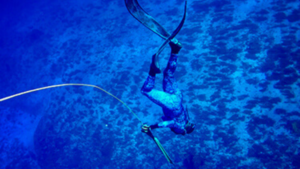
A freediver moving through a shaft of light.
A turtle passing quietly over the reef.
A silhouette disappearing into blue water.
A model suspended inside a Mexican cenote.
Sometimes the best underwater photograph happens because you left most of the equipment behind.
What Is Freediving Photography?
Freediving photography is underwater photography performed while breath-hold diving rather than using scuba equipment.
The photographer typically wears basic freediving equipment such as:
- Mask
- Snorkel
- Freediving fins
- Exposure protection when necessary
- Appropriate weighting
- Underwater camera system
Then the photographer descends on a breath hold, captures images and returns to the surface.
That sounds simple.
Until you add a camera.
Photography creates another task underwater. You now have to think about exposure, focus, composition, subject movement and camera position while still monitoring your own dive, depth, comfort and surroundings.
DAN has repeatedly highlighted how distracting underwater cameras can be, noting that photographers can become so focused on an image that they lose awareness of depth, surroundings or other safety considerations. Divers Alert Network
The first rule of freediving photography is therefore not photographic at all:
The image is never more important than the dive.
Why Freedive Instead of Scuba for Underwater Photography?
Scuba gives underwater photographers something extremely valuable:
Time.
You can adjust settings, reposition strobes, wait for a subject and examine the back of the camera without needing to return to the surface every few moments.
So why freedive?
Because freediving offers different advantages.
Less Equipment and Less Drag
A streamlined freediver can move through the water much more easily than a photographer carrying a full scuba system.
This becomes particularly useful when photographing:
- Dolphins
- Whales where local regulations permit encounters
- Fast-moving pelagic animals
- Freedivers
- Snorkelers
- Shallow reefs
- Underwater models
DAN’s discussion of breath-hold photography specifically notes situations involving fast-moving megafauna and shallow environments where scuba equipment can be cumbersome. Divers Alert Network
No Bubbles
This matters for both wildlife and aesthetics.
Scuba bubbles can enter the frame and create noise around marine animals.
Freediving lets photographers move more quietly through the environment.
That does not mean animals will suddenly pose.
They have still declined to join your production schedule.
But you may be able to approach some situations more naturally.
Greater Freedom of Movement
Freedivers can change direction quickly, descend for a photograph and return to the surface without managing a large scuba configuration.
For creative photography involving another freediver, that movement can be especially useful because photographer and model can work in a similar way underwater.
Freediving Photography vs. Scuba Photography
Neither method is universally better.
They solve different problems.
| Freediving Photography | Scuba Photography |
|---|---|
| Minimal life-support equipment | Full scuba system |
| Short working periods underwater | Long continuous bottom time |
| Very mobile | More equipment and drag |
| No exhaust bubbles | Regular bubbles |
| Excellent for freedivers and fast marine life | Excellent for patient reef and macro work |
| Requires repeated surface recovery | Allows long periods composing underwater |
| Photographer must carefully manage apnea | Photographer manages gas and dive profile |
A travel photographer who loves marine life may eventually use both.
The question is not which one is superior.
It is which approach fits the subject.
You Need Freediving Skills Before Photography Skills
This is probably the most important practical lesson in the entire guide.
Become comfortable freediving before adding a camera.
A camera introduces distraction, drag and another object to manage. Underwater photography requires enough water control that basic movement does not consume all your attention.
You should already be comfortable with:
- Equalization
- Duck diving
- Finning
- Surface recovery
- Buddy procedures
- Basic buoyancy control
- Body positioning
- Conservative breath-hold diving
DAN makes a similar point for underwater photographers generally: once fundamental diving skills become automatic, adding photography becomes significantly more manageable. Divers Alert Network
If you are still thinking intensely about every fin kick, equalization and body position, add those skills first.
The camera can wait.
The turtle will probably still refuse to cooperate later anyway.
Never Freedive for Photos Alone
A photographer is especially vulnerable to tunnel vision.
You see the shot.
You descend.
The animal turns.
You follow it.
You want one more frame.
That is exactly why freediving photography must still follow freediving buddy procedures.
DAN specifically states that freedivers should work in buddy teams because breath-hold diving carries the risk of hypoxia and blackout. Divers Alert Network
Your buddy’s job should be safety.
Not filming behind-the-scenes content.
Not checking their own photographs.
Not floating 40 meters away.
A camera does not make blackout less likely.
It simply gives you something else to think about while it happens.
What Camera Is Best for Freediving Photography?
There is no universal best camera.
The right setup depends on:
- Your experience
- What you photograph
- How deep you work
- Whether you travel frequently
- How much equipment you are comfortable swimming with
- Your budget
The main options range from action cameras to professional mirrorless systems.
Action Cameras
Action cameras are the easiest entry point.
They are:
- Small
- Lightweight
- Easy to travel with
- Low-drag
- Good for wide-angle scenes
- Useful for both photos and video
They work especially well for:
- Recreational freediving
- Travel content
- Snorkeling
- Behind-the-scenes footage
- Wide underwater landscapes
- Social media
The downside is less control over lenses, lighting and image quality compared with larger systems.
For many travelers, though, simplicity wins.
A technically superior camera sitting on the boat because it is annoying to swim with produces remarkably few photographs.
Compact Underwater Cameras
Compact systems can provide more photographic control without the bulk of a professional housing.
They may offer:
- RAW capture
- Manual exposure
- Better autofocus
- Improved image quality
- Accessory lighting options
This can be an excellent middle ground for serious travelers who do not need a large interchangeable-lens system.
Mirrorless Cameras in Underwater Housings
For photographers who want the most control, a mirrorless camera inside a dedicated underwater housing offers:
- Interchangeable lenses
- High image quality
- RAW files
- Strong autofocus
- Better low-light capability
- Professional video options
The disadvantage is obvious the moment you pick it up.
It is bigger.
And more complicated.
And more expensive.
Then you add ports, handles, lights and strobes and suddenly your minimalist freediving setup has developed a small infrastructure department.
Professional systems can create extraordinary images.
Just keep the rig streamlined enough that you can safely manage it while freediving.
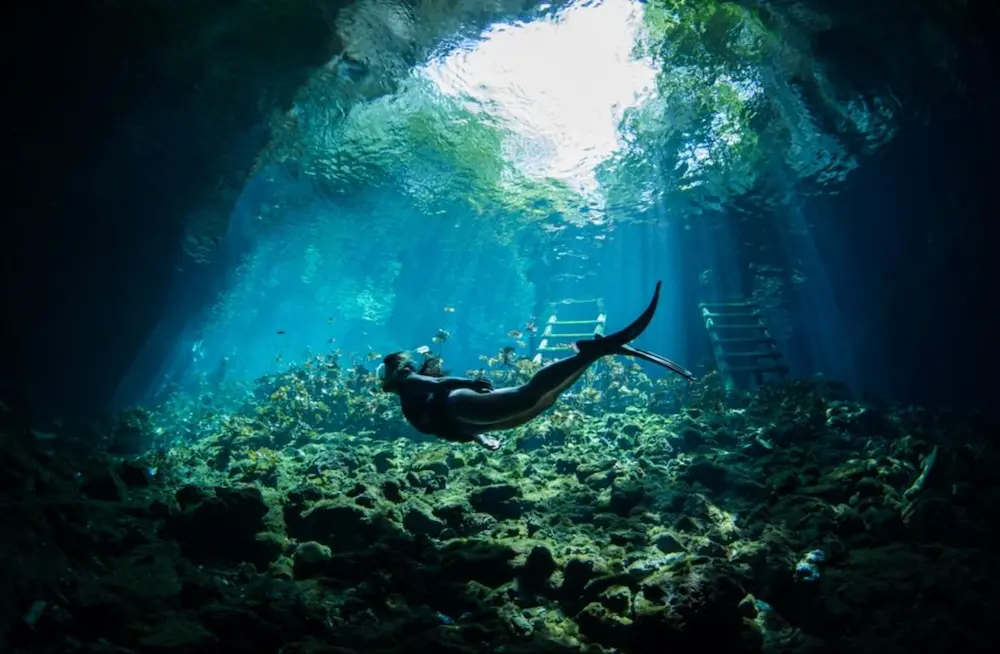
Why Streamlining Matters in Freediving Photography
Every piece of equipment creates resistance in water.
DAN’s freediving-photography guidance specifically discusses the tradeoff between useful lighting equipment and the extra drag created by bulky strobes and arms. Divers Alert Network
This matters because drag requires effort.
Effort uses energy.
Energy consumption matters when you are holding your breath.
A freediving camera setup should therefore be as efficient as the photography requires.
Useful questions include:
Do I really need two strobes?
Can I photograph this with available light?
Can I shorten these arms?
Can I remove equipment I am not using?
Freediving encourages photographers to become ruthless minimalists.
At least until they get back on land and begin buying camera accessories again.
What Lens Is Best for Freediving Photography?
Wide-angle lenses dominate many forms of underwater photography.
There is a practical reason.
Water reduces clarity and contrast over distance.
Getting physically closer to the subject generally improves underwater images.
A wide lens lets you work close while still showing the environment.
Wide-angle lenses are excellent for:
- Freedivers
- Cenotes
- Large marine life
- Reefs
- Underwater portraits
- Wrecks
- Sunbeams
- Split-level images
Fisheye lenses can also produce impressive underwater results because they allow very wide compositions at close distances.
Why Getting Close Matters Underwater
Water changes photography.
It absorbs light.
It reduces contrast.
It removes color.
It puts particles between your lens and your subject.
That means the more water you photograph through, the more image quality suffers.
Underwater photographers therefore often follow a simple principle:
Get close. Then get closer.
DAN notes that water rapidly absorbs colors and emphasizes proximity as an important component of underwater photography. Divers Alert Network
Obviously, this does not mean chasing wildlife or pushing into coral.
The subject and environment still decide how close is appropriate.
Natural Light in Freediving Photography
Available light is one of freediving photography’s biggest advantages.
Removing strobes makes your camera smaller and easier to swim with.
It also creates a very natural aesthetic.
Natural light works especially well for:
- Shallow reefs
- Large animals
- Freedivers
- Silhouettes
- Cenotes
- Surface light
- Wide-angle compositions
DAN photographer Stephen Frink describes choosing available light for some freediving encounters specifically because strobes would create unnecessary drag while subjects were moving quickly near the surface.
Natural light does require planning.
You need to understand where the sun is.
You need to know what happens when your subject becomes backlit.
And you need to accept that deeper water will lose warm color.
Sometimes that loss of color creates the mood you want.
When Should You Use a Strobe?
Artificial light can restore contrast and color, particularly when:
- The subject is relatively close
- You are working deeper
- The subject is backlit
- You want detail in a diver’s face
- You are creating portraits
- Ambient light is weak
But strobes add size and drag.
That tradeoff matters much more to a freediver than to a photographer comfortably hovering on scuba.
DAN’s freedive-photography example describes using smaller strobes at reduced power where they added useful contrast while avoiding excessively bulky gear. Divers Alert Network
The simplest rule is:
Use the light when it improves the photograph enough to justify carrying it.
Best Time of Day for Freediving Photography
Light changes dramatically throughout the day.
Morning
Morning can provide:
- Calm conditions
- Softer sunlight
- Fewer boats
- Beautiful directional light
- Cleaner water before busy activity begins
Midday
Photographers normally complain about midday light on land.
Underwater, midday can be excellent.
When the sun sits higher, more light penetrates vertically into the water.
That can produce:
- Stronger underwater illumination
- Sunbeams
- Better reef color
- Dramatic cenote light
- Easier available-light photography
Late Afternoon
Lower sunlight can become more directional and atmospheric.
You may get:
- Softer backgrounds
- Dramatic rays
- Warmer surface light
- Silhouettes
But available underwater light begins disappearing rapidly as sunset approaches.
There is no universal best hour.
Choose according to the photograph.
How to Photograph Another Freediver
A freediver is one of the best subjects you can have underwater.
The human body immediately provides:
- Scale
- Movement
- Story
- Shape
- Direction
Instead of photographing an empty blue environment, you now have something that shows the viewer how large or deep the scene feels.
The most effective images often keep the pose simple.
Ask the model to focus on:
- Long body lines
- Calm movement
- Clean fin position
- Slow turns
- Looking toward or away from light
- Leaving space between limbs
- Relaxed hands
Avoid trying to choreograph twelve movements underwater.
You do not have twelve minutes.
Communication Before a Freediving Photo Shoot
Do most of the directing before going underwater.
This saves huge amounts of time.
Discuss:
- Where the photographer will position
- Where the model will descend
- Which direction to swim
- Approximate depth
- Hand signals
- When the attempt ends
- Safety procedures
- What the pose should look like
Experienced underwater photographers emphasize pre-shoot orientation and communication even when working with experienced freediving models. Divers Alert Network
One clear plan is better than repeatedly surfacing to explain:
“No, I meant turn the OTHER direction while pointing your toes and somehow also look relaxed.”
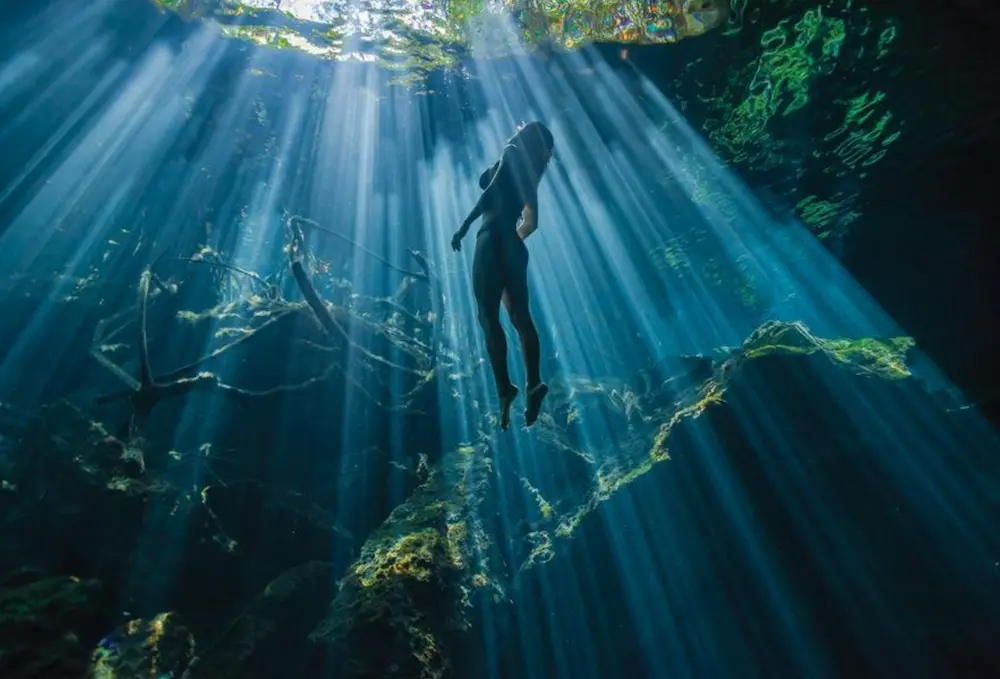
Photographing Freedivers in Cenotes
Cenotes are almost absurdly photogenic.
Clear freshwater.
Dark limestone.
Tree roots.
Openings in the ceiling.
Long shafts of sunlight.
A single freediver inside that environment creates an immediate sense of scale.
Cenotes work particularly well for:
- Silhouettes
- Environmental portraits
- Sunbeams
- Wide compositions
- Black-and-white photography
- Freediver portraits
- Underwater couple photography
The challenge is contrast.
A cenote can contain very bright surface openings and very dark underwater areas in the same frame.
That means careful exposure becomes important.
How to Photograph Cenote Light Beams
Light beams appear when sunlight enters darker water and particles make the path of the light visible.
For a stronger photograph:
Position the diver where the light intersects the scene.
Expose carefully for the highlights.
Use the darker surroundings as natural framing.
Give the diver enough separation from the background.
Keep the pose simple.
And most importantly, understand that the position of the sun changes.
The spectacular beam you saw online may only appear during a specific part of the day or season.
This is where local knowledge becomes extremely valuable.
The cenote is not malfunctioning simply because you arrived at 4:30 p.m. and the famous light ray is gone.
Ocean Freediving Photography
The ocean produces a very different visual style.
Instead of rock and darkness, you can work with:
- Huge blue backgrounds
- Surface reflections
- Reef structure
- Marine life
- Schools of fish
- Sunbursts
- Negative space
Ocean photography can feel much more open.
A single diver suspended in blue water can create an extremely clean composition.
The challenge is that you now have:
- Current
- Waves
- Boats
- Greater movement
- Less predictable subjects
Conditions matter much more.
Blue-Water Freediving Photography
Blue-water photography means working offshore without obvious bottom or reef reference.
This can create incredible images of pelagic marine life.
It is also an environment for experienced photographers.
DAN describes blue-water photography as an advanced undertaking because photographers need constant awareness of their location in the water column, depth, boat position and surface conditions. Divers Alert Network
The visual simplicity is beautiful.
Blue everywhere.
The navigational simplicity is less beautiful.
Blue everywhere.
This is not where beginners should learn freediving while simultaneously learning underwater photography.
Marine Life for Freediving Photography
One of freediving’s biggest attractions is wildlife.
Depending on destination and season, photographers may encounter:
- Sea turtles
- Rays
- Reef fish
- Schooling fish
- Sharks
- Dolphins
- Large pelagic fish
- Marine mammals where regulated encounters are permitted
The challenge is letting the animal determine the encounter.
Do not chase.
Do not corner.
Do not touch.
Do not block its movement.
The best marine-life images often happen when the photographer positions themselves well and lets the animal decide whether to approach.
Wildlife is much better at swimming.
You are unlikely to win the chase anyway.
Freediving Photography and Sea Turtles
Turtles are excellent photographic subjects because their movement can be graceful and predictable enough to compose around.
Useful approaches include:
- Stay slightly below or level with the turtle where appropriate
- Avoid descending directly on top of it
- Give the animal space
- Use blue water as negative space
- Photograph the environment as well as the animal
- Watch for surface breaths
Do not interrupt feeding or resting behavior simply for the photograph.
The animal does not need another person hovering directly in its face.
Photographing Schools of Fish
Schools create natural patterns.
Look for:
- Repetition
- Shape
- Contrast
- Direction
- A single freediver for scale
- Light passing through the school
Wide lenses are particularly useful.
Instead of trying to photograph one fish perfectly, think about the shape created by hundreds of them.
Sometimes underwater photography becomes less about animals and more about geometry.
Freediving Photography With Sharks and Large Animals
Large marine life creates dramatic photographs because scale becomes part of the image.
Wide-angle photography works well here.
But wildlife photography should always follow local regulations and professional guidance.
Do not change your dive behavior simply because the animal is exciting.
The classic photographer thought—
one more shot
—is not a safety strategy.
If the dive should end, the dive ends.
Black and White Freediving Photography
Not every underwater image needs tropical color.
Freedivers make excellent subjects for monochrome photography because their bodies create clear shapes and silhouettes.
Black and white works especially well with:
- Cenotes
- Strong light beams
- Silhouettes
- Open blue-water scenes
- Bubbles
- Rock formations
- Underwater portraits
Once color disappears, attention moves toward:
- Shape
- Contrast
- Texture
- Light
- Movement
That can turn a travel photograph into something much more artistic.
Freediving Portrait Photography
Underwater portraits can range from athletic to almost surreal.
You can photograph:
- Freedivers in fins
- Models without masks
- Couples
- Bridal portraits
- Flowing fabric
- Silhouettes
- Fine-art concepts
The photographer needs to understand the model’s water ability before designing the session.
DAN’s profile of professional underwater portrait work stresses assessing a model’s comfort in water, conducting orientation and using additional safety support when working in deeper water. Divers Alert Network
Start simply.
Shallow water can produce exceptional images.
Depth is not a requirement for good photography.
Freediving Photography With Models
A model who looks relaxed underwater is often doing considerably more work than the final image suggests.
They may be thinking about:
- Breath
- Buoyancy
- Hair
- Hands
- Facial expression
- Body position
- Clothing
- Direction
- Camera position
Give them one or two instructions per attempt.
Do not expect a complicated choreography.
If the model needs to perform a movement, rehearse it above water first.
That makes the underwater portion much easier.
Underwater Wedding and Couple Photography
Freediving skills can also support underwater couple sessions.
The photographs may involve:
- Holding hands
- Floating
- Swimming toward each other
- Silhouettes
- Flowing clothing
- Short controlled descents
For couples without freediving experience, shallow environments are generally much easier and safer to manage.
The goal is the image.
Nobody needs a wedding portrait at 20 meters just because the photographer owns a depth gauge.
Freediving Photography Camera Settings
There is no single setting that works everywhere.
But some principles remain useful.
Shutter Speed
You usually need enough shutter speed to freeze:
- Fins
- Hair
- Marine animals
- Camera movement
Slow shutter speeds can create intentional motion effects, but beginners will generally find a faster shutter easier.
Aperture
A moderate aperture can help maintain enough depth of field when both diver and environment matter.
Wider apertures may work for portraits or low-light situations.
ISO
Use the ISO necessary to maintain the shutter speed and aperture you need.
Modern cameras handle higher ISO surprisingly well.
A sharp photograph with some noise is generally more useful than a beautifully clean photograph where the turtle has become a blur.
Continuous Shooting
Burst shooting can be extremely useful.
Freediving movement happens quickly.
The perfect body position might exist for half a second.
DAN also recommends fast memory cards because a full buffer while breath-holding can leave photographers waiting instead of shooting during a short encounter. Divers Alert Network
Autofocus
Continuous autofocus can help when subjects move toward or away from the camera.
Animal-eye detection and modern tracking systems can also be useful where the camera supports them.
But do not spend your entire breath hold staring at autofocus indicators.
Composition still matters.
Shoot RAW When Possible
RAW files give you more flexibility to correct:
- White balance
- Exposure
- Highlights
- Shadows
- Underwater color
- Contrast
This is particularly useful underwater because color and contrast shift quickly with depth.
RAW does not fix everything.
A photograph taken through 20 meters of murky water remains a photograph taken through 20 meters of murky water.
But it gives you much more room to work.
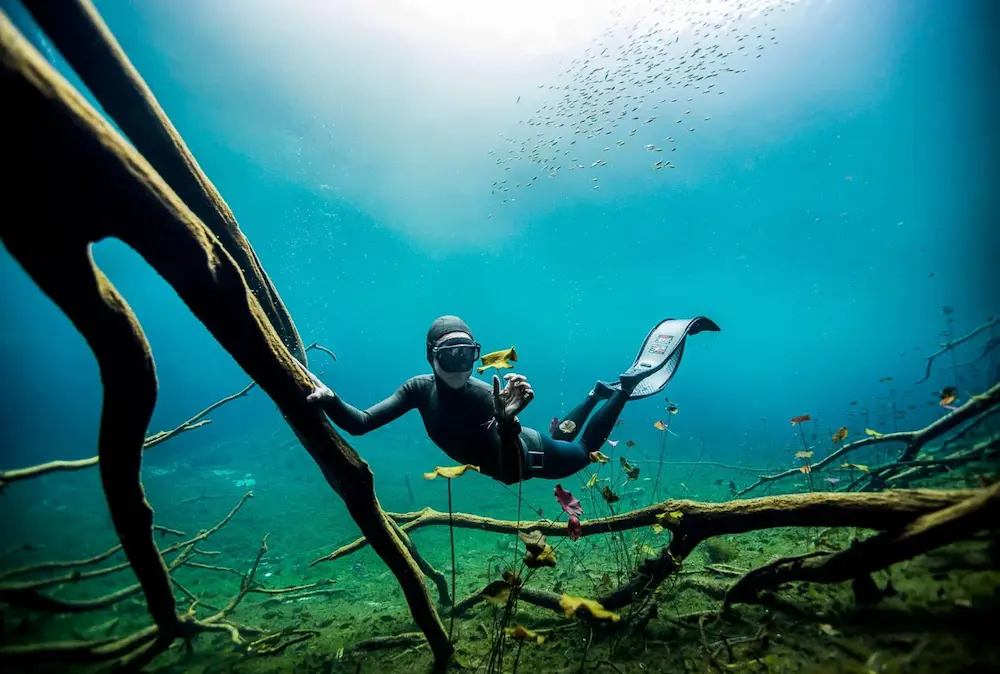
Why Underwater Color Changes With Depth
Water filters light.
Warm colors disappear quickly, while blue and green wavelengths penetrate farther.
The deeper you descend, the more your photograph naturally shifts toward blue or green.
This is why:
- Close distance helps
- Artificial light can restore color
- RAW files are useful
- White balance matters
- Shallow water is easier
Sometimes you should restore the color.
Sometimes the blue is the photograph.
Do not assume every underwater image needs to look like it was photographed in a brightly lit aquarium.
Composition Tips for Freediving Photography
Good underwater photographs still follow many of the same principles as photography on land.
Use Negative Space
Blue water provides some of the cleanest negative space you will ever find.
Use it.
Shoot Upward
Photographing toward the surface can create:
- Sunbursts
- Reflections
- Silhouettes
- Light gradients
Include the Environment
A freediver against a reef, cenote wall or open ocean tells a stronger story than a random body floating in blue.
Use the Diver for Scale
Place a diver near large rock formations, wrecks or expansive water to communicate size.
Watch Fins and Hands
Small details matter.
A beautiful pose can look awkward when one fin points in a completely unrelated direction.
Leave Space in Front of Movement
If the diver or animal is moving toward one side of the frame, give the subject room to travel visually.
Common Freediving Photography Mistakes
Adding the Camera Too Early
Become comfortable underwater first.
Carrying Too Much Gear
Every accessory creates drag.
Chasing Depth for the Photograph
The best composition may be five meters down.
Ignoring Your Buddy
Photography does not suspend normal freediving procedures.
Following Wildlife Too Aggressively
Let the animal control the interaction.
Shooting From Too Far Away
Too much water between camera and subject reduces clarity and contrast.
Forgetting the Background
Even underwater, branches, fins and other divers can appear to grow directly out of someone’s head.
Trying to Change Everything Underwater
Set up as much as possible before diving.
Your breath hold is not the ideal time to explore a camera menu.
Best Equipment for Traveling Freediving Photographers
If you travel frequently, think about the entire system rather than only the camera.
Useful equipment may include:
- Camera
- Housing
- Port
- Spare O-rings
- Lens
- Memory cards
- Batteries
- Charger
- Wrist strap or secure lanyard
- Small cleaning kit
- Dry bag
- Backup storage
- Freediving mask
- Fins
- Exposure protection
In open-water situations, securing the camera can be especially important. DAN’s blue-water guidance recommends a wrist lanyard among the photographer’s safety considerations because losing a housing into deep water makes for a spectacularly expensive afternoon. Divers Alert Network
Protecting Camera Gear Around Saltwater
Saltwater is wonderful for photographs.
It is less wonderful for electronics.
After shooting:
- Rinse the housing thoroughly in fresh water
- Operate buttons while rinsing when appropriate for your housing
- Dry before opening
- Inspect the O-ring
- Keep sand away from seals
- Recharge batteries
- Back up files
Do not open your housing dripping wet beside the ocean because you cannot wait another 40 seconds to see the photographs.
The images will remain on the card.
Saltwater inside the camera will remain there too.
Freediving Photography in Mexico
Mexico is particularly interesting for photographers because you can combine dramatically different underwater environments in one trip.
The Mexican Caribbean offers:
- Caribbean reefs
- Clear tropical water
- Cenotes
- Freedivers
- Marine life
- Snorkeling
- Buceo
- Underwater portraits
MExplor currently lists underwater photography as one of the activities that can be incorporated into its Custom Camps, alongside freediving, scuba diving and snorkeling. MExplor Travel
For photographers, this variety matters.
You might shoot ocean scenes one day and completely different freshwater imagery the next.
Same trip.
Different visual world.
Cenote Freediving Photography in Mexico
Cenotes are one of the strongest reasons to consider Mexico specifically for freediving photography.
The Yucatán Peninsula provides environments where:
- Water can be exceptionally clear
- Rock formations create natural frames
- Sunlight enters through openings
- Darkness creates dramatic contrast
- Freedivers provide scale
Unlike an open reef, a cenote often feels like a natural underwater studio.
Except the studio is made from limestone and several thousand years of geology.
Slight upgrade from seamless paper.
Best Time for Freediving Photography in the Mexican Caribbean
The best period depends on your subject.
| Goal | What Matters Most |
|---|---|
| Cenote photography | Sun position, access and desired light beams |
| Reef photography | Visibility, wind and water conditions |
| Marine life | Species season and local regulations |
| Freediver portraits | Calm conditions and appropriate light |
| Ocean landscapes | Surface weather and visibility |
| Underwater video | Light consistency and manageable current |
There is no single “best photography month.”
Plan around the image you want.
Freediving Photography as Part of a Photography Trip
If photography is the main purpose of the trip, build the schedule around it.
Do not treat the shoot like an activity squeezed between lunch and another excursion.
A more useful approach allows time for:
- Scouting
- Understanding the light
- Preparing equipment
- Briefing models
- Multiple attempts
- Rest
- Backup
- Changing conditions
Underwater photography moves slowly.
Freediving makes the actual shooting window short.
That combination means preparation matters enormously.
Photography Camp and Custom Trips
MExplor’s broader travel programs currently include both Photography Camps and Campamentos personalizados, with Custom Camps able to combine freediving and underwater photography according to the traveler’s interests. MExplor Travel
For photographers, a customized itinerary can make more sense than a generic tour because you may care about:
- Specific cenotes
- Marine subjects
- Light direction
- Freediving models
- Underwater portraits
- Particular camera techniques
- Several days of shooting rather than one excursion
That is a very different goal from simply wanting “some nice underwater photos.”
The itinerary should reflect that.
Frequently Asked Questions About Freediving Photography
What is freediving photography?
Freediving photography is underwater photography performed while breath-hold diving rather than using scuba equipment. It is particularly useful for mobile subjects, freedivers, shallow environments and situations where minimal equipment is advantageous.
Do I need to be a certified freediver to take underwater photos?
You should have appropriate freediving training and strong safety skills before combining apnea with photography. The camera adds distraction and task loading underwater.
Can beginners do freediving photography?
Beginners can start in shallow, controlled environments after developing basic freediving skills. Adding a camera before you are comfortable with equalization, movement and safety makes the experience unnecessarily difficult.
Can you freedive with a professional camera?
Yes. Professional photographers use mirrorless and other camera systems inside underwater housings, but larger systems create more drag and require greater in-water control.
What lens is best for freediving photography?
Wide-angle lenses are extremely useful because they allow photographers to work close to the subject while still showing the underwater environment.
Do you need strobes for freediving photography?
No. Available light can work exceptionally well, particularly for shallow water, freedivers, large animals and cenotes. Strobes can restore contrast and color but also create additional drag. Divers Alert Network
Are cenotes good for freediving photography?
Yes. Cenotes can provide clear freshwater, dramatic rock formations, sunbeams and strong contrast, making them excellent environments for freediver portraits and wide-angle underwater photography.
Can you photograph marine life while freediving?
Yes, where local wildlife regulations permit it. Freediving can be useful for some fast-moving or shallow-water species because it reduces equipment and eliminates scuba bubbles. Divers Alert Network
Is freediving photography dangerous?
Breath-hold diving carries the risk of hypoxia and blackout, and photography adds distraction. DAN recommends freedivers work with buddies and remain within appropriate personal limits. Divers Alert Network
Should I use an action camera or a mirrorless camera?
Action cameras are easier for travel and beginner use. Mirrorless systems offer much more creative control and image quality but require larger underwater housings and stronger water skills.
Is Mexico good for freediving photography?
Yes. The Mexican Caribbean combines ocean environments, reefs and cenotes, allowing photographers to create very different styles of underwater imagery within one region. MExplor also allows underwater photography and freediving to be combined within customized travel experiences. MExplor Travel
The Best Freediving Photography Starts Before You Dive
The camera matters.
The housing matters.
The light matters.
But freediving photography really begins before you press the shutter.
You understand the environment.
You prepare the camera.
You communicate with your model.
You know what the photograph should look like.
You decide where the photographer and subject will move.
And you make safety part of that plan rather than something you remember after getting excited about the shot.
Then you dive.
For a few seconds, everything comes together.
The light.
The water.
The movement.
The subject.
You press the shutter.
And you return to the surface.
Sometimes the photograph works.
Sometimes your freediver turns the wrong direction, the sun disappears behind a cloud and one fin inexplicably occupies half the frame.
That is underwater photography.
Try again.
Create a Freediving Photography Adventure With MExplor
If you want to combine photography with actually experiencing the underwater world, MExplor can incorporate freediving and underwater photography into a Custom Camp in Mexico, alongside activities such as scuba diving, snorkeling and other Caribbean experiences. MExplor Travel
Instead of treating photography as an afterthought, the itinerary can be built around the environments and images you want to create—from cenote light and freediver portraits to Caribbean water and marine life.
Contact MExplor to create a freediving photography experience built around your photography level, water skills and the underwater stories you want to bring home.
Also you are interested
LA VENTANA DIVE CENTER
La Ventana Dive Center: Discover the Sea of Cortez with Venta Dive Center La Ventana may be famous internationally for kiteboarding and wind sports, but
Freediving Trips in Mexico | MExplor Caribbean Experiences
Freediving Trips in the Mexican Caribbean: Explore at Your Own Pace There is a particular moment during a water-based vacation when you stop thinking about
Paquetes de Buceo
Paquetes de Buceo Paquetes de Buceo Cancun Es un cóctel de diferentes zonas de buceo, que comienza a partir de 3 días y 6 inmersiones
