

Nautilos Spearfishing: Gear, Equipment and How to Start Your Spearfishing Adventure
If you searched for “nautilos spearfishing,” you are probably looking for Nautilus Spearfishing, the specialized freediving and spearfishing retailer based in Miami, Florida.
And that search usually leads to a second question pretty quickly:
What equipment do I actually need to go spearfishing?
Because spearfishing gear has a way of becoming complicated very fast.
You start looking for a mask.
Ten minutes later, you are comparing carbon fins, shafts, reels, float lines, camouflage wetsuits and spearguns that look suspiciously serious for something you originally described as “going fishing while snorkeling.”
Nautilus Spearfishing currently sells a broad range of freediving and spearfishing equipment, including spearguns, wetsuits, freediving fins, masks, snorkels, weight systems, reels, shafts, knives, floats, float lines, polespears and other accessories. Its physical shop is currently located at 348 SW 57th Avenue in Miami.
But buying good equipment is only part of the story.
Spearfishing combines freediving, fishing, marine knowledge, physical control and responsible harvesting. The equipment needs to match your experience, the environment and the species you legally intend to target.
And if you plan to take that equipment somewhere like Mexico, local fishing rules matter just as much as which speargun is sitting in your bag.
This guide explains what Nautilos Spearfishing searches are likely looking for, what Nautilus Spearfishing actually offers, how basic spearfishing equipment works, what beginners should prioritize and what adventurous travelers need to understand before planning a spearfishing trip in Mexico.
Is Nautilos Spearfishing the Same as Nautilus Spearfishing?
Most likely, yes.
The established business is named Nautilus Spearfishing, not Nautilos Spearfishing.
Search results for the phrase nautilos spearfishing consistently point toward Nautilus Spearfishing, the Miami-based retailer specializing in spearfishing and freediving equipment. Its current online catalog includes both Nautilus-branded products and equipment from multiple specialist manufacturers.
So if you reached this guide after searching nautilos spearfishing, you are in the right general place.
We will use the correct company name—Nautilus Spearfishing—from here.
What Is Nautilus Spearfishing?
Nautilus Spearfishing is a specialist freediving and spearfishing retailer in Miami.
Rather than being a general sporting-goods store with one small fishing shelf, its inventory is centered around underwater hunting, freediving and related equipment.
Current categories include:
Spearguns
Freediving fins
Wetsuits
Masks and snorkels
Weight belts and weights
Dive gloves and socks
Knives
Speargun reels
Speargun shafts
Slip tips
Polespears
Hawaiian slings
Floats
Float lines
Speargun parts
Rigging accessories
The current catalog carries equipment from brands including Nautilus, Salvimar, Rob Allen, MVD, SpearPro, HammerHead, C4 and others.
That range makes the store particularly relevant to people who already know they want equipment designed specifically for freediving or spearfishing rather than adapting ordinary snorkeling gear.
What Equipment Do You Actually Need for Spearfishing?
This is where beginners can save themselves a considerable amount of money.
You do not need every accessory available before your first trip.
A practical basic spearfishing setup usually revolves around:
| Equipo | Main Purpose |
|---|---|
| Low-volume mask | Clear underwater vision and easier equalization |
| Snorkel | Surface breathing between dives |
| Freediving fins | Efficient underwater propulsion |
| Exposure protection | Warmth, skin protection and comfort |
| Weight belt | Helps manage buoyancy when properly weighted |
| Speargun or polespear | Equipo de pesca |
| Float and line | Visibility, support and equipment management |
| Gloves | Hand protection |
| Dive knife | Emergency cutting tool |
| Fishing permit | Legal requirement where applicable |
Your exact equipment depends on where you are diving.
Shallow tropical reef fishing and deeper blue-water spearfishing do not require identical setups.
This is one reason walking into a specialist retailer such as Nautilus Spearfishing can make more sense than simply ordering whichever speargun has the most impressive product photo.
The most expensive setup is not automatically the right one.
Choosing a Speargun
The speargun tends to get all the attention.
It is also one of the pieces beginners are most likely to overthink.
Spearguns vary according to factors such as:
Length
Band configuration
Shaft size
Material
Power
Reel setup
Target species
Water visibility
Hunting environment
A shorter gun may be easier to maneuver around reefs or areas with more structure.
Longer setups can provide greater reach in clearer, more open water.
That does not mean everyone visiting the Caribbean should immediately buy the longest gun available.
Handling matters.
Experience matters.
The fish you are legally targeting matters.
The environment matters.
Spearfishing is much easier when your equipment fits the situation instead of your desire to own something that looks impressive in the airport.
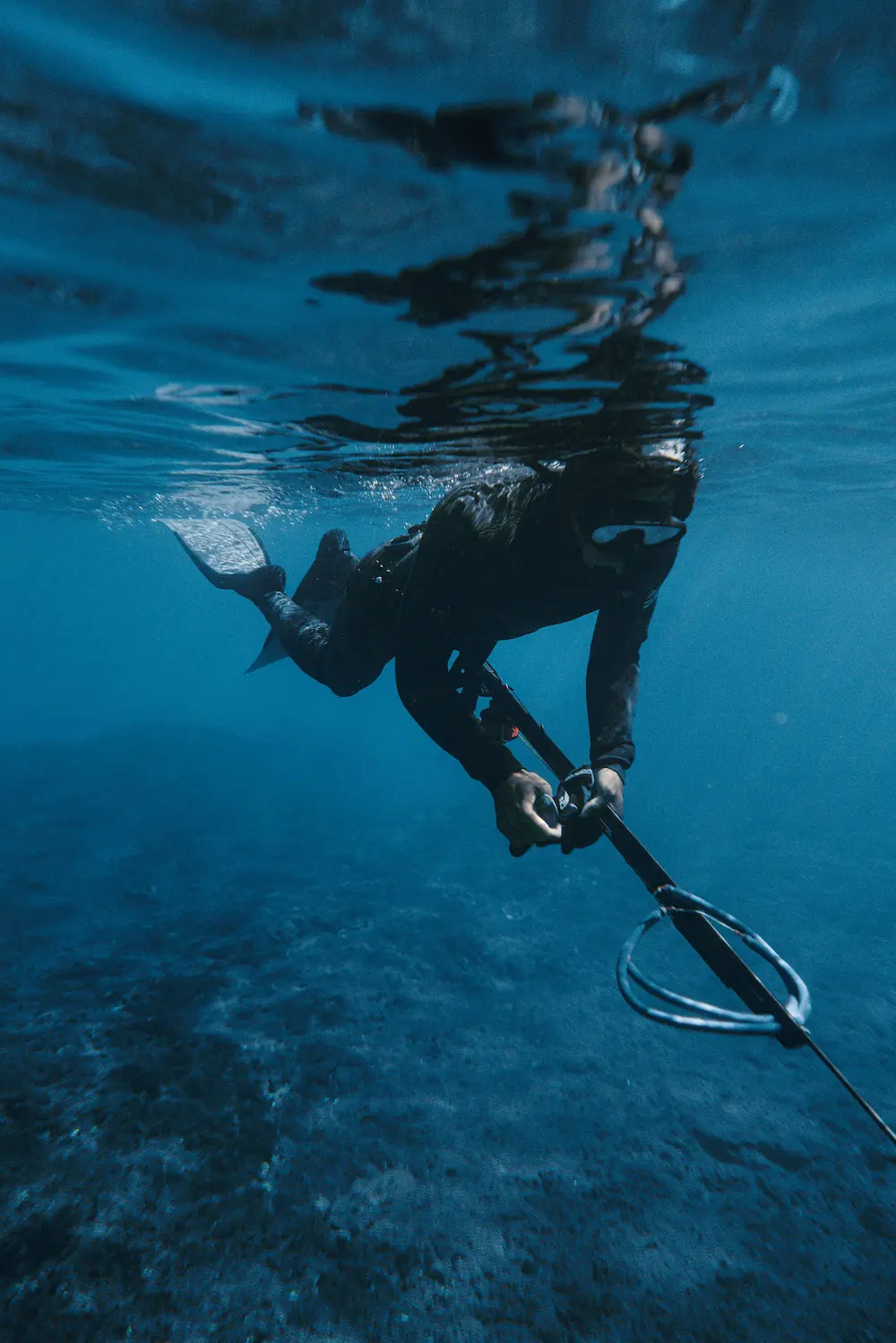
Polespear vs. Speargun
Not every spearfisher starts with a traditional speargun.
Polespears provide a simpler system and can be useful for learning basic hunting skills in environments where they are legal.
| Polespear | Speargun |
|---|---|
| Simple design | More mechanical components |
| Compact | Greater potential range |
| Useful for developing stalking skills | More versatile for many environments |
| Generally less complex to maintain | More configuration choices |
| Works well for some reef applications | Common across many forms of spearfishing |
Nautilus Spearfishing currently stocks both polespear-related equipment and speargun systems.
The correct choice depends more on the intended fishing environment than on which one looks more serious.
Freediving Fins for Spearfishing
Spearfishing normally relies heavily on freediving skills.
That makes fins important.
Freediving fins are generally longer than ordinary snorkeling fins and are designed to move water efficiently during surface swimming and underwater dives.
Current Nautilus Spearfishing inventory includes traditional plastic/composite options as well as higher-end carbon blade systems.
You will commonly encounter three broad categories:
Plastic Fins
Usually the easiest entry point.
They are durable, relatively affordable and perfectly capable of introducing someone to freediving and spearfishing.
Composite Fins
Often lighter and more responsive than basic plastic blades.
They can provide a useful middle ground between entry-level equipment and carbon.
Carbon Fins
Carbon fins are lightweight and efficient and are popular among experienced freedivers.
They are also more expensive.
If you are still learning basic finning technique, carbon blades will not magically transform an inefficient kick into professional freediving technique.
Training first.
Shopping later.
Your bank account will appreciate this order.
Choosing a Spearfishing Mask
Spearfishing and freediving masks generally have relatively low internal volume.
Why?
Because as you descend, pressure changes inside the mask and you need to equalize that airspace.
Lower-volume masks require less air to manage.
Other useful considerations include:
Comfortable skirt
Good facial seal
Wide enough field of view
Low profile
Reliable strap
Lens style
Fit around your nose for equalization
Nautilus currently sells multiple specialist freediving and spearfishing masks as well as mask-and-snorkel combinations.
Fit matters more than brand prestige.
A premium mask that leaks every thirty seconds is still a bad mask for your face.
Does Camouflage Matter in a Spearfishing Wetsuit?
Possibly less than many beginners assume.
Spearfishing wetsuits commonly use camouflage patterns because hunters want to reduce visual contrast in the underwater environment.
Nautilus currently offers several of its own camouflage wetsuit designs in different thicknesses.
But wetsuit selection should begin with practical considerations:
Water temperature
Fit
Thickness
Mobility
Comfort
Durability
Diving depth
A beautifully camouflaged wetsuit that leaves you freezing is not particularly useful.
Neither is a seven-millimeter suit in warm tropical water simply because you found it discounted.
Choose exposure protection for the environment first.
Color comes afterward.
Weight Belts and Proper Buoyancy
Spearfishers frequently use weight belts because wetsuits create positive buoyancy.
The purpose is not simply to add as much weight as possible so descending becomes effortless.
Improper weighting can create serious safety problems.
A diver should remain appropriately buoyant for the intended diving conditions and training level.
Weight configuration depends on:
Wetsuit thickness
Body composition
Salt vs. freshwater
Target depth
Equipo
Freediving technique
If you are learning, this is something to establish with experienced supervision rather than guessing.
More weight is not automatically better.
Sometimes it simply means getting into trouble faster.
Why Floats and Float Lines Matter
Floats are not decorative spearfishing accessories.
They can serve several useful functions.
A highly visible float can help make a diver’s presence more apparent at the surface, depending on local regulations and marine traffic.
Float systems can also be used to:
Carry equipment
Manage fish
Connect appropriate fishing systems
Provide surface reference
Support blue-water setups
Nautilus Spearfishing currently sells floats and float-line equipment among its specialist categories.
The exact configuration depends heavily on the type of spearfishing being practiced.
Blue-water fishing is not simply reef fishing with a longer swim.
Speargun Reels vs. Float Lines
These are two common approaches to managing line after a shot.
Speargun Reel
A reel sits directly on the gun and contains additional line.
It creates a compact system and is common in reef-style spearfishing.
Float-Line System
The line connects through a system leading toward a surface float.
This can be particularly useful when dealing with larger fish or open-water environments.
Nautilus currently sells reels, float lines and related rigging equipment, reflecting how differently spearguns can be configured depending on the intended style of fishing.
Beginners do not need to independently build a complicated blue-water system after watching one video.
Setups should match both the environment and the diver’s experience.
Spearfishing Is Freediving First
This may be the single most important thing for adventurous travelers to understand.
Spearfishing is not simply fishing with a mask.
You are freediving.
That means you need to manage:
Breath holding
Equalization
Descent
Buoyancy
Finning
Position
Surface recovery
Awareness of other divers
Marine conditions
And then, on top of all that, you are trying to locate and identify fish.
Someone who struggles with basic freediving skills will usually benefit much more from improving those fundamentals than from upgrading equipment.
Calm divers tend to move more efficiently.
Efficient movement creates more time to observe.
Observation matters enormously in spearfishing.
The fish is generally much better at swimming than you are.
It has been practicing longer.
Never Spearfish Alone
Spearfishing adds additional complexity to breath-hold diving.
It does not remove the basic freediving rule:
Do not practice serious breath-hold diving alone.
A competent buddy should actively supervise diving and understand freediving safety and rescue procedures.
The presence of fishing equipment does not make blackout risk disappear.
If anything, hunting can distract divers because attention becomes focused on the fish instead of the breath hold.
A responsible spearfishing trip should therefore prioritize:
Buddy procedures
Conservative dives
Clear communication
Appropriate weighting
Safe gun handling
Surface recovery
Conditions suitable for the divers’ level
Catching a fish is optional.
Returning safely is not.
Learn Freediving Before Chasing Fish
Beginners often want to start directly with the exciting part.
See fish.
Dive.
Aim.
Catch dinner.
But learning freediving fundamentals first produces a better experience.
Training can improve:
Equalization
Relaxation
Duck diving
Finning efficiency
Breath-hold awareness
Safety
Buddy skills
Once those skills require less mental attention, you have much more capacity to observe the underwater environment.
The experience becomes calmer.
And usually more successful.
Spearfishing in Mexico: Know the Rules Before Entering the Water
If your nautilos spearfishing search eventually turns into a trip to Mexico, the legal side matters.
Mexico’s federal fishing authority, CONAPESCA, states that underwater recreational fishing requires an individual fishing permit. It also requires anglers to respect current minimum sizes, closed seasons, catch limits and authorized fishing methods.
There are additional restrictions.
According to CONAPESCA, recreational fishing may not be conducted within 250 meters of frequently used swimming beaches or near commercial fishing vessels and fixed fishing gear. Protected areas and fish refuges are governed by their own specific rules and authorizations.
This is particularly important in the Mexican Caribbean because many of the most beautiful reefs are protected.
A beautiful reef is not automatically a legal spearfishing location.
Mexico’s Underwater Fishing Catch Limits
Underwater recreational fishing has stricter limits than general recreational fishing from a boat.
CONAPESCA’s current published guidance states that underwater recreational fishing is limited to five fish per fisher per day.
It also specifies that underwater fishing may target fish, while crustaceans and mollusks cannot generally be taken through this method, with an exception listed for squid.
Those rules sit alongside:
Closed seasons
Minimum sizes
Protected species
Area-specific restrictions
Marine protected area regulations
That is why travelers should check current regulation for the exact area rather than assuming that a valid permit lets them hunt anywhere.
It does not.
Protected Areas Can Ban Spearfishing Completely
This is especially relevant around Quintana Roo.
Some protected areas explicitly prohibit spearfishing.
For example, current CONANP visitor rules for Banco Chinchorro state that spearfishing is not allowed. The rules also prohibit harming or extracting wildlife and require authorized tourism providers for access.
Other protected areas have their own fishing restrictions. Sian Ka’an visitor regulations, for example, prohibit fishing in specified visitor-use areas, while fish refuges elsewhere in Quintana Roo can carry additional limitations.
The practical lesson is simple:
Ask exactly where the activity will take place and what regulations apply there.
Do not assume.
Responsible Spearfishing Means Identifying Before Shooting
A responsible spearfisher should know what species they are looking at before taking a shot.
That includes understanding:
Legal species
Minimum size
Closed seasons
Protected species
Local catch limits
The order should be:
Identify – Decide – Then act.
Not:
Shoot – Surface – Ask everyone on the boat what it was.
Responsible harvesting is one of the major differences between thoughtful spearfishing and simply treating the reef as an underwater target range.
Take Only What You Intend to Use
Spearfishing can be selective.
That is one of its attractions.
The diver sees the individual fish before deciding whether to take it.
That opportunity should be used responsibly.
Avoid taking fish simply because an opportunity appeared.
Think about:
Species
Size
Legal limits
Your actual food needs
The ecosystem
Whether the shot is responsible
A successful spearfishing day does not need to end with the maximum legally permitted number of fish.
Limits are maximums.
They are not objectives.
Reef Spearfishing vs. Blue-Water Spearfishing
These environments can feel like completely different sports.
| Reef Spearfishing | Blue-Water Spearfishing |
|---|---|
| Structure nearby | Open ocean |
| Reef-associated species | Pelagic species |
| Shorter visual distances possible | Usually clearer, more open water |
| Compact maneuvering | Greater emphasis on open-water systems |
| Reef awareness essential | Float and line systems particularly important |
| Often more accessible | Usually more specialized |
Beginners generally benefit from learning in conditions suited to their skill level before progressing toward more demanding environments.
Blue water can look beautifully simple.
There is just water everywhere.
That simplicity becomes slightly less comforting when you remember the bottom may be very far away.

What Marine Life Might You Encounter?
Spearfishing trips are still marine-life experiences even when no fish ends up on the menu.
Depending on the region and environment, divers may encounter:
Reef fish
Barracuda
Rays
Sea turtles
Schooling fish
Jacks
Groupers
Snappers
Pelagic species
Coral and reef life
Not everything you encounter is a target.
In fact, most of it should not be.
Part of becoming a better spearfisher is becoming better at understanding the underwater environment.
Best Conditions for Spearfishing
Ideal conditions vary by location and experience.
Generally, divers appreciate:
Manageable current
Good visibility
Appropriate water temperature
Moderate surface conditions
Safe boat traffic
Suitable depth
Visibility matters because spearfishing depends heavily on observation.
Current matters because swimming against moving water can dramatically increase effort.
Wind affects the surface and boat operations.
The best day is therefore not always the hottest or sunniest one.
Local conditions matter more than the hotel weather icon.
Best Time for Spearfishing in the Mexican Caribbean
Spearfishing opportunities can exist throughout much of the year in areas where the activity is legal, but the experience changes seasonally.
| Period | General Conditions to Consider |
|---|---|
| December–April | Popular dry-season travel period; cooler water and seasonal weather systems possible |
| May–June | Warmer conditions and transition toward summer |
| July–August | Warm water and hot surface conditions |
| September–October | Greater tropical-weather uncertainty |
| November | Transition toward drier winter conditions |
Species availability and legal closed seasons are more important than simply choosing a month based on weather.
If you have one specific species in mind, check current regulations before planning the trip.
What to Bring on a Spearfishing Trip
If equipment is not included, your packing list may include:
Mask
Snorkel
Freediving fins
Appropriate wetsuit
Weight belt
Gloves
Dive knife
Speargun or polespear where appropriate
Float system
Fishing permit
Sun protection
Agua
Dry clothes
For international travel, also check airline policies and laws governing transportation of spearguns.
A speargun is not something to casually arrive at airport security carrying under your arm.
Travel rules should be confirmed before departure.
Should Beginners Buy Their Own Gear?
Some equipment is worth owning early.
A mask that properly fits your face is a good example.
Fins can also become a worthwhile purchase once you understand what stiffness and foot-pocket fit suit you.
A full spearfishing system is different.
Before spending heavily, consider trying the activity with a qualified guide or instructor.
You may discover:
You prefer reef hunting
You want to develop freediving first
You prefer a polespear
You need softer fins
You require a different wetsuit thickness
You do not actually enjoy spearfishing
That final discovery is much cheaper before you own $2,000 of equipment.
Nautilus Spearfishing Gear vs. a Guided Spearfishing Experience
These two things solve different problems.
Nautilus Spearfishing helps you obtain equipment.
A professional local guide helps you understand the environment where you intend to use it.
| Specialist Gear Shop | Guided Spearfishing Experience |
|---|---|
| Equipment selection | Local conditions |
| Spearguns and accessories | Legal fishing areas |
| Fins and wetsuits | Species knowledge |
| Replacement parts | Safety procedures |
| Rigging components | Local regulations |
| Equipment upgrades | Practical experience |
Serious spearfishers eventually need both knowledge and equipment.
Buying a great speargun without understanding local regulations does not create a good spearfisher.
Neither does hiring a guide while ignoring basic freediving skills.
The pieces work together.
How to Choose Spearfishing Gear Without Overspending
Start with environment and experience.
Ask:
Where will I primarily dive?
How deep am I currently comfortable diving?
What species am I legally targeting?
Is this reef, structure or open water?
How warm is the water?
Will I travel frequently with the equipment?
Then choose gear.
Not the other way around.
A sensible buying order for many beginners is:
Proper mask and snorkel
Appropriate freediving fins
Exposure protection
Weight system with proper instruction
Safety equipment
Fishing system suitable for your environment
Specialized upgrades once you actually need them
This approach is considerably less exciting than buying everything simultaneously.
It is also much more likely to leave you with equipment you actually use.
Spearfishing for Travelers Looking for More Than a Boat Tour
Spearfishing appeals to a specific kind of traveler.
You do not just want to see the Caribbean.
You want to participate in it.
There is swimming.
Freediving.
Observation.
Fishing.
Learning about marine species.
And the possibility of bringing home dinner rather than simply photographing it.
It is physically and mentally more involved than a standard fishing charter, which is exactly why some travelers love it.
You are not waiting for a fish to find a hook from the comfort of the boat.
You are entering its environment.
That changes the entire experience.
Combining Spearfishing With Freediving
This is one of the most logical combinations.
A traveler can spend part of a trip improving:
Relaxation
Equalization
Fin technique
Duck dives
Safety
Depth comfort
Then apply those skills in appropriate recreational spearfishing environments.
MExplor currently offers freediving activities in Mexico and also lists spearfishing among its fishing experiences.
That creates an opportunity to build a trip around skill development rather than treating spearfishing as an isolated excursion.
Combine Spearfishing With a Custom Camp
For travelers who want several ocean experiences rather than a single fishing day, spearfishing can fit naturally into a broader adventure.
A customized trip might combine:
Freediving
Spearfishing where legally permitted
Buceo
Snorkeling
Pesca
Underwater photography
Cenotes
Marine wildlife experiences
Beach and recovery days
This is particularly useful for groups where everybody does not want to spend every day doing the same activity.
One person may want to spearfish.
Another may prefer photography.
Someone else may want to freedive.
Everybody still gets an ocean-focused vacation.
Frequently Asked Questions About Nautilos Spearfishing
Is Nautilos Spearfishing a company?
The established company appears under the name Nautilus Spearfishing. Searches for nautilos spearfishing commonly lead to the Miami-based Nautilus Spearfishing retailer.
Where is Nautilus Spearfishing located?
Its current website lists the store at 348 SW 57th Ave., Miami, Florida 33144.
What does Nautilus Spearfishing sell?
Its current catalog includes spearguns, wetsuits, freediving fins, masks, snorkels, gloves, weight systems, knives, reels, shafts, polespears, floats, float lines and other freediving and spearfishing equipment.
Does a beginner need carbon freediving fins?
No. Plastic or composite fins can be perfectly appropriate for beginners. Carbon fins can offer performance advantages, but proper technique matters more than premium materials when you are learning.
Do I need freediving training before spearfishing?
Formal freediving skills are strongly recommended because spearfishing involves underwater breath holding, equalization, buoyancy, finning and buddy safety.
Do I need a fishing permit to spearfish in Mexico?
Yes. CONAPESCA states that underwater recreational fishing requires an individual permit.
How many fish can I catch while spearfishing in Mexico?
Current CONAPESCA guidance states that underwater recreational fishing has a maximum of five fish per fisher per day, subject to additional species, size, closed-season and area restrictions.
Can I spearfish anywhere in the Mexican Caribbean?
No. Protected areas, fish refuges and other regulated zones may prohibit or limit fishing. Banco Chinchorro, for example, explicitly prohibits spearfishing under its current visitor rules.
Can I spearfish around swimmers?
CONAPESCA states that recreational fishing cannot take place within 250 meters of shores frequently used by swimmers.
Is spearfishing suitable for beginners?
Yes, when introduced gradually with appropriate freediving skills, legal fishing areas and experienced supervision. Beginners should focus on safety and water skills before worrying about advanced equipment.
From Nautilos Spearfishing Searches to the Real Underwater Experience
Searching nautilos spearfishing may begin because you need a pair of fins, a wetsuit or a new speargun.
But equipment is only the beginning.
Spearfishing rewards people who understand the water.
You learn to move quietly.
You learn to identify fish.
You learn when not to take a shot.
You learn how current changes your dive.
You become better at freediving.
And you start looking at the underwater environment differently.
That is what makes spearfishing more than buying a gun and going fishing.
The equipment gives you the tools.
Experience teaches you when—and whether—to use them.
Plan a Spearfishing and Freediving Adventure With MExplor
If your gear research is turning into plans for an actual trip, MExplor can incorporate spearfishing, fishing and freediving into an adventure in Mexico, depending on current conditions, legal fishing areas, permits and your experience level. MExplor currently lists spearfishing alongside trolling and bottom fishing within its fishing experiences.
A Campamentos Personalizados can also combine ocean activities with freediving instruction, snorkeling, scuba diving, underwater photography and other experiences instead of building the entire vacation around one activity.
Bring your own equipment or discuss what is required for the experience before traveling.
Most importantly, bring enough curiosity to learn the water rather than simply hunt in it.
Contact MExplor to plan a spearfishing or freediving experience built around your level, travel dates and the Mexican waters you want to explore.
Also you are interested

Residencial en Puerto Morelos
Residencial en Puerto Morelos Un residencial en Puerto Morelos es un conjunto de viviendas que están ubicadas en una misma zona o terreno, y que
Cancun Fishing Charters: Seasons, Species & What to Expect
Cancun Fishing Charters: A Complete Guide to Fishing the Mexican Caribbean Cancun is usually sold through turquoise water, white beaches and cocktails arriving before lunch.
Cancun Fishing MExplor
Cancun Fishing: The Ultimate Guide to Deep Sea & Sport Fishing Adventures With warm Caribbean waters, year-round fishing opportunities, and access to both offshore and
