

Planning a Photography Trip: How to Build a Journey Around the Photos You Want to Take
There is a big difference between taking photos while you travel and actually planning a photography trip.
On a normal vacation, photography happens somewhere between breakfast, sightseeing and wondering why you packed three pairs of shoes.
On a photography trip, the images help shape the itinerary.
You think about where the sun rises. You check whether a cenote receives dramatic light beams in the morning or afternoon. You leave space in the schedule for weather changes. You choose accommodations partly because of location. And yes, you may willingly wake up before sunrise while everyone else is still asleep.
The reward is that you come home with more than random snapshots of places you barely had time to experience.
A well-planned photography trip gives you enough time to observe a destination, understand its landscapes and people, and create images that actually tell the story of where you went.
Whether you are carrying a professional camera or simply want better travel photographs from your phone, this guide covers what to consider when planning a photography trip, including destinations, weather, equipment, logistics, underwater photography and why the Mexican Caribbean is particularly interesting for photographers.
What Is a Photography Trip?
A photography trip is a journey where creating images is one of the main reasons for traveling.
That does not mean every minute has to be spent behind a camera.
In fact, some of the best travel photographs happen because you slowed down enough to actually notice what was happening around you.
The main difference is intention.
Instead of arriving somewhere and asking, “What should we do today?” you may already know that you want to photograph:
- Sunrise over the Caribbean
- Wildlife in a protected natural area
- Underwater reefs
- Cenote light beams
- Local streets and markets
- Traditional architecture
- Dancers in motion
- Portraits
- Landscapes
- Night scenes
When planning a photography trip, those goals influence when you visit, where you stay and how much time you spend in each place.
Why Planning a Photography Trip Matters
Photography depends heavily on things you cannot completely control.
Light changes.
Weather changes.
Animals definitely do not care about your itinerary.
And places that look peaceful in photographs online may have 200 visitors standing just outside the frame.
Planning gives you better odds.
It helps you identify when the light is likely to be best, how much travel time you need, whether photography is permitted and what equipment is actually worth carrying.
It also prevents one of the most common travel mistakes: trying to photograph too many places in too little time.
A good photography itinerary usually has breathing room.
That allows you to return somewhere if conditions are poor or stay longer when something interesting happens.
Start by Deciding What You Want to Photograph
Before choosing hotels or flights, decide what kind of images you actually want.
This is one of the most important parts of planning a photography trip because different subjects require very different itineraries.
Landscape photography
Landscape photographers normally care about:
- Sunrise and sunset direction
- Weather
- Access to viewpoints
- Tides
- Cloud cover
- Seasonal vegetation
- Crowd levels
A beautiful beach at noon and the same beach at sunrise can feel like completely different locations.
Wildlife photography
Wildlife requires more patience and much less control.
Your itinerary should consider:
- Animal seasons
- Local guides
- Protected-area regulations
- Distance from wildlife
- Longer lenses
- Early mornings
In protected natural areas of Quintana Roo, visitors are specifically required to avoid disturbing, feeding or harming wildlife. Some protected areas also regulate where visitors may go and which tourism operators may provide access. Descubre ANP
The animal getting the photograph is never more important than the animal itself.
Street photography
Street photography usually benefits from spending more time in fewer neighborhoods.
Markets, town squares, small restaurants and local celebrations often provide more interesting images than racing between famous landmarks.
Underwater photography
Underwater photography requires additional planning because you are dealing with:
- Water visibility
- Currents
- Dive or snorkel ability
- Marine life
- Underwater housings
- Lighting
- Safety
The Mexican Caribbean is especially interesting because photographers can work in both ocean environments and freshwater cenotes during the same trip.
Choose a Destination Based on the Images, Not Just the Reputation
A famous destination is not automatically the best photography destination for you.
If your goal is wildlife, a busy resort may not make sense.
If you love architecture and street photography, spending the entire trip on an isolated beach may become limiting.
Ask yourself:
What do I want my final collection of photographs to look like?
That question can completely change how you plan.
For example, a photography trip through the Mexican Caribbean could combine:
- Caribbean beaches
- Coral reefs
- Cenotes
- Fishing villages
- Mangroves
- Wildlife
- Mayan landscapes
- Local dance
- Underwater photography
That gives you significantly more visual variety than staying inside one resort for seven days.
Why the Mexican Caribbean Works Well for a Photography Trip
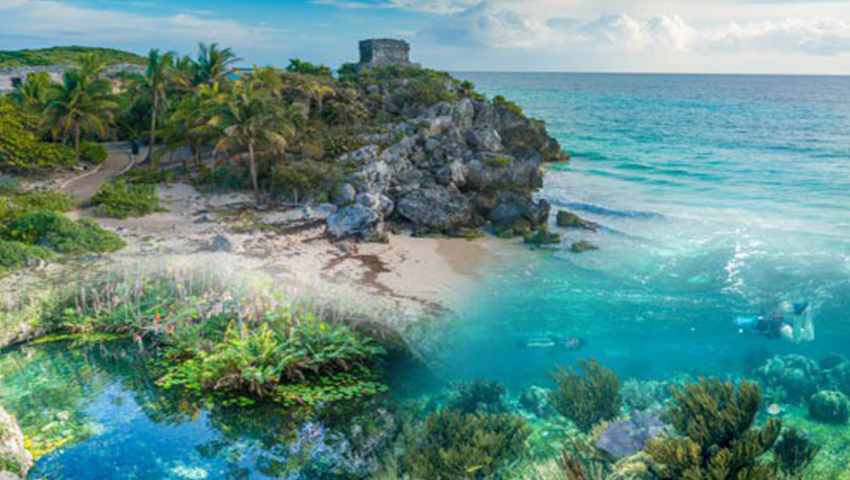
The Mexican Caribbean offers several very different photography environments within relatively short distances.
You can photograph turquoise water at sunrise, descend into a cenote in the afternoon and photograph dancers that evening.
Places such as Cancún, Puerto Morelos, Playa del Carmen, Cozumel and Tulum also provide access to marine environments, towns, protected areas and inland cenotes.
Puerto Morelos Reef National Park, for example, officially lists nature and outdoor photography, wildlife observation, cenote visits and other nature activities among the experiences available in the protected area. Descubre ANP
Farther south, the Sian Ka’an reef system contains coral reefs, mangroves, lagoons and marine wildlife and is recognized by Mexico’s protected-area authority as an important destination for recreational diving and underwater photography. Descubre ANP
That variety is useful because not every photography day depends on the same conditions.
If the ocean is rough, you may photograph inland.
If midday light is harsh, explore a cenote.
If clouds ruin sunset, photograph people or street scenes instead.
That flexibility is valuable when planning a photography trip.
Planning a Photography Trip Around the Best Light
Photographers talk about light constantly for a reason.
It can completely change a scene.
Sunrise
Sunrise is particularly useful for:
- Beaches
- Seascapes
- Empty streets
- Reflections
- Silhouettes
- Soft portraits
In the Mexican Caribbean, the Caribbean Sea sits east of much of the coastline, which makes sunrise photography particularly attractive along many beaches.
You also get another major advantage:
Fewer people.
The price is waking up early enough to question your life choices.
Usually worth it.
Golden hour
Golden hour occurs shortly after sunrise and before sunset.
The light is lower, warmer and softer than midday sun.
It works beautifully for:
- Portraits
- Landscapes
- Architecture
- Lifestyle photography
Midday
Midday has a terrible reputation among photographers, but it is not useless.
In tropical destinations, bright overhead sunlight can make water look intensely blue and turquoise.
It can also work well underwater because more sunlight penetrates the surface.
And cenotes sometimes create their most dramatic visual effects when direct sunlight enters openings in the rock.
The lesson is not simply “avoid midday.”
It is:
Match the subject to the light.
Planning Photography Around Weather and Climate
Weather should influence your itinerary but should not completely control it.
Clouds can make a landscape more dramatic.
Rain creates reflections.
Stormy skies can produce better photographs than perfect blue ones.
The problem is when weather prevents access altogether.
Mexican Caribbean weather
The region has a tropical climate, meaning photographers should expect warmth and humidity for much of the year.
Official information for protected areas around Quintana Roo describes conditions as warm to hot, often with high humidity. Descubre ANP
A general planning guide looks like this:
| Period | Typical Photography Considerations |
|---|---|
| December–April | Generally comfortable temperatures and popular travel season |
| May–August | Hotter, humid and bright tropical conditions |
| September–October | Greater possibility of tropical weather interruptions |
| November | Transition toward generally drier conditions |
Weather can vary considerably from day to day, so leave some flexibility in your photography schedule.
How Many Locations Should You Include?
Probably fewer than you initially want.
A common mistake when planning a photography trip is creating an itinerary that reads like this:
Sunrise here.
Breakfast there.
Drive two hours.
Photograph cenote.
Drive another hour.
Sunset somewhere else.
Dinner.
Repeat.
By day three, you are photographing mostly because the itinerary says you should.
Photography improves when you have time to observe.
For a five-day trip, three main photography areas can often produce better work than eight rushed locations.
Build a Photography Shot List
A shot list does not mean deciding every photograph in advance.
It simply gives your trip some direction.
You might divide it into categories.
Landscapes
- Sunrise
- Wide coastal view
- Jungle
- Cenote interior
- Reflections
People
- Environmental portraits
- Local activities
- Baile
- Fishermen
- Travelers interacting naturally with the environment
Details
- Tropical plants
- Food
- Hands
- Architecture
- Textures
- Boats
- Equipo
Underwater
- Reef scenes
- Freedivers
- Snorkelers
- Marine life
- Sun rays
- Split-level photographs
A list helps when you suddenly realize that you spent six days photographing beaches and forgot everything else.
Planning an Underwater Photography Trip
If your photography trip includes the Mexican Caribbean, underwater photography deserves its own planning.
This region provides access to both coral reef environments and freshwater cenotes.
Those are completely different photographic situations.
Reef photography
Reefs can provide opportunities to photograph:
- Tropical fish
- Sea turtles
- Coral structures
- Snorkelers
- Divers
- Freedivers
- Sunlight patterns
Protected-area rules are important.
For example, visitors to Banco Chinchorro are instructed not to touch, harass, feed, damage or extract wildlife and not to stand on coral. Descubre ANP
That should really be standard behavior anywhere underwater.
A photograph is not improved by stressing the animal in it.
Cenote photography
Cenotes can produce completely different images.
Think:
- Dark limestone walls
- Clear freshwater
- Reflections
- Shafts of sunlight
- Roots
- Freedivers appearing almost suspended in space
The challenge is exposure.
You may have a very bright beam of sunlight surrounded by extremely dark rock.
This is where understanding manual exposure or exposure compensation can help.
But you do not need to become a technical wizard before the trip.
Modern cameras are very forgiving.
The important part is recognizing what makes the scene visually interesting.
Photography and Freediving
Freediving can create some of the most striking underwater travel photographs because the diver has very little equipment.
That produces clean silhouettes and a sense of movement.
Photographers can capture:
- A freediver descending
- A diver passing through a beam of light
- Reflections near the surface
- Long fins against open blue water
- Human scale against a cenote wall
If you intend to photograph while freediving yourself, however, safety comes before the image.
Use proper buddy procedures and never extend a breath hold simply because the photograph “almost” looks right.
There will always be another frame.
Photographing Marine Life Responsibly
Wildlife photography works best when animals behave naturally.
Do not chase animals for photographs.
Do not touch them.
Do not feed them.
And avoid blocking their path.
Official protected-area regulations throughout Quintana Roo repeatedly prohibit disturbing or feeding wildlife. Descubre ANP
A practical approach is to position yourself patiently and allow the animal to decide whether it comes closer.
This often creates better photographs anyway.
An animal swimming naturally toward you looks significantly better than one desperately trying to escape your GoPro.
What Camera Gear Should You Bring?
This is where photographers frequently lose all self-control.
You probably do not need every lens you own.
When planning a photography trip, think about what you will realistically photograph.
A simple setup might include:
- Camera body
- General-purpose zoom lens
- Wide-angle lens
- Telephoto lens if wildlife is important
- Spare batteries
- Memory cards
- Cleaning cloth
- Lightweight tripod
- Waterproof bag or dry bag
For underwater photography:
- Waterproof housing
- Dome port if required
- Spare seals or O-rings
- Anti-fog solution
- Tether
- Extra batteries
And yes, your phone counts as a camera.
A modern smartphone can be extremely useful when carrying a large camera is impractical.
Camera vs Smartphone for a Photography Trip
You do not necessarily need professional equipment to justify planning a photography trip.
| Smartphone | Dedicated Camera |
|---|---|
| Lightweight | Better image quality |
| Easy to carry | More lens options |
| Fast for candid moments | Better low-light performance |
| Simple sharing | More manual control |
| Excellent computational photography | Better for specialized work |
Many travelers use both.
A camera may handle sunrise landscapes and underwater work, while a phone captures spontaneous scenes throughout the day.
The best camera is still the one you actually take out of the bag.
Protecting Camera Gear in Tropical Destinations
Humidity, sand and saltwater deserve respect.
Especially saltwater.
A photography trip involving beaches should include some basic equipment care.
Use a dry bag
This is particularly important on boats.
Even calm water has an impressive ability to find expensive electronics.
Clean salt spray
Salt can accumulate on lenses, camera bodies and zippers.
Wipe your equipment after marine activities.
Avoid changing lenses on the beach
Sand blowing into the camera body is not something you want to discover three days later.
Carry extra batteries
Heat, video and constant camera use can drain batteries quickly.
Back up photographs every day
Do not wait until the end of the trip.
Use:
- Laptop
- External SSD
- Cloud storage when internet permits
Ideally, keep at least two copies.
No one wants the most dramatic part of their photography trip to be losing the photographs.
Should You Bring a Drone on a Photography Trip to Mexico?
Possibly, but this requires more planning than simply packing one.
Mexico regulates remotely piloted aircraft, and current rules vary according to aircraft weight, registration, operator status and intended use. Official Mexican government guidance advises travelers to check whether registration or authorization is required and to carry documentation such as proof of purchase and technical information. Sidof
Foreign visitors also face specific regulatory conditions for recreational drone use. Orden Jurídico
Additionally, do not assume that because flying a drone may be generally legal, it is permitted everywhere.
Individual protected areas can prohibit drones entirely. For example, current CONANP visitor rules for Otoch Ma’ax Yetel Kooh explicitly prohibit drone flights. Descubre ANP
When planning a photography trip, always verify the rules for each individual location before bringing a drone.
Photography Permits and Location Rules
Not every beautiful place operates like a public sidewalk.
Some destinations restrict:
- Tripods
- Professional shoots
- Commercial photography
- Drones
- Flash
- Access to certain areas
Protected areas may also require authorized guides or tourism providers.
Banco Chinchorro, for instance, requires access through authorized tourism service providers. Descubre ANP
The practical rule is simple:
Check before the trip.
It is much easier than arriving with three camera bodies, lights and a tripod and learning that the location allows none of them.
Best Time of Day for Different Travel Photography
Here is a simple planning reference:
| Subject | Good Time to Photograph |
|---|---|
| Beach landscape | Sunrise or golden hour |
| Turquoise water | Late morning to midday |
| Portraits | Early morning or late afternoon |
| Street photography | Morning and late afternoon |
| Cenotes | Depends on cenote orientation and sunlight |
| Underwater reefs | Often when sunlight is higher |
| Wildlife | Frequently early morning |
| Nightlife and dance | Evening |
This is not a rigid formula.
It simply helps create a smarter itinerary.
Photographing Dance While Traveling
Photography trips do not have to be entirely about landscapes.
Dance can be an excellent way to photograph movement and culture.
In destinations such as Cancún and other parts of the Mexican Caribbean, salsa and bachata events can add an entirely different visual layer to your trip.
Dance photography works especially well when you look for:
- Motion
- Hands
- Expressions
- Connection between partners
- Spinning clothing
- Musicians
- Ambient light
You do not always need to freeze movement completely.
A slower shutter speed can intentionally create motion blur and make the image feel alive.
And unlike sunrise photography, nobody expects you to wake up at 5:30 in the morning.
How to Plan a Five-Day Photography Trip
A balanced five-day itinerary could look something like this:
Day 1: Arrival and exploration
Use your first afternoon to walk around, understand the area and scout locations.
Do not pressure yourself to create your best photographs immediately.
Day 2: Sunrise and local life
Photograph sunrise, then spend the morning exploring the town or coastline.
Rest during the hottest part of the afternoon.
Return for golden hour.
Day 3: Underwater photography
Plan a snorkeling, freediving or diving experience.
Use the rest of the day for backing up images and relaxing.
Day 4: Cenotes and inland landscapes
Visit a cenote or natural area.
Leave time for unexpected stops.
Day 5: Return to your favorite location
This is important.
Do not automatically choose somewhere new.
Returning to the same place with different light or weather can produce your strongest photographs.
Common Mistakes When Planning a Photography Trip
Scheduling every minute
Photography is unpredictable.
Leave gaps.
Bringing too much gear
You will eventually stop carrying half of it.
Ignoring travel times
Google Maps may say 45 minutes.
Real life may disagree.
Only photographing famous locations
Some of your best images may happen between attractions.
Forgetting to experience the destination
This one is easy to do.
Occasionally lower the camera.
The point is still to travel.
Should You Hire a Local Photography Guide?
Sometimes this is one of the smartest decisions you can make.
A local guide may know:
- When the light reaches a location
- Which areas are crowded
- Where photography is permitted
- How conditions change seasonally
- Local wildlife behavior
- Less obvious viewpoints
This is particularly valuable for underwater photography, remote natural areas and trips where you only have a few days.
You are not just paying someone to show you a location.
You are often buying time.
And time is one of the most valuable things on a short photography trip.
Planning a Photography Trip With MExplor
For travelers interested in the Mexican Caribbean, photography does not have to be treated as a separate activity from the rest of the vacation.
It can be built into the experience.
A photography-focused trip can combine:
- Beaches
- Cenotes
- Freediving
- Snorkeling
- Buceo
- Marine wildlife
- Local communities
- Salsa and bachata
- Landscape photography
- Underwater photography
This is especially useful for travelers who want photographs that tell a broader story rather than returning with 400 versions of the same beach.
MExplor can help build customized experiences around the activities and environments you want to photograph, allowing photography to become part of the itinerary instead of something squeezed into whatever time remains.
Practical Checklist for Planning a Photography Trip
Before leaving, check:
- Your priority subjects
- Sunrise and sunset times
- Seasonal weather
- Photography restrictions
- Protected-area regulations
- Drone laws if applicable
- Transportation times
- Camera insurance
- Memory cards
- Batteries
- Backup storage
- Waterproof protection
- Appropriate clothing
- Local guides or experiences
And most importantly:
Leave space for something you did not plan.
Travel photography would be rather boring if every photograph existed in your head before you arrived.
Final Thoughts on Planning a Photography Trip
The best approach to planning a photography trip is not creating the most complicated itinerary.
It is creating the right conditions to photograph well.
Know what you want to shoot.
Research the light.
Understand the weather.
Choose a few strong locations.
Protect your equipment.
Respect wildlife and local rules.
Then leave enough flexibility for the destination to surprise you.
For photographers visiting the Mexican Caribbean, that surprise might happen underwater beside a coral reef, inside a cenote illuminated by sunlight, along a quiet beach at sunrise or on a dance floor later that evening.
You can plan the trip carefully.
You just cannot plan every photograph.
And that is usually where the interesting ones begin.
Also you are interested
Centro de buceo el hierro, el destino perfecto para bucear
¡Descubre la magia submarina en el Centro de Buceo El Hierro!

Embark on an Underwater Adventure: Scuba Diving Playa del Carmen Explained
Dive into Paradise: The Ultimate Scuba Diving Playa del Carmen Have you ever wondered what it’s like to explore a world entirely different from ours,
Pesca en Playa del Carmen
Pesca en Playa del Carmen La pesca en Playa del Carmen ha existido durante muchas décadas y ha sido un lugar favorito para turistas, lugareños
