

Freediving With Whales: A Guide to One of the Ocean’s Most Extraordinary Encounters
There is a very big difference between seeing a whale from a boat and seeing one underwater.
From the surface, you notice the blow, the dorsal fin and maybe an enormous tail disappearing beneath the sea.
Underwater, you finally understand the scale.
A humpback whale can glide past almost silently while you float beside it, making something weighing tens of thousands of kilograms look strangely effortless. You hear sounds that seem to travel through your entire body. You watch a pectoral fin move beneath you and suddenly realize that the “fin” is roughly the size of the person swimming next to you.
It is easy to understand why freediving with whales appears on so many ocean lovers’ dream lists.
But there is an important distinction to make immediately: getting into the water with whales is highly regulated and is not legal everywhere. Even where in-water encounters are permitted, the experience may be limited to snorkeling or surface swimming rather than actively diving down beside the animals.
The International Whaling Commission specifically recommends that swim-with-cetacean activities be discouraged in places where they are not already established, because repeated human interaction can disturb natural behavior. Responsible whale tourism should allow the animal—not the swimmer—to determine how an encounter unfolds.
So freediving with whales should never mean spotting a whale from your boat, putting on fins and jumping overboard.
It means traveling to a destination where in-water encounters are legally managed, choosing an authorized operator and following rules designed around the whales rather than around getting the perfect photograph.
When those conditions come together, the experience can be remarkable.
What Does Freediving With Whales Actually Mean?
The phrase freediving with whales is sometimes used rather loosely in travel marketing.
In a true freediving context, a person would descend underwater while holding their breath instead of using scuba equipment.
Whale-swimming experiences, however, often operate differently.
Depending on local regulations, participants may be required to remain close to the surface wearing a mask, snorkel and fins. Diving down toward the animal may be limited or prohibited even if you happen to be an experienced freediver.
That distinction matters.
You are participating in a wildlife encounter, not a depth-training session.
The goal is not to see how close or deep you can get.
The goal is to be in the water while a wild whale chooses to remain nearby.
Is Freediving With Whales Legal?
Sometimes.
But definitely not everywhere.
Rules vary enormously between countries, species and even individual regions within the same country.
For example, Tonga legally regulates whale watching and swimming and specifically requires visitors to use licensed whale operators. Humpback whales migrate into Tongan waters between roughly July and October to mate, give birth and raise calves.
French Polynesia also permits regulated in-water humpback encounters under strict conditions. Whale tourism operators require government authorization, and French Polynesia strengthened its mammal-observation framework again in 2026, including certification requirements for captains and guides.
Other countries take a very different approach.
NOAA guidance in the United States specifically tells the public not to swim with, touch or attempt to interact with wild marine mammals, and additional minimum approach distances apply to various whale species and regions.
Mexico also provides an important example. Under the regulations governing authorized whale-watching areas, activities such as swimming and diving are prohibited during whale observation. That means seeing humpback or gray whales in Mexico does not automatically give you permission to enter the water with them.
Always check the current rules for the exact destination before planning an in-water encounter.
Best Places for Freediving With Whales
Only a limited number of destinations have established regulated programs allowing people into the water around whales.
Even in these places, regulations change as governments learn more about tourism pressure and whale behavior.
Tonga: Swimming With Humpback Whales
Tonga is probably one of the world’s best-known destinations for swimming with humpback whales.
Southern humpback whales migrate from Antarctic feeding grounds into warmer Tongan waters during the austral winter, where mothers give birth and care for their calves.
Tonga Tourism lists the main whale season from July through October and specifically instructs visitors to book licensed whale operators.
The experience usually begins with searching from a boat.
Once a suitable whale or group is located, the guide evaluates behavior and decides whether swimmers can enter.
Sometimes the whale stays.
Sometimes it leaves.
Sometimes you spend a surprisingly large amount of your dream whale day staring at open ocean.
Wildlife did not receive your itinerary.
That uncertainty is part of the experience.
French Polynesia: Humpback Whales in Tropical Blue Water
French Polynesia is another famous destination for underwater humpback encounters.
Whales migrate into Polynesian waters during the austral winter to reproduce, give birth and rest.
Locations such as Moorea, Tahiti and Rurutu have become particularly well known for whale tourism.
A 2026 government brief for Moorea notes that humpbacks are commonly present from approximately July through late October and emphasizes that the animals are protected and may only be approached more closely through authorized providers.
French Polynesia also operates a marine-mammal sanctuary throughout its entire Exclusive Economic Zone. Whale harassment, capture and hunting are prohibited, and authorized whale-watching activities are regulated by the environmental authorities.
For travelers, the practical lesson is simple:
Do not book based purely on the words “swim with whales.”
Check that the operator appears on the current authorized list.
Dominica: Sperm Whale Encounters
Dominica offers a completely different whale experience.
Instead of seasonal humpbacks, the island is known for a resident population of sperm whales.
Dominica has described itself as the only country where sperm whales reside year-round, with sightings historically most common between November and March.
The country dramatically increased protection for these animals with the Sperm Whale Reserve Act of 2025, establishing the world’s first dedicated sperm whale reserve. New regulations continued to develop in 2026. The legislation explicitly regulates whale-watching and swim-with-whale activities and prohibits unregulated encounters.
That makes Dominica especially interesting for marine travelers, but it also means that old blog posts describing informal whale swims should not be treated as current guidance.
Use officially authorized operators and verify what in-water activities are permitted when you travel.
Best Whale Seasons for Underwater Encounters
Whales migrate, so timing matters enormously.
| Destination | Main Whale | Approximate Season | Important Note |
|---|---|---|---|
| Tonga | Humpback whale | July–October | Use licensed whale-swim operators |
| French Polynesia | Humpback whale | Roughly July–October/November | Rules and authorized areas are tightly controlled |
| Dominica | Sperm whale | Present year-round | Tourism now governed by the Sperm Whale Reserve framework |
| United States | Several whale species | Varies by region | NOAA advises against swimming with wild marine mammals |
| Mexico | Humpback and gray whales among others | Varies by species and region | Swimming/diving is prohibited during regulated whale observation |
Migration dates are never perfectly fixed.
Water temperature, food availability, reproductive cycles and ocean conditions influence whale movements.
That means traveling during “whale season” improves your chances.
It does not create a whale appointment.
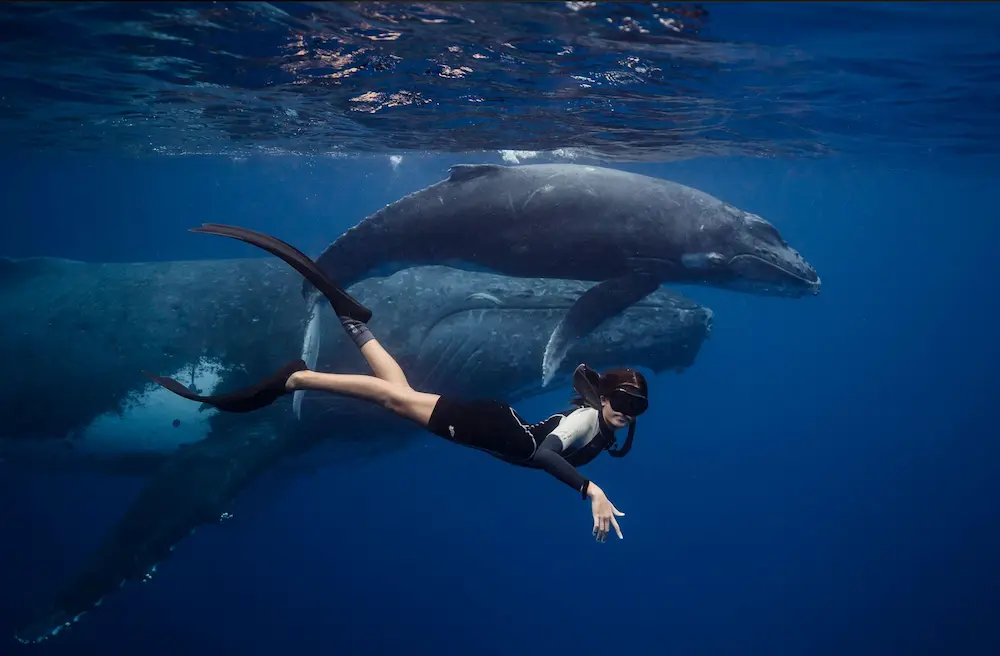
Humpback Whales vs. Sperm Whales Underwater
These animals create very different encounters.
Freediving With Humpback Whales
Humpbacks are the species most people picture when imagining freediving with whales.
Their long pectoral fins, huge tails and distinctive body shape make them incredibly photogenic underwater.
Mother-and-calf pairs are often encountered in tropical breeding areas, which is also exactly why operators need to behave cautiously.
A resting mother with a young calf does not need six boats and thirty swimmers repeatedly interrupting her afternoon.
Responsible operators limit interaction when the animals appear uncomfortable or begin moving away.
Swimming With Sperm Whales
Sperm whales have a completely different appearance and behavior.
They are deep-diving toothed whales famous for hunting squid at extreme depths.
Dominica’s underwater topography brings deep water relatively close to the island, which helps explain why sperm whales can be found relatively near shore.
Underwater encounters can involve whales resting or socializing near the surface between deep dives.
Again, access is highly regulated.
You are visiting animals that have important feeding, resting and social behaviors to complete.
Your vacation photograph is not at the top of their schedule.
Do You Need to Be a Certified Freediver?
Not necessarily.
Many regulated whale-swimming experiences are designed primarily for strong swimmers and snorkelers rather than advanced freedivers.
But freediving training can make you significantly more comfortable in the water.
Useful skills include:
Efficient finning
Calm surface breathing
Mask and snorkel comfort
Equalization
Ocean awareness
Controlled duck dives where permitted
Recovery breathing
Buddy awareness
A freediving certification also teaches something particularly valuable around wildlife:
not every dive needs to happen.
If you are tired, stressed, cold or uncomfortable, stay at the surface.
The whale will not be offended.
How Good a Swimmer Do You Need to Be?
This matters more than breath-hold time.
Whale encounters often happen in open ocean.
That can involve:
Waves
Current
Wind
Boat traffic
Deep water
Long surface swims
Repeated boat entries and exits
You should be comfortable swimming in natural ocean conditions.
A swimming pool is controlled.
The Pacific Ocean has not received the memo.
Some operators may require participants to demonstrate swimming ability before entering the water.
If you struggle to swim comfortably while wearing fins and a snorkel, work on those skills before planning a whale trip.
What Freediving With Whales Actually Feels Like
The first thing you notice is often not the whale.
It is the waiting.
The boat moves slowly while guides scan the horizon.
Someone sees a blow.
The captain changes direction.
Then you wait again while the crew evaluates the animal.
Eventually, the guide says it is time.
Suddenly everyone who has spent two hours calmly discussing conservation begins putting on fins at Olympic speed.
You enter the water.
At first, you see nothing except blue.
Then a shape appears.
And it keeps getting larger.
Scale becomes difficult to process underwater. A whale can look close long before it actually is because your brain simply does not have many familiar objects that size floating beside you.
When the whale passes, the movement can be surprisingly calm.
There is no dramatic soundtrack underwater.
Just water, breathing at the surface and an animal large enough to make you feel very small.
Why You Should Never Chase a Whale
If a whale moves away, let it go.
This may be the most important behavioral rule during any underwater whale experience.
Chasing an animal changes the interaction immediately.
Responsible whale tourism tries to create conditions where the whale controls whether the encounter continues.
The International Whaling Commission defines responsible whale watching partly around minimizing disturbance and allowing animals to determine the nature and duration of interactions as much as possible.
Do not:
Swim directly at the whale
Block its direction of travel
Surround it
Separate a mother and calf
Dive directly above or below it
Touch it
Try to ride it
Use aggressive underwater scooters to pursue it
You are observing wildlife.
You are not participating in an underwater meet-and-greet.
Mother and Calf Whale Encounters
Many tropical humpback destinations are breeding and nursery areas.
That means encounters frequently involve mothers and calves.
They can create extraordinary observations.
They also require additional restraint.
A calf may behave curiously and approach swimmers.
That does not give swimmers permission to approach the calf.
The mother needs room to rest and care for her young.
Both the International Whaling Commission and national whale regulations commonly emphasize avoiding interference with mother-and-calf pairs.
If the whales choose to approach, stay calm and follow your guide.
Let them decide how close the encounter becomes.
Freediving Safety Around Whales
The whale is usually not the biggest risk.
The ocean is.
Freedivers still need to manage the same hazards they would during any other open-water breath-hold activity.
These include:
Hypoxic blackout
Waves
Current
Boats
Fatigue
Cold
Dehydration
Seasickness
Separation from the group
Wildlife creates an additional problem: distraction.
You may normally turn toward the surface after 30 seconds.
Then a whale swims below you and suddenly your brain becomes very interested in staying another ten seconds.
Do not.
A whale encounter is not the time to test your breath-hold limits.
Never Turn a Whale Swim Into a Depth Attempt
This deserves its own section.
Experienced freedivers may be tempted to descend deeper for a photograph.
Only do so when local regulations and the operator explicitly permit it.
Even then, stay well inside your normal limits.
Wildlife encounters add excitement, physical exertion and unpredictability.
That is a terrible combination for chasing a personal record.
Your deepest dive does not need to happen next to a 30-ton animal.
The whale is already impressive enough for both of you.
Boat Safety During Whale Encounters
In many destinations, the boat environment deserves just as much attention as the water.
Whale tourism can involve several operators searching the same area.
Responsible management therefore includes vessel numbers, approach distances, speed restrictions and limits on interaction time. These are among the management tools recommended internationally by the IWC.
When entering the water:
Listen to your guide.
Stay within the designated swimmer group.
Know where the boat is.
Do not swim away chasing an animal.
And when the guide tells you to return, return.
“This whale really seemed like it wanted another five minutes” is not a convincing maritime safety argument.
What Equipment Do You Need for Freediving With Whales?
Most professional whale-swim operations provide or recommend relatively simple equipment.
You may need:
Mask
Snorkel
Freediving or snorkeling fins
Wetsuit
Comfortable swimsuit
Underwater camera if allowed
Appropriate sun protection
Towel and warm clothing for boat intervals
Long freediving fins can make swimming more efficient, but they are not essential for every experience.
If you are not accustomed to using them, shorter fins may actually be easier.
Comfort matters more than looking like the most serious freediver on the boat.
Choosing the Right Wetsuit
Whale destinations can be deceptively cool.
You may be somewhere tropical while spending several hours wet, exposed to wind and repeatedly entering the ocean.
Water temperature also varies significantly between destinations.
A proper wetsuit helps with:
Warmth
Sun protection
Buoyancy
Comfort during longer swims
In French Polynesia, for example, a 2026 tourism brief notes winter water around Moorea can range roughly from 21–27°C during whale season.
That can feel pleasant during the first swim.
After several wet boat rides, you may become considerably less impressed.
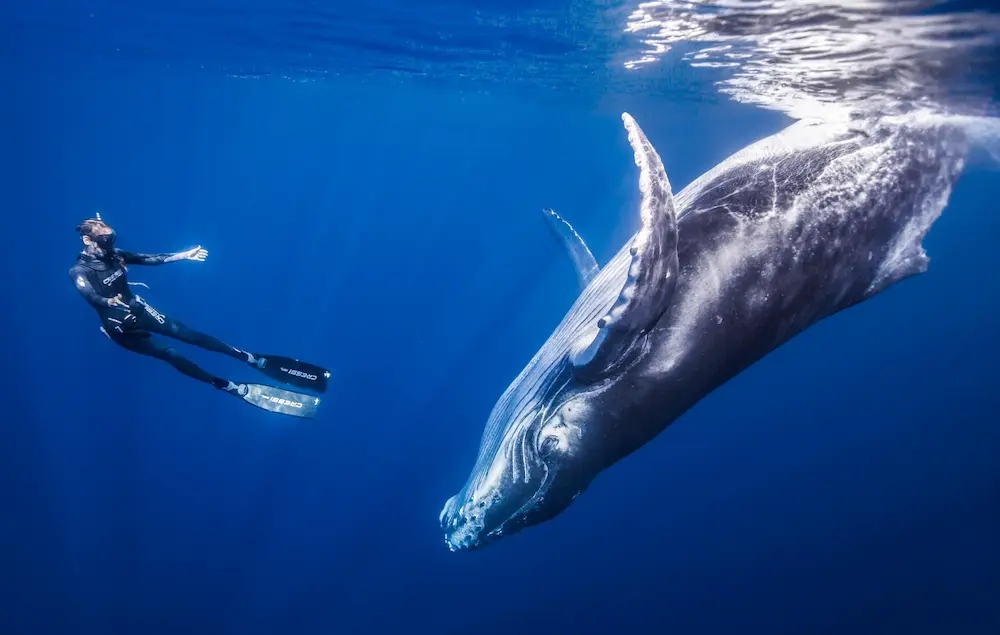
Underwater Photography With Whales
Whales create some of the most dramatic underwater photographs possible.
They also create one of the easiest situations in which photographers forget every conservation rule they supposedly support.
Do not chase an animal for the shot.
Do not swim between a mother and calf.
Do not touch a whale.
Do not repeatedly reposition the group because you want a cleaner background.
Instead, prepare before entering the water.
Use a wide-angle setup if appropriate.
Understand your camera controls.
Choose settings before the whale appears.
Then let the animal determine what photograph you get.
A technically imperfect image from an ethical encounter is better than an extraordinary photograph created by harassing wildlife.
Why Wide-Angle Photography Works Best
Whales are enormous.
That creates a fairly predictable lens problem.
A narrow field of view can turn your breathtaking whale encounter into an impressive photograph of approximately 14% of a whale.
Wide-angle cameras allow you to show both the animal and the surrounding blue water.
They also help communicate scale by including a swimmer in the frame at an appropriate distance.
GoPro-style action cameras can work surprisingly well for beginners because they offer wide fields of view and are simple to operate.
More advanced photographers may use underwater housings and wide-angle lenses.
Just remember that expensive equipment does not grant additional whale privileges.
Can You Touch a Whale?
No.
Even if the whale approaches you.
Even if the calf appears curious.
Even if someone on social media posted themselves doing it.
Responsible marine wildlife observation is based on reducing interference with natural behavior.
NOAA specifically advises people not to touch or attempt to interact physically with wild marine mammals, while destinations allowing regulated whale swims maintain their own approach rules designed to reduce disturbance.
Stay still.
Enjoy the moment.
Your hands can survive without participating.
How Close Can You Get to a Whale?
There is no universal number.
Approach distances differ between jurisdictions and can also differ depending on whether you are in a boat or in the water.
In French Polynesia, for example, current whale-tourism management includes controlled observation zones, authorized operators and specific rules governing where swimmers can enter the water. The regulations have also been tightened over recent seasons in response to increasing tourism pressure.
The important concept is that you do not decide the distance yourself.
Your guide follows local regulations.
After entering the water, the whale may choose to approach more closely.
That is very different from you swimming toward the whale.
Signs a Whale Does Not Want Interaction
You do not need to become a cetacean biologist overnight.
Your guide should be trained to interpret behavior.
However, obvious avoidance matters.
If a whale repeatedly changes direction, increases speed or moves away from swimmers or boats, do not pursue it.
The IWC notes that poorly managed whale-watching pressure can change whale behavior and habitat use and potentially affect feeding or reproductive success.
The best encounter is one where the whale does not need to escape the encounter.
Weather Conditions for Freediving With Whales
A perfect whale season does not guarantee a perfect ocean day.
Conditions can include:
| Condition | Why It Matters |
|---|---|
| Wind | Creates rougher surface conditions |
| Waves | Make swimming and boat entry harder |
| Current | Increases swimming effort |
| Visibility | Determines how easily whales can be seen underwater |
| Rain | Can affect comfort and visibility |
| Water temperature | Determines exposure protection |
| Swell | Can make boat rides difficult |
Tours may be canceled even when whales are present.
That can be frustrating after traveling halfway around the planet.
It is still the right decision.
A wildlife experience stops being enjoyable rather quickly when half the boat is seasick and the other half is trying not to lose a fin.
How Many Days Should You Book?
If seeing whales underwater is one of the primary reasons for your trip, do not rely on one afternoon.
Wild animals move.
Weather changes.
Sea conditions deteriorate.
Whales may be present but unsuitable for swimming.
Giving yourself several potential whale days dramatically improves your chances of experiencing good conditions.
It also removes pressure from each individual trip.
Instead of thinking, “I paid for today, therefore a whale must cooperate,” you can enjoy the search itself.
How to Choose a Responsible Whale Swim Operator
This may be more important than choosing the destination.
Before booking, ask:
Is the operator currently licensed?
Are guides specifically trained for whale encounters?
How many swimmers enter the water?
What are the minimum approach distances?
How long does each interaction last?
What happens if a whale repeatedly swims away?
Are mother-and-calf interactions restricted?
Is freediving below the surface actually permitted?
What swimming ability is required?
Does the operator provide a safety briefing?
Are sightings or swims guaranteed?
That final question can tell you a lot.
A responsible operator cannot guarantee that a wild whale will cooperate.
The IWC provides a specific checklist for travelers choosing responsible whale-watching businesses and stresses looking for operations that minimize impacts while providing meaningful education.
Red Flags When Booking Whale Encounters
Be cautious if a company advertises:
Guaranteed touching
Guaranteed close contact
Chasing whales until they stop
No limits on swimmer numbers
No mention of permits
No safety briefing
Aggressive diving around calves
Captains ignoring approach distances
Also be skeptical of promotional images showing behavior that seems inconsistent with published regulations.
Marketing photographs can outlive the rules under which they were taken.
Always check current regulations.
Freediving With Whales vs. Whale Watching From a Boat
Getting into the water is not automatically the better experience.
| Freediving / Swimming With Whales | Boat-Based Whale Watching |
|---|---|
| Immersive underwater perspective | Accessible to more travelers |
| Requires strong swimming comfort | No swimming ability required |
| Available in relatively few destinations | Available worldwide |
| More affected by ocean conditions | Easier in varied conditions |
| Strictly regulated | Also regulated but more widely available |
| Incredible underwater photography potential | Excellent for breaches and surface behavior |
Boat-based viewing can sometimes provide much better observations of breaching, tail slaps and surface behavior.
The goal should not be entering the water at any cost.
Choose the experience appropriate for the destination and animals.

What About Freediving With Whales in Mexico?
Mexico has spectacular whale tourism.
But this is where terminology matters.
Baja California and Baja California Sur offer famous gray whale and humpback whale encounters from boats.
That does not mean tourists can simply freedive with those whales.
Mexico’s whale-observation regulations prohibit swimming and diving during authorized whale-watching activities.
Mexico does regulate some other in-water wildlife experiences separately. For example, current federal management includes regulated swimming with whale sharks and, more recently, a management framework for non-extractive observation and swimming with orcas in the La Ventana region of Baja California Sur.
Neither should be confused with swimming with humpback or gray whales.
A whale shark is a shark.
An orca is a cetacean.
And apparently marine tourism requires considerably more taxonomy than most vacations.
Other Marine Life You May Encounter
The search for whales often brings you through extraordinarily productive marine environments.
Depending on destination, you may also encounter:
Dolphins
Rays
Sea turtles
Flying fish
Reef fish
Sharks
Seabirds
Large schools of pelagic fish
Treat these animals with the same respect.
Do not suddenly turn your regulated whale encounter into an improvised wildlife chase because a turtle appeared.
Sometimes the unexpected animal becomes the memory you talk about most.
Why Freedivers Often Love Whale Encounters
Freediving changes the way you experience large marine animals.
Without scuba bubbles or heavy equipment, you can remain relatively quiet and streamlined in the water.
You also become much more aware of your body.
Your breathing slows before entry.
You listen.
You watch.
Then something enormous appears from the blue.
For experienced freedivers, the challenge is often doing less rather than more.
There is no need to demonstrate your depth.
You already have the skills necessary to remain comfortable.
Now you can simply observe.
Frequently Asked Questions About Freediving With Whales
Can you legally freedive with whales?
Only in certain destinations and under specific regulations. Tonga and French Polynesia are examples of places with established regulated in-water humpback encounters. Other countries prohibit or discourage swimming with wild whales.
Where is the best place to freedive with whales?
Tonga and French Polynesia are among the best-known destinations for regulated humpback whale swims. Dominica offers regulated tourism around a resident sperm whale population. The best choice depends on the species you want to encounter and current local rules.
What is the best time to swim with humpback whales?
In Tonga, the official tourism season generally runs from July through October. French Polynesia also receives migrating humpbacks during the austral winter, generally from around July into the later part of the year. Always verify the current official season before booking.
Do I need a freediving certification to swim with whales?
Usually not, although requirements differ by operator. Strong swimming ability and comfort in open water are often more important. Freediving training can make the experience safer and more comfortable.
Can I dive down next to a whale?
Do not assume so. Some destinations allow in-water observation but restrict how swimmers can approach or whether they can actively dive toward whales. Follow the guide and current local regulations.
Can you touch whales while swimming with them?
No. Responsible whale tourism avoids touching, chasing or deliberately interfering with wild cetaceans.
Are whales dangerous to freedivers?
Wild whales are extremely large animals, so swimmers should always maintain appropriate distance and follow professional guidance. In practice, common risks during whale-swim experiences also include currents, waves, boats, fatigue and breath-hold safety.
Can you swim with whales in Mexico?
Mexico offers world-class whale watching, but swimming and diving are prohibited during regulated whale-observation activities involving species such as gray and humpback whales. Other regulated marine wildlife swims operate under separate rules.
Can you freedive with sperm whales?
Regulated in-water sperm whale tourism exists in very limited locations, with Dominica being the best-known example. Dominica’s 2025 Sperm Whale Reserve legislation specifically regulates swim-with-whale tourism and prohibits unregulated operations.
What happens if no whales are found?
You have spent a day on the ocean looking for wild animals.
Sometimes that is the result.
Responsible operators cannot manufacture wildlife encounters and should never pursue or harass animals simply because customers expect a swim.
Freediving With Whales Is About Restraint as Much as Adventure
Seeing a whale underwater can completely change your understanding of the ocean.
These animals are not simply large.
They are operating on a scale that is difficult to appreciate from a boat.
For a few minutes, you may be floating in blue water while a humpback and calf move beneath you or watching the unmistakable shape of a sperm whale resting near the surface.
But the best freediving with whales experiences happen when we resist the urge to control them.
You do not need to get closer.
You do not need to dive deeper.
You do not need to touch anything.
You need a legal destination, a responsible operator, solid water skills and enough patience to let a wild animal decide whether it wants to share the water with you.
And sometimes it will.
If you want to build a marine-focused trip around freediving, underwater photography and wildlife experiences, a MExplor Custom Camp can combine your preferred ocean activities into a personalized adventure while respecting the regulations and seasons of each destination.
Because the most memorable wildlife encounters are rarely the ones we force.
They are the ones the ocean allows us to have.
