

Women Freediving: Strength, Technique and Confidence on One Breath
Freediving has a funny way of making strength look completely different.
On land, we often associate athletic ability with moving faster, lifting more or pushing harder. Underwater, trying harder can actually make everything worse. The diver who relaxes, moves efficiently and stays calm may comfortably descend while someone using twice as much effort is already wondering why the surface suddenly looks very far away.
That is one reason women freediving have become such an important part of the sport.
Freediving rewards technique, body awareness, patience, relaxation and an understanding of your own limits. It is not simply a competition to see who has the biggest lungs.
Women have also practiced forms of breath-hold diving for centuries. On South Korea’s Jeju Island, generations of haenyeo women have traditionally dived without breathing equipment to collect shellfish and other seafood. UNESCO added the Culture of Jeju Haenyeo to its Representative List of the Intangible Cultural Heritage of Humanity in 2016.
Modern freediving looks different, but that same combination of calmness, skill and respect for the sea remains at the heart of the sport.
Whether your goal is exploring a reef, swimming through clear cenote water, taking underwater photographs or eventually training for greater depth, this guide explains what women should know before taking the first breath and heading below the surface.
Is Freediving Good for Women?
Absolutely.
There is no reason women cannot learn, train and progress in recreational or competitive freediving.
Some physiological differences between men and women can influence things such as average lung volume, oxygen storage or responses during apnea. A recent study of inexperienced breath-hold divers, for example, found longer average maximal apnea times among the male participants, partly associated with larger lung and spleen volumes. However, the cardiovascular diving response itself was similar between the sexes.
That does not mean a particular man will outperform a particular woman.
Freediving ability depends on a long list of factors, including:
Technique
Relaxation
Equalization
Water confidence
Fitness
Experience
Mental control
Efficient movement
Individual physiology
Training changes the equation enormously.
A technically skilled female freediver can easily be more efficient and comfortable underwater than a larger or stronger person who has never learned how to freedive properly.
In other words, freediving is not about proving how long you can suffer without breathing.
It is about becoming incredibly efficient with the breath you have.
Why Freediving Appeals to So Many Women
Ask ten freedivers why they started and you will probably get ten different answers.
Some wanted to improve their snorkeling skills. Some wanted underwater photos. Some were scuba divers who became curious about exploring without a tank. Others wanted a sport that combined physical challenge with mental control.
Freediving can be appealing because the equipment is relatively simple and the experience feels incredibly direct.
There is no regulator bubbling beside your face.
No tank behind you.
No constant stream of noise.
You breathe at the surface, descend and suddenly everything becomes quiet.
For some women, that quiet becomes one of the biggest reasons to continue.
Women Freediving Throughout History
Women participating in breath-hold diving is hardly a modern phenomenon.
The Jeju Haenyeo of South Korea are one of the best-known examples. Traditionally, these women dive without breathing equipment to gather seafood from the ocean floor. Knowledge is passed between generations, and experienced divers guide less experienced members of the community. UNESCO describes Haenyeo who continue diving into older age and historically worked underwater for hours each day through repeated breath-hold dives.
Their tradition is different from recreational freediving, but it demonstrates something important.
Women have been capable breath-hold divers long before freediving became an organized international sport.
Today’s female freedivers can be found training in pools, competing for depth records, exploring reefs, working as instructors, creating underwater photography and simply diving recreationally because being underwater feels good.
What Happens to a Woman’s Body During Freediving?
The basic physiological response to apnea is not fundamentally different simply because the diver is a woman.
When you hold your breath and immerse your face in water, the body begins conserving oxygen.
Heart rate can slow.
Blood vessels in the extremities constrict.
The body prioritizes oxygen delivery to important organs such as the brain and heart.
The spleen can also contract during repeated apnea, releasing additional red blood cells into circulation.
This collection of responses is commonly called the diving response or mammalian diving reflex.
Research into sex-specific differences is still limited. Studies suggest there can be differences in lung capacity, spleen size and cardiovascular responses, but the picture is more complicated than simply saying one sex is naturally better suited for freediving.
For a recreational beginner, obsessing over those differences is usually far less useful than learning to equalize correctly and stop wasting energy underwater.
Women Freediving and the Menstrual Cycle
This is probably one of the first questions women ask once they begin training seriously.
Can your menstrual cycle affect freediving performance?
Possibly.
A small study involving 12 healthy women found that maximal breath-hold duration differed between menstrual-cycle phases. Average breath-hold time was longer during the mid-luteal phase than during the early follicular phase in that particular study. Researchers suggested hormonal effects on ventilation and metabolism could help explain the difference.
The important word here is small.
This does not mean every woman will suddenly become a dramatically better freediver during one specific week.
Individual experience matters enormously.
Some women barely notice a difference throughout their cycle. Others may notice changes in:
Energy
Cramping
Body temperature
Mood
Hydration
Headaches
Breath-hold comfort
Exercise tolerance
Rather than assuming your performance should follow a particular pattern, pay attention to your own body.
If training feels unusually uncomfortable one day, adjust it.
Freediving is already a sport built around listening closely to physical signals.
Your menstrual cycle is simply another piece of information.
Can You Freedive While on Your Period?
For most healthy women, menstruation itself is not a reason to automatically avoid water activities.
Divers Alert Network notes that menstruation generally does not require women to stop diving, although symptoms such as cramps, dizziness, headaches or unusual fatigue may affect comfort or safety and should be taken into account.
For freediving specifically, the practical question is less “Am I menstruating?” and more:
How do I feel today?
If you feel normal, comfortable and energetic, your period does not necessarily prevent you from training.
If you are dealing with strong cramps, migraine, dizziness or unusually low energy, this is probably not the day to chase a personal depth record.
The ocean will still be there tomorrow.
Women Freediving During Pregnancy
Pregnancy deserves much more caution.
The available scientific data on diving during pregnancy are limited, and ethical limitations make rigorous human research difficult. PADI’s current medical questionnaire, which applies to recreational scuba and freediving courses, advises women who are pregnant or attempting to become pregnant not to dive.
DAN has discussed historical breath-hold diving among female diving communities, but also emphasizes that available information about freediving during pregnancy is limited.
This is not a situation where advice from a blog, dive buddy or social media comment section should replace medical guidance.
If pregnancy is involved, speak with your physician and follow the medical requirements of your training organization.
Does Freediving Equipment Fit Women Differently?
It can.
Your mask does not particularly care whether you are male or female.
Your wetsuit might.
A good wetsuit should fit your actual body rather than simply matching the number printed on the tag. Many women find women’s-specific wetsuit cuts more comfortable because they allow more room through the hips, chest and thighs while fitting more closely elsewhere.
An uncomfortable wetsuit can create several problems:
Excess water movement
Restricted breathing
Poor shoulder mobility
Cold exposure
Chafing
General irritation that becomes much more annoying after an hour in the water
Fit matters more than branding.
A beautifully marketed “women’s freediving wetsuit” that fits badly is still a bad wetsuit.
Choosing a Freediving Wetsuit for Women
Freediving wetsuits are generally softer and more flexible than many standard scuba suits because freedom of movement matters so much.
Thickness depends on water temperature.
| Water Conditions | Common Exposure Protection |
|---|---|
| Warm tropical water | Thin wetsuit or suitable exposure protection |
| Warm but extended sessions | 1.5–3 mm depending on individual cold tolerance |
| Temperate water | Approximately 3–5 mm |
| Cold water | Thicker specialized freediving suit |
These are broad guidelines rather than rules.
Some people get cold almost immediately.
Others appear to have been assembled with their own internal heater.
Women may also experience differences in cold tolerance related to body size, composition and other individual factors. DAN notes that a properly fitted exposure suit is one of the most important tools for managing heat loss during immersion.
Other Freediving Equipment Women Need
A beginner freediving setup normally includes:
Low-volume mask
Snorkel
Long freediving fins
Wetsuit when appropriate
Weight belt
Neck weight for certain pool disciplines
Dive computer as training becomes more advanced
Freediving lanyard for line training
You do not need to buy everything before your first course.
In fact, renting equipment initially can be smarter.
Learn what you actually like before purchasing fins that are taller than half your luggage.
Do Women Need Different Freediving Fins?
Not specifically because they are women.
Fin choice depends more on leg strength, technique, experience and preference.
Beginners frequently assume that extremely stiff fins must produce more power.
Sometimes they simply produce extremely tired legs.
Softer blades can work particularly well for smaller divers or anyone developing efficient technique.
The ideal fin should help you move smoothly without requiring excessive effort.
Remember: oxygen is your limited resource.
Every unnecessary kick costs some of it.
Is Freediving Harder for Smaller Women?
Not necessarily.
Smaller body size can mean lower absolute lung volume, but smaller divers also move less body mass through the water.
Body shape, technique, flexibility and hydrodynamics all influence efficiency.
Freediving performance is not determined by one measurement.
In fact, trying to compare your breath hold with someone twice your size is not particularly useful.
Your job is to become efficient inside your own body.
Learning Equalization for Women Freediving
Equalization is often the skill that determines whether a beginner progresses comfortably.
As you descend, increasing pressure affects the middle ear.
You need to equalize that pressure.
Many beginner freedivers initially use techniques similar to those used during scuba diving, but deeper freediving generally requires more efficient methods such as Frenzel equalization.
Learning good equalization early is far better than trying to force your ears.
Pain is not a challenge to overcome.
It is a warning.
If you cannot equalize, stop descending.
Going another meter because everyone else did is an excellent strategy for ending the session early.
Women Freediving and Breath-Hold Training
A common beginner misconception is that freediving training consists mostly of seeing how long you can hold your breath.
It does not.
A proper freediving course should include:
Relaxation
Breathing preparation
Recovery breathing
Static apnea
Dynamic apnea
Duck diving
Streamlining
Finning
Equalization
Line diving
Buddy procedures
Rescue skills
PADI, for example, does not require previous freediving experience before beginning its entry-level Freediver training.
Your breath hold usually improves as you learn to relax and tolerate increasing carbon dioxide.
Beginners are often surprised by what becomes possible once they stop treating the urge to breathe like an immediate emergency.
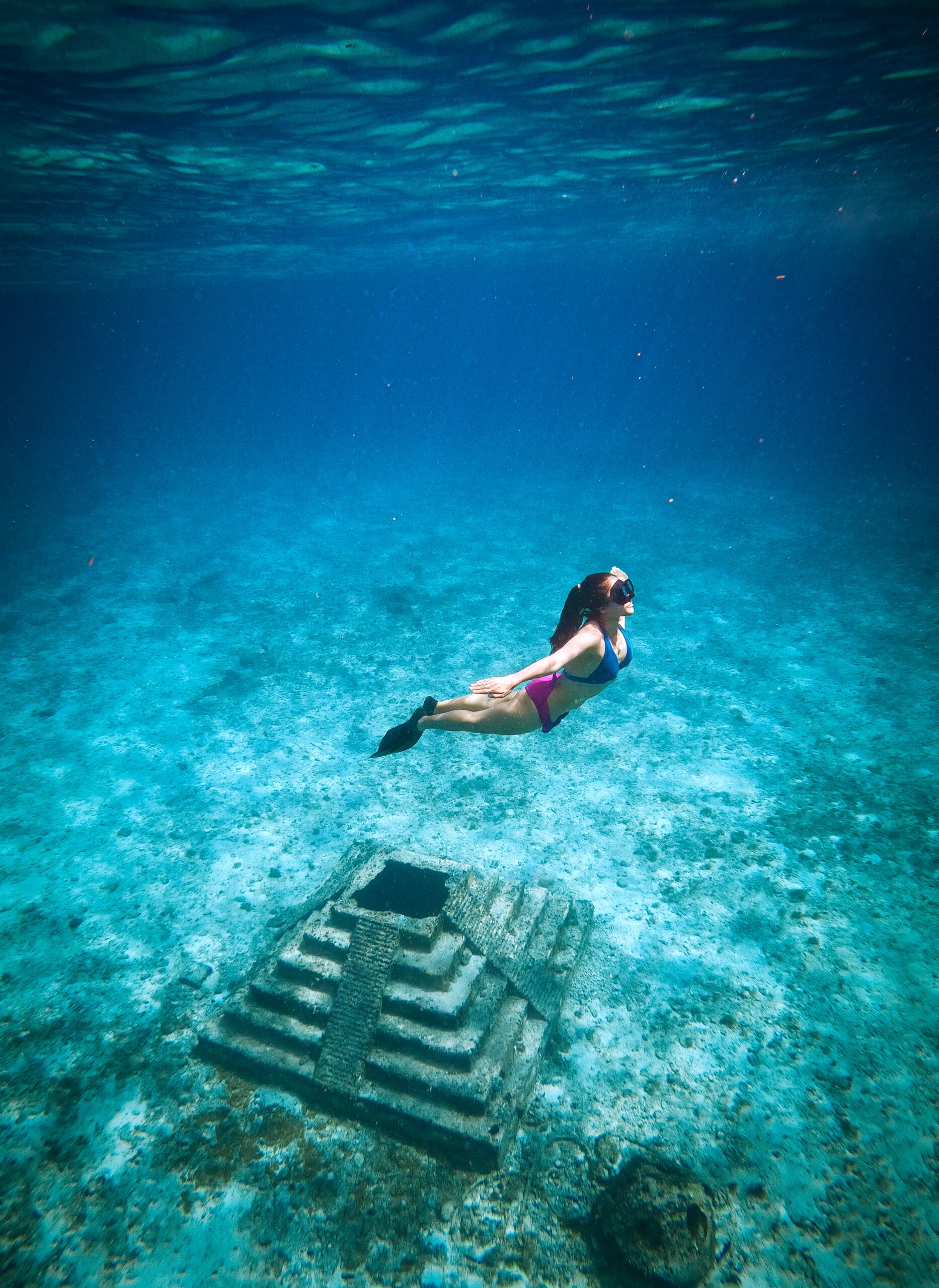
Why Relaxation Matters So Much in Freediving
Imagine trying to conserve fuel while driving with the accelerator pressed halfway down.
That is basically what tension does underwater.
Tense shoulders, frantic kicking and anxious thoughts all consume energy.
Freedivers learn to relax before and during the dive because lower unnecessary effort means slower oxygen consumption.
This is also what makes freediving mentally interesting.
You cannot always overpower discomfort.
Sometimes the most effective response is doing less.
Women Freediving and Confidence in Deep Water
A woman can be physically capable of freediving and still feel nervous in deep water.
That is normal.
Depth removes many familiar reference points.
You might look down and see nothing except blue.
For some beginners, that feels peaceful.
For others, their brain immediately decides there must be a prehistoric sea monster approximately two meters below visibility.
Confidence develops gradually.
Start somewhere controlled.
Use a dive line.
Train with an instructor.
Increase depth slowly.
There is no prize for becoming comfortable faster than everyone else.
Freediving Safety for Women
The fundamental safety rules do not change because the diver is female.
The biggest one is extremely simple:
Never freedive alone.
Freediving can lead to hypoxia, loss of motor control or blackout. DAN recommends formal training and direct supervision by trained freediving buddies or safety divers.
Your buddy should understand freediving safety.
Someone sitting on the boat vaguely aware that you entered the water does not count.
Proper buddy procedures include observing the diver during ascent, meeting them at an appropriate depth and watching them closely after surfacing.
Why Hyperventilation Is Dangerous
Taking a series of aggressive deep breaths before diving may feel like you are “loading up” on oxygen.
You are not.
Hyperventilation mainly reduces carbon dioxide.
That can delay the urge to breathe without providing a comparable increase in oxygen reserves, allowing oxygen levels to fall dangerously low before your body’s warning signals become strong.
Research confirms that hyperventilation can extend apnea duration while delaying involuntary breathing responses, which is precisely why it increases blackout risk.
A certified instructor should teach appropriate preparation breathing and recovery techniques.
Do not learn aggressive breath-hold routines from a random internet challenge.
Best Freediving Environments for Women Beginners
The perfect beginner environment is usually not the deepest one.
Look for:
Warm water
Good visibility
Low current
Easy entry
Calm surface conditions
Qualified instruction
A proper freediving buoy and line
Small training groups
Clear water can make a huge psychological difference.
When you can see the line, instructor and environment around you, the water often feels much less intimidating.
Women Freediving in Cenotes
Cenotes can provide an extraordinary setting for freediving.
Many cenotes in Mexico’s Yucatán Peninsula contain extremely clear freshwater, dramatic limestone formations and protected conditions.
For beginners, that visibility can be beautiful.
For experienced freedivers, deeper cenotes can create spectacular training environments when used with knowledgeable local instructors.
Cenote freediving does require respect for the environment.
Overhead environments, caverns and caves are completely different from open-water recreational freediving and require appropriate specialized training.
A pretty opening in the rock is not an invitation to start exploring underwater tunnels.
Women Freediving in the Mexican Caribbean
The Mexican Caribbean gives freedivers access to two very different environments within the same region.
There is the Caribbean Sea, with warm water, reefs and marine life.
Then inland, there are cenotes with freshwater visibility and limestone landscapes.
That combination makes the region particularly appealing for travelers who want freediving to become part of a larger adventure rather than the only activity during the trip.
One day might involve line training.
Another could mean snorkeling.
Another could involve underwater photography or simply enjoying the reef.
Learning feels considerably less like training when your classroom happens to be tropical water.
Marine Life You May See While Freediving
One of the biggest attractions of recreational freediving is wildlife.
Depending on destination and season, freedivers may encounter:
Tropical reef fish
Sea turtles
Rays
Dolphins
Sea lions
Large schools of fish
Reef ecosystems
Whale sharks in locations where regulated encounters are permitted
Freediving can be particularly rewarding around marine life because you move more quietly than a scuba diver.
There are no continuous bubbles.
That does not mean getting closer is always better.
Good wildlife encounters depend on allowing animals to choose their distance.
Never chase, touch, block or corner marine animals for a photograph.
The moment becomes considerably less magical when the animal is trying to escape you.
Women Freediving for Underwater Photography
Freediving and underwater photography work exceptionally well together.
Without a tank, a freediver can move more naturally through the frame.
Flowing dresses, long fins, sunlight and clear water can create photographs that look almost unreal.
For women interested in underwater modeling or photography, freediving skills also make shoots safer and more controlled.
Instead of repeatedly struggling underwater for an image, you understand how to:
Equalize comfortably
Position your body
Control your buoyancy
Move efficiently
Stay relaxed
Return safely to the surface
The photograph may look effortless.
The technique behind it usually is not.
Freediving as a Solo Hobby Without Diving Alone
This distinction is important.
You can absolutely start freediving without a partner or spouse who shares the hobby.
But you should not freedive alone.
Freediving communities, courses and clubs make it relatively easy to meet trained buddies.
Many women actually enter the sport independently and discover that the community becomes one of their favorite parts of it.
A good freediving group gives you people to train with, travel with and learn from.
It also gives someone permission to tell you when today’s attempt at a personal record is probably not your brightest idea.
How to Start Freediving as a Woman
The safest starting point is a recognized beginner freediving course.
Organizations such as PADI, AIDA, SSI and Molchanovs offer structured entry-level programs.
A proper course should include theory, water skills and safety training.
Before booking, ask:
Which certification is offered?
How experienced is the instructor?
How many students are in each group?
Where does open-water training happen?
Is equipment included?
How are rescue skills taught?
What happens if you cannot equalize?
Is there pressure to meet depth targets?
The last question matters.
A good instructor wants you to develop into a safe freediver.
They do not need you to touch a number on the line just so everybody gets a dramatic Instagram story.
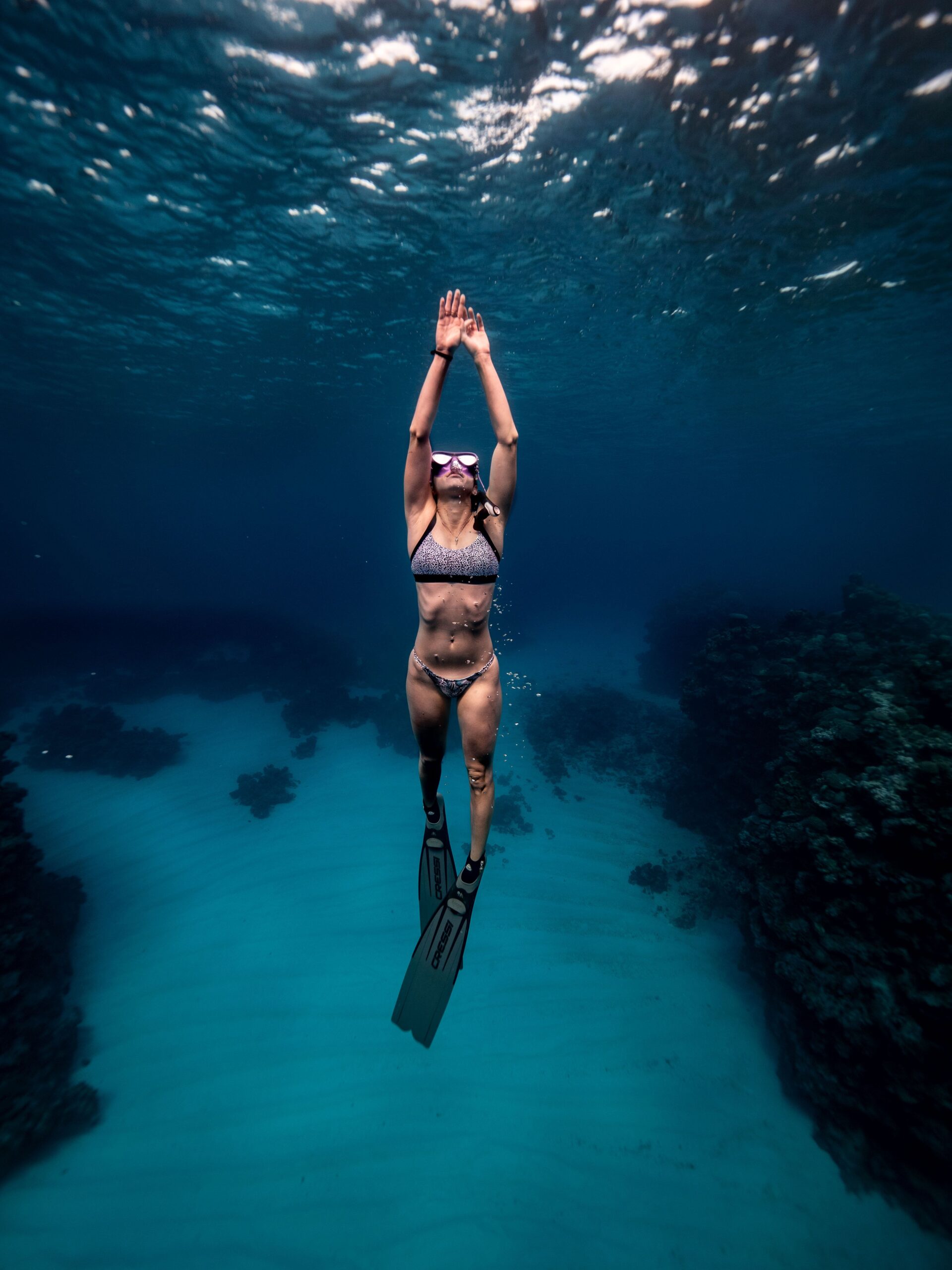
Best Training Tips for Women Freediving
Progress usually comes from consistency rather than dramatic attempts.
Focus on:
Relaxation
Equalization
Streamlining
Technique
Regular water sessions
General fitness
Mobility
Sleep
Hydration
Recovery
Track how training feels, not only the numbers.
Women who menstruate may find it useful to note cycle phase alongside training sessions—not because every month will follow the same pattern, but because personal trends may become visible over time.
Your own data is usually more useful than somebody else’s claim about how you “should” perform.
Does Strength Training Help Women Freedivers?
It can.
Freediving does not require bodybuilding-level strength, but general strength and conditioning can support good posture, finning efficiency and injury resistance.
Useful training may include:
Core stability
Hip strength
Back strength
Shoulder mobility
Leg endurance
Swimming
Aerobic conditioning
The goal is not creating as much muscle tension as possible.
You want a body that is strong enough to move efficiently and relaxed enough not to waste oxygen.
Yoga and Freediving for Women
Yoga and freediving are often paired because both involve breathing awareness, mobility and relaxation.
Gentle mobility work may help with:
Rib cage flexibility
Shoulder mobility
Hip movement
Relaxation
Body awareness
Meditation can also help some freedivers become more comfortable sitting with the sensations created by apnea.
You do not need to become a yogi to freedive.
And you definitely do not need to be flexible enough to fold yourself into luggage.
But learning how to relax deliberately can transfer remarkably well into the water.
What Does Your First Freediving Course Feel Like?
Most beginners arrive wondering whether they can hold their breath long enough.
Then the instructor explains that this is not actually the main problem.
You practice breathing.
You learn safety.
You try static apnea.
You work on equalization.
Then eventually you descend a line.
The first few meters may feel awkward.
Your ears demand attention.
Your fins suddenly seem enormous.
You reach your planned depth, turn and begin ascending.
Then your face breaks the surface.
You breathe.
And something that looked impossible an hour earlier suddenly feels achievable.
That is often the moment people understand why freediving becomes addictive.
Common Mistakes New Female Freedivers Make
Women do not have a completely different collection of beginner mistakes than men.
Most new freedivers make remarkably similar ones.
Trying to Keep Up With Someone Else
Your buddy reaches 15 meters.
You reached 10.
That does not mean today’s dive needs five more meters.
Depth progression is individual.
Ignoring the Cold
Once you become cold, relaxation becomes much harder.
Use adequate exposure protection.
Buying Equipment Too Early
Learn what suits your body and technique first.
Forcing Equalization
Never push through ear pain.
Focusing Only on Breath-Hold Time
Technique and safety matter more.
Treating Discomfort as Failure
Some days simply feel better underwater than others.
That is normal.
Best Time of Year for a Freediving Trip
The ideal season depends on destination.
For a beginner-focused trip, prioritize water conditions rather than chasing the most dramatic wildlife encounter.
| Condition | Why It Helps |
|---|---|
| Warm water | Easier relaxation |
| Good visibility | Increased confidence |
| Low wind | Calmer surface sessions |
| Low current | Easier line training |
| Stable weather | More reliable training days |
| Comfortable water temperature | Longer enjoyable sessions |
If marine life is one of your priorities, season becomes even more important because wildlife encounters often occur during specific migration or feeding periods.
Build the trip around both training conditions and the experience you actually want.
Women-Only Freediving Trips and Training
Some women prefer mixed groups.
Others enjoy women-only training environments.
Neither is inherently better.
A women-focused freediving trip can provide a comfortable environment for discussing things such as wetsuit fit, periods, body confidence and other topics that students may feel less comfortable raising in a mixed group.
It can also create an appealing social dynamic for solo female travelers.
What matters most is instructor quality and safe training.
A women-only course with poor instruction is still a poor course.
Frequently Asked Questions About Women Freediving
Is freediving safe for women?
Yes, when practiced with proper training and appropriate safety procedures. Freediving carries real risks for everyone, including hypoxic blackout, so divers should train with qualified instructors and never freedive alone.
Can women freedive during their period?
Many women can participate normally during menstruation. Individual symptoms such as cramps, migraine, dizziness or fatigue may affect comfort and should guide training decisions.
Does the menstrual cycle affect breath holding?
Possibly. One small study found differences in maximal breath-hold performance between menstrual-cycle phases, but individual responses vary and more research is needed.
Are women naturally better at freediving?
There is no simple answer. Men and women can show physiological differences in factors such as lung volume and oxygen stores, but freediving performance depends heavily on technique, training, relaxation and individual physiology.
Do women need special freediving equipment?
Not necessarily, although many women benefit from wetsuits designed around female body shapes. Masks, fins and most other equipment should be selected primarily according to fit, comfort and technique.
Can a woman start freediving without previous diving experience?
Yes. Entry-level freediving courses are designed for beginners, and organizations such as PADI do not require previous freediving experience to start their standard beginner pathway.
How deep do beginner female freedivers go?
There is no female-specific beginner depth. Training depths depend on the certification program, skill level, equalization and individual comfort. Depth should increase gradually under supervision.
Can you freedive alone once you are experienced?
No. Experience does not remove the risk of hypoxic blackout. Proper freediving requires a trained buddy or safety diver.
Is freediving good for solo female travelers?
It can be an excellent travel activity because courses and freediving communities make it possible to join structured training without arriving with your own partner. You should still always dive with qualified buddies.
Women Freediving: It Is Less About Being Fearless Than Being Comfortable
You do not need to be fearless to become a freediver.
Most people have something that makes them nervous.
Depth.
Dark water.
Equalization.
Holding their breath.
Marine life.
The first time they look down and cannot see the bottom.
The goal is not eliminating every nervous thought before you start.
It is building enough knowledge and experience that the underwater environment gradually stops feeling unfamiliar.
For women freediving, that progression can become one of the most rewarding parts of the sport. You learn how your body responds. You stop comparing your numbers with everyone else’s. You become calmer in the water. Eventually, somewhere between the surface and the bottom of the line, you realize you are doing something that once seemed completely outside your comfort zone.
If you want to make that first experience part of a larger adventure, MExplor can build a Custom Camp around freediving in Mexico, combining professional instruction with cenotes, Caribbean water, marine experiences, snorkeling, diving or underwater photography.
You do not need to arrive as an experienced freediver.
You just need to start at the surface.
