

Zouk Dance: A Beginner’s Guide to Brazilian Zouk, Music and Movement
At first, Zouk dance can be slightly confusing to watch.
One moment, two people are taking what look like relaxed walking steps. A few seconds later, their bodies are moving through waves, turns and changes of direction while the follower’s hair seems to have developed choreography of its own.
It looks fluid.
It looks complicated.
And if you have danced salsa or bachata before, your first instinct may be to ask where the counts went.
Welcome to Brazilian Zouk.
Brazilian Zouk is a partner dance that developed in Brazil from Lambada during the early 1990s. Over time, it grew into an international social-dance style known for flowing movement, elastic partner connection, body isolations, rotations, musical interpretation and distinctive head movements. The name Brazilian Zouk was formally adopted by the dance community in 2006 to distinguish it from the Caribbean musical genre called zouk.
And despite how dramatic advanced dancers can make it look, you do not begin by throwing your head backward while somebody spins you around.
You begin with the basics.
Balance.
Weight transfer.
Connection.
Timing.
Walking.
Learning where your own body is.
The impressive part comes later.
What Is Zouk Dance?
When dancers casually say Zouk dance today, they are usually referring to Brazilian Zouk, a partner dance created in Brazil from the evolution of Lambada.
Brazilian Zouk has recognizable foundations and rhythmic structures, but it also gives dancers considerable freedom to interpret music through changes in timing, body movement and connection. Brazilian ZouK Council
Some of its most recognizable characteristics include:
- Continuous, flowing movement
- Partner connection
- Turns and rotations
- Body isolations
- Waves
- Changes of direction
- Head movement
- Musical interpretation
- Improvisation
The result is a dance that can feel very different depending on the song and the dancers.
One Zouk dance can feel playful and energetic.
Another can look slow and almost meditative.
A third can look as though gravity has become optional.
The underlying technique connects them.
Is Zouk a Brazilian or Caribbean Dance?
This is where the terminology becomes important.
Zouk music and Brazilian Zouk dance do not have the same origin.
The musical genre called zouk developed in the French Caribbean, particularly around Martinique and Guadeloupe.
Brazilian Zouk dance, meanwhile, developed in Brazil from Lambada.
During the late 1980s and early 1990s, Lambada was enormously popular in Brazil. As the musical landscape changed, Lambada dancers began adapting their dancing to other music, including Caribbean zouk. That transition gradually produced a new partner dance.
For years, dancers used several names for the evolving style.
In 2006, dancers and teachers meeting at the Minas Zouk Congress in Belo Horizonte voted to standardize the name Brazilian Zouk. The name became increasingly established internationally in the years that followed.
So the simplest explanation is:
| Zouk | Origin | What It Refers To |
|---|---|---|
| Caribbean Zouk | Martinique and Guadeloupe | Musical genre |
| Lambada | Brazil | Partner dance that helped give rise to Brazilian Zouk |
| Brazilian Zouk | Brazil | Modern partner dance |
| Zouk dance | Common shorthand | Usually Brazilian Zouk in dance communities |
That distinction prevents a lot of confusion.
Where Did Brazilian Zouk Come From?
To understand Zouk, you need Lambada.
Lambada became widely popular in Brazil during the 1980s and gained international attention through music, clubs, television and artists associated with the Lambada boom.
Brazilian dancers eventually began adapting Lambada movement to different styles of music, especially Caribbean zouk music.
The dance changed.
Movements slowed.
New techniques developed.
Teachers in different parts of Brazil began creating their own approaches.
Eventually, the community recognized that the dance had developed an identity distinct enough to need its own name.
In 2014, Larissa Thayane and Kadu Pires founded the Brazilian Zouk Dance Council, which now supports the international community through education, competitions, events and other initiatives designed to preserve and develop the dance.
Today, Brazilian Zouk is danced far beyond Brazil.
You can find communities, festivals, workshops and social dances across North America, Europe, Asia, Australia and Latin America.
A dance that evolved because Brazilian dancers needed new music eventually became one of the most international partner-dance communities around.
What Does Zouk Dance Look Like?
The easiest word is:
Fluid.
Salsa often creates clearer directional patterns and sharper rhythmic changes.
Bachata may use compact partner movement, footwork and body movement.
Zouk tends to create a continuous feeling.
One movement often flows directly into another.
Dancers may rotate.
Bodies may change orientation.
The follower may move through curves and spirals.
Connection may expand and compress.
And instead of returning constantly to a visually obvious basic step, the dancers can appear to move continuously through space.
That is one reason advanced Zouk dance can look so unusual to someone seeing it for the first time.
You may struggle to identify where one “move” finished and another started.
That is often intentional.
Brazilian Zouk vs. Salsa
If you already dance salsa, Zouk can feel both familiar and completely alien.
Both are partner dances with leaders and followers.
Both involve weight transfer, turns, timing and connection.
But the overall movement language differs significantly.
| Brazilian Zouk | Salsa |
|---|---|
| Flowing and circular movement | Often more linear or rotational depending on style |
| Elastic connection | Generally more structured partner frame |
| Extensive body movement | Greater emphasis on steps and turn patterns |
| Head movement can be incorporated | Head movement is not central |
| Wide variety of music used socially | Salsa music provides a clearer genre foundation |
| Timing can feel highly interpretive | Strong rhythmic timing structure |
| Often continuous and wave-like | Often sharper rhythmic changes |
Salsa dancers sometimes arrive at Zouk assuming they can simply learn a few new patterns.
Then Zouk politely informs them that their entire relationship with posture and connection is about to become a project.
Existing dance experience helps.
It just does not eliminate the learning curve.
Zouk Dance vs. Bachata
This comparison is even more common because both dances can look fluid and intimate.
But they are not the same.
Modern or sensual bachata often uses body waves, isolations and close partner connection.
Brazilian Zouk also uses these elements, but its movement vocabulary and connection system developed from a different dance history.
| Zouk Dance | Bachata |
|---|---|
| Developed from Lambada | Originated in the Dominican Republic |
| Often uses flowing rotational movement | Built around bachata rhythm and basic |
| Extensive head-movement vocabulary | Head movement appears mainly in modern/sensual styles |
| Elastic connection is central | Connection varies by bachata style |
| Danced to many contemporary genres | Primarily danced to bachata music, with fusion exceptions |
| Can cover significant space | Often more compact |
If you enjoy sensual bachata because you like body movement and musical interpretation, you may find Zouk particularly interesting.
Just do not expect your bachata body wave to automatically solve everything.
Zouk has its own mechanics.

What Music Do You Dance Zouk To?
One of the most interesting things about modern Brazilian Zouk is that dancers are not restricted to one musical genre.
Historically, Caribbean zouk music played an important role in the dance’s development.
Modern social dancers also use music such as:
- R&B
- Pop
- Electronic music
- Downtempo tracks
- Acoustic music
- Remixes
- Brazilian music
- Contemporary songs
The Brazilian Zouk Dance Council notes that the dance evolved as Lambada dancers adapted to new musical choices, and this willingness to interpret different music has remained part of the culture. Brazilian ZouK Council
For dancers, that versatility can be addictive.
You hear a song you already know from outside the dance world.
Then somebody plays a Zouk remix.
Suddenly you are reconsidering the entire song.
What Is the Basic Step in Zouk Dance?
Brazilian Zouk has foundational rhythmic patterns, although the exact way they are taught can vary by methodology and style.
Beginners typically work first on:
- Weight transfer
- Basic rhythm
- Walking
- Posture
- Partner connection
- Direction changes
- Lateral movements
- Simple turns
The important word is weight.
A lot of Zouk depends on understanding where your body’s weight is and when it changes.
If your weight is accidentally spread across both feet while your partner thinks you are ready to move, things become confusing remarkably quickly.
This is why beginners spend time doing movements that may not look dramatic at all.
Those foundations eventually create the freedom that makes advanced Zouk appear effortless.
What Is Zouk Connection?
Connection is the communication system between partners.
The leader does not simply push the follower into shapes.
The follower does not memorize what happens next.
Information travels through the dancers’ frame, body positioning, movement, direction and changing levels of tension.
Brazilian Zouk is often described as having an elastic connection because that connection can expand, contract and change dynamically throughout the dance.
Imagine a conversation where the volume constantly changes but neither person stops listening.
That is closer to the idea.
A good leader creates clear information.
A good follower remains responsive while maintaining their own balance and movement.
Neither partner is furniture.
Leader and Follower Roles in Zouk Dance
Like salsa and bachata, Brazilian Zouk commonly uses leader and follower roles.
Either gender can learn either role.
The leader proposes movement.
The follower interprets and responds.
Both dancers remain responsible for:
- Their own balance
- Posture
- Timing
- Body control
- Safety
- Connection
Advanced Zouk can look as though the leader is physically manipulating the follower’s entire body.
Good technique is much subtler.
The goal is communication, not force.
That distinction becomes especially important once dancers begin learning upper-body and head movements.
Why Does Zouk Have So Much Body Movement?
Zouk uses the torso as part of the dance language.
Instead of treating the body as one fixed block sitting above the legs, dancers learn how different areas move independently and in sequence.
Training may include awareness of the:
- Chest
- Rib cage
- Hips
- Spine
- Shoulders
- Head
- Pelvis
Those individual actions can eventually connect into waves, curves and spirals.
This takes time.
Watching an advanced dancer makes the movement look spontaneous.
Learning it can initially feel like receiving five instructions for five different body parts and realizing your brain has only prepared for two.
That phase passes.
Usually.
Head Movement in Zouk Dance
Head movement is one of the most recognizable features of Brazilian Zouk.
It is also one of the parts beginners should not try to copy casually from videos.
Proper Zouk head movement is connected to:
- Body alignment
- Direction
- Torso movement
- Balance
- Partner communication
- Controlled pathways
It is not simply tossing the head backward or drawing circles with the neck.
Good instruction progresses gradually because careless head movement can create unnecessary strain and disorientation.
A beginner should first develop posture, balance and basic connection.
Then head movement can be introduced through controlled technique.
The hair flying dramatically across the dance floor is the visual result.
It is not the technique.
Is Zouk Dance Sensual?
It can be.
But “sensual” does not fully describe the dance.
Brazilian Zouk can feel:
- Romantic
- Playful
- Dramatic
- Energetic
- Emotional
- Soft
- Powerful
- Experimental
The feeling changes according to the music and dancers.
Like sensual bachata, Zouk sometimes uses closer physical connection. But proximity does not automatically make a social dance romantic or sexual.
Dance connection is still dance communication.
Dancers should respect each other’s comfort, boundaries and preferred level of connection.
A visually intimate dance can still be completely social.
Consent and Boundaries in Zouk
This deserves attention because Zouk includes movements involving the upper body and sometimes close positioning.
A partner’s body is never something you simply reposition because you learned a new technique in class.
Good social dancing means adapting.
If your partner prefers more space, use more space.
If someone does not want certain head or body movements, those movements do not happen.
Experienced dancers often communicate comfort through positioning and connection, but verbal communication is perfectly appropriate when needed.
The goal is for both people to enjoy the dance.
Not for one person to complete their latest combination at all costs.
Is Zouk Dance Difficult?
The basics can be accessible.
Mastery takes time.
Zouk asks dancers to develop several skills simultaneously:
- Timing
- Balance
- Weight transfer
- Connection
- Body movement
- Rotation
- Musicality
- Spatial awareness
This can make the beginning feel slower than some partner dances.
You may learn enough salsa steps in one class to recognize what you are doing.
With Zouk, the quality of the movement itself matters heavily.
That means there can be an awkward period where you understand the instructions intellectually but your body is still reviewing the proposal.
Keep going.
Can Complete Beginners Learn Zouk?
Yes.
You do not need salsa, bachata or Lambada experience first.
A beginner Zouk course should progressively introduce the fundamentals rather than assuming previous partner-dance knowledge.
A sensible progression may look like:
| Stage | Main Focus |
|---|---|
| First lessons | Rhythm, posture and weight transfer |
| Beginner | Basic steps, connection and simple turns |
| Developing beginner | Rotations, body awareness and musicality |
| Improver | Body movement and more dynamic connection |
| Intermediate | Head movement, complex transitions and interpretation |
| Advanced | Greater control, improvisation and stylistic freedom |
The exact order depends on the teaching methodology.
What should not happen is:
Lesson one: dramatic neck movement because it looked cool on Instagram.
There is plenty of time for dramatic hair later.
Do You Need to Be Flexible to Dance Zouk?
No.
Flexibility can expand certain possibilities, but it is not a requirement for learning Brazilian Zouk.
Good technique should work within your available range of movement.
Beginners benefit much more from developing:
- Balance
- Coordination
- Mobility
- Body awareness
- Relaxation
- Posture
- Control
Trying to imitate an extremely flexible professional dancer by forcing your range does not make the movement more authentic.
It just makes tomorrow morning more interesting.
Do You Need a Partner to Learn Zouk?
No.
Many classes rotate partners.
In fact, partner rotation is useful because it prevents you from learning to respond only to one person’s habits.
You can also practice several important elements alone:
- Weight transfer
- Basic rhythm
- Body isolations
- Posture
- Turns
- Mobility
- Musicality
Eventually, of course, partner connection requires another human.
Preferably one who also knows you are practicing Zouk.
What Is a Zouk Social?
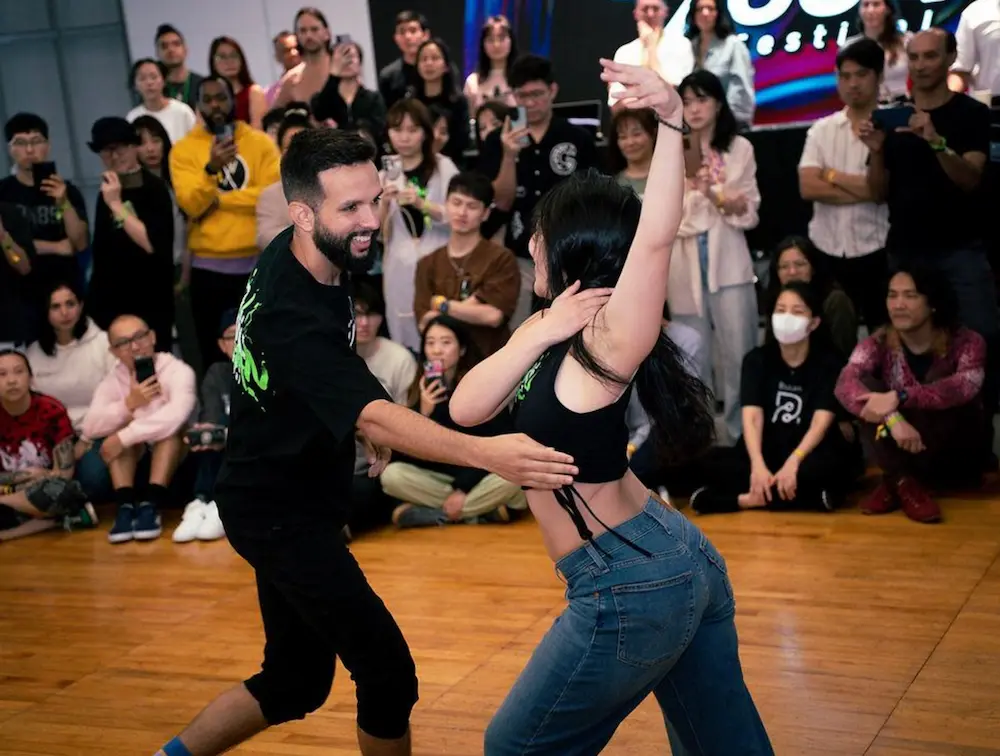
A Zouk social is an event where dancers gather primarily to social dance.
Unlike a choreography class, the dancing is improvised.
You do not know exactly what sequence will happen.
The leader responds to the music.
The follower responds to the lead.
Both adjust to each other.
Partners normally change throughout the evening.
This makes social dancing one of the most important parts of learning.
Classes teach vocabulary.
Socials teach conversation.
You quickly discover that doing a movement with your instructor is not exactly the same as leading or following it with someone you met 40 seconds ago.
Useful discovery.
Zouk Classes vs. Zouk Social Dancing
Both are essential if you want to improve.
Classes Help You Learn
Classes give you:
- Technical explanations
- Structured progression
- Corrections
- Practice exercises
- New vocabulary
Social Dancing Helps You Apply It
Socials give you:
- Different partners
- Unfamiliar music
- Real-time improvisation
- Floorcraft
- Adaptability
A dancer who only takes classes may accumulate lots of combinations without learning how to comfortably use them.
A dancer who only attends socials may repeat the same habits without correction.
Mixing both usually works better.
Brazilian Zouk Styles
As Brazilian Zouk evolved internationally, different teachers and communities developed recognizable approaches and influences.
You may encounter names such as:
- Traditional Zouk
- Rio Zouk
- Neo Zouk
- SoulZouk
- Lambazouk
- Modern or fusion approaches
These categories can overlap, and terminology is not always used identically by every community.
The important thing for beginners is not choosing a Zouk identity on day two.
Learn solid fundamentals first.
Then explore.
The Brazilian Zouk Dance Council exists partly to preserve the dance’s recognizable foundation while supporting its development internationally.
Zouk Dance and Musicality
Musicality is one of the reasons experienced Zouk dancers can look so different from beginners even when both know the same basic movements.
A beginner hears:
song.
An experienced dancer may hear:
bass.
voice.
melody.
percussion.
pause.
build.
drop.
Different movements can emphasize different layers.
One moment may call for a simple walk.
Another may invite a rotation.
Another may almost stop completely.
This freedom is one reason Zouk works well with such a wide range of contemporary music.
The music changes.
The dance adapts.
What Should You Wear to a Zouk Class?
Comfort first.
Zouk requires freedom of movement, especially through the torso and hips.
Good options include:
- Lightweight tops
- Comfortable pants
- Leggings
- Flexible skirts
- Dancewear
- Clothing that allows torso movement
Shoes vary widely.
Many Zouk dancers prefer:
- Dance shoes
- Smooth-soled shoes
- Dance sneakers
- Socks in appropriate studio settings
- Barefoot dancing where the venue allows it
For your first class, use something secure and comfortable.
Avoid footwear that aggressively grips the floor because Zouk involves significant turning and rotation.
Your shoes should help you dance.
Not anchor you to the building.
Zouk for Salsa and Bachata Dancers
Already dance salsa or bachata?
You have some advantages.
You understand:
- Partner roles
- Social-dance etiquette
- Weight transfer
- Timing
- Asking strangers to dance without making it weird
But you may also bring habits that need adjusting.
Salsa dancers may need to soften certain patterns or rethink connection.
Bachata dancers may recognize body movement but need to learn very different mechanics.
That crossover is part of the fun.
Learning another partner dance usually reveals how many things you thought were universal were actually just rules from the first dance you learned.
Zouk Dance for Couples
Zouk can be a great couples activity because connection is such an important part of the dance.
You learn to communicate movement rather than simply memorize matching choreography.
Private lessons can be particularly useful for couples because the instructor can work directly on:
- Connection
- Timing
- Leading
- Following
- Balance
- Shared movement
But couples do not need to dance exclusively together.
Rotating partners can improve technique because each person learns to communicate more clearly.
Whether you rotate is entirely up to the class format and your preferences.
Zouk Dance for Solo Travelers
Partner dancing is one of the easiest activities to join alone.
You do not need to arrive with a partner.
At classes and socials, partner rotation naturally introduces you to people.
This makes dance particularly useful while traveling.
Instead of sitting in a bar wondering how everyone apparently already knows each other, you enter a class where interaction is built into the activity.
Five minutes later, you have already met six people.
Admittedly, you may only remember three names.
Still counts.
Zouk Dance as a Travel Experience
Taking a dance class while traveling lets you interact with a destination differently.
Your trip stops being only about places.
It becomes about communities.
You can spend the day:
Exploring a city.
Swimming.
Visiting a cenote.
Eating local food.
Then spend the evening learning or social dancing.
For travelers who already enjoy salsa and bachata, trying Zouk dance adds another layer to that experience.
You begin finding studios, socials and festivals that would never appear on a normal tourism itinerary.
Zouk Dance in Mexico
Brazilian Zouk has become part of the broader social-dance landscape in Mexico, particularly in cities and destinations with established Latin-dance communities.
MExplor itself includes Zouk dancing alongside salsa and bachata within its dance offerings in Mexico and other destinations. Its current dance program lists locations including Cancún, Playa del Carmen, Puerto Morelos, Tulum, Mexico City and Los Cabos, among others. MExplor Travel
For travelers, private instruction can make sense when local group schedules do not match the vacation.
Instead of finding a weekly course that began six weeks before you arrived, you can start at your actual level.
Zouk Dance in the Mexican Caribbean
The Mexican Caribbean already attracts people for beaches, nightlife, diving, cenotes and adventure.
Dance fits surprisingly naturally into that mix.
A day could involve:
Morning: Caribbean water or cenote
Afternoon: Relaxation or exploring town
Early evening: Zouk lesson
Night: Social dancing or dinner
This is especially useful for couples or solo travelers who want something active in the evening but are not interested in spending every night inside a traditional nightclub.
It also works when tropical weather decides your planned outdoor activity is no longer happening.
Rain outside?
Excellent.
There is a dance floor inside.
Salsa, Bachata or Zouk: Which Should You Learn?
There is no correct answer.
It depends on what you enjoy.
| Dance | You Might Like It If You Enjoy… |
|---|---|
| Salsa | Energy, rhythm, turns and lively social dancing |
| Bachata | Connection, romantic music and accessible basics |
| Zouk | Flow, musical interpretation and body movement |
If you love energetic music and fast partnerwork, salsa may grab you first.
If you prefer slower partner connection, bachata may feel immediately accessible.
If you enjoy fluidity, contemporary music and movement exploration, Zouk dance may become your new problem.
And yes, you can learn all three.
This is how dance shoes begin multiplying in your luggage.
How Long Does It Take to Learn Zouk?
You can understand basic movements fairly quickly.
Feeling comfortable takes longer.
Becoming very good takes years.
That is normal.
Progress depends on:
- Class frequency
- Social dancing
- Practice
- Previous dance experience
- Body awareness
- Quality of instruction
- Consistency
Do not judge progress only by how many advanced movements you know.
Better indicators include:
- Improved balance
- Clearer connection
- Better timing
- More relaxed movement
- Greater musical awareness
- Increased comfort with different partners
Those improvements are less flashy.
They are also what makes advanced dancing possible.

Common Zouk Dance Mistakes for Beginners
Trying Head Movements Too Soon
Build alignment and body control first.
Memorizing Moves Instead of Learning Connection
Your partner cannot see the choreography stored inside your brain.
The lead still needs to work.
Dancing Too Big
Control comes before range.
Forcing the Follower
Zouk is based on communication, not physical manipulation.
Ignoring Your Own Balance
Your partner should not be responsible for keeping you upright.
Trying to Look Advanced
This one affects nearly every social dance.
Simple movement done comfortably will usually feel much better than advanced movement done badly.
How to Improve Your Zouk Dance Faster
Consistency wins.
A useful learning mix includes:
- Regular classes
- Solo body-awareness practice
- Social dancing
- Listening to Zouk sets
- Basic mobility work
- Occasional private lessons
- Video review
- Dancing with different partners
Do not spend all your practice time learning new movements.
Repeat basics.
Then repeat them again.
Advanced dancers often look advanced because their fundamentals are excellent, not because they possess a secret catalog containing 600 more moves than everyone else.
Is Zouk Dance Safe?
Yes, when taught and practiced responsibly.
But certain advanced movements require proper technique.
This is particularly relevant for:
- Head movement
- Deep inclinations
- Large rotations
- Off-axis movement
- Dips
These should be learned progressively.
A partner should never force another person’s head, neck, spine or range of motion.
If something hurts, stop.
Pain is not evidence that you have finally discovered authentic Brazilian movement.
It is your body asking a fairly clear question.
What Makes a Good Zouk Instructor?
Look beyond impressive performance videos.
A good instructor should be able to explain:
- Weight transfer
- Connection
- Posture
- Movement mechanics
- Safety
- Lead and follow technique
- Musicality
- Progressive head-movement technique
The instructor should also adjust material to the student’s level.
Being an excellent performer and being an excellent teacher are related skills.
They are not identical skills.
The person who can execute a spectacular movement should also be able to explain why your first version should be much smaller.
Private Zouk Classes vs. Group Classes
Both have advantages.
| Private Zouk Classes | Group Zouk Classes |
|---|---|
| Personalized corrections | Social atmosphere |
| Learn at your speed | Meet other dancers |
| Focus on specific goals | Practice with different partners |
| Excellent for travelers | Usually lower cost |
| Useful for couples | Good preparation for socials |
| Faster technical feedback | Structured community learning |
Travelers often benefit from private classes because schedules can be adapted around the trip.
Local dancers may benefit more from a regular group program combined with socials.
Ideally, serious students eventually use both.
Frequently Asked Questions About Zouk Dance
What is Zouk dance?
Zouk dance usually refers to Brazilian Zouk, a partner dance that developed in Brazil during the early 1990s from Lambada. It is known for fluid movement, partner connection, body movement, rotations and musical interpretation. Brazilian ZouK Council
Is Zouk from Brazil?
Brazilian Zouk dance is from Brazil. The zouk musical genre that influenced its development comes from the French Caribbean. These are related historically but should not be confused. Brazilian ZouK Council
Is Zouk the same as Lambada?
No. Brazilian Zouk evolved from Lambada, but it developed into a distinct partner dance with its own techniques and international community. Brazilian ZouK Council
Is Zouk similar to bachata?
There are visual similarities, especially when comparing Zouk with sensual bachata, because both may use body movement and close connection. Their origins, music, technique and movement structures are different.
Is Zouk difficult for beginners?
Beginners can learn Zouk, but fluid connection and advanced body movement take practice. Good courses build progressively from posture, timing and basic weight transfer.
Do I need a partner for Zouk classes?
No. Many group classes rotate partners, and private lessons can be taken individually.
What music is used for Zouk dance?
Modern Brazilian Zouk can be danced to zouk music as well as pop, R&B, electronic, acoustic and other contemporary music. The dance’s musical adaptability developed as dancers moved beyond the original Lambada repertoire. Brazilian ZouK Council
Is Zouk a sensual dance?
It can be sensual, but that is only one expression of the style. Zouk can also be playful, energetic, dramatic or soft depending on the music and dancers.
Why do Zouk dancers move their heads?
Controlled head movement is part of Brazilian Zouk’s movement vocabulary. It should be learned progressively with proper alignment and technique rather than copied by throwing the head around.
Can salsa and bachata dancers learn Zouk?
Yes. Previous partner-dance experience can help with timing, connection and social-dance skills, although Zouk uses its own techniques that still need to be learned.
Can I learn Zouk in Mexico?
Yes. Zouk communities and instruction exist in Mexico, and MExplor currently includes Zouk alongside salsa and bachata in its dance offerings in several Mexican destinations.
Why Zouk Dance Becomes Addictive
At first, you learn steps.
Then you learn connection.
Then you realize the music can be interpreted in far more ways than you thought.
That is when Zouk dance becomes interesting.
The goal stops being:
What move comes next?
Instead, it becomes:
What does this moment in the music feel like?
Two dancers can hear the same song and create something completely different.
They can dance together again five minutes later and create something different again.
That freedom is one of Brazilian Zouk’s biggest attractions.
It combines technique with improvisation.
Structure with creativity.
Connection with individual expression.
And once you become comfortable enough to stop thinking about every movement, the dance begins to feel as fluid as it looked when you first saw it.
Learn Zouk With MExplor
If you want to add dance to your trip through Mexico or the Caribbean, MExplor offers Zouk alongside salsa and bachata within its dance experiences, with private instruction available in multiple destinations. MExplor Travel
Beginners can start with the fundamentals.
Experienced partner dancers can work on connection, body movement and musicality.
Couples can learn together.
Solo travelers do not need to arrive with a partner.
And if you want dance to become more than one class, it can also be incorporated into a broader MExplor dance or custom travel experience.
You do not need flexibility.
You do not need previous Zouk experience.
And you definitely do not need to arrive ready for the dramatic hair movements.
Start with the basic. Learn the connection. Let the flow come later.
Also you are interested
Danza de los Viejitos de Michoacán: máscaras, zapateado y mucha alegría
Pensar en Michoacán es traer a la mente mariposas monarca, carnitas, corundas, pueblos mágicos, el auténtico día de muertos y, ¡cómo no! La tradicional Danza de los Viejitos. Michoacán es

Couples Vacation Packages
Couples Vacation Packages in Mexico: Romantic Caribbean Experiences Couples Vacation Packages: The Perfect Romantic Getaway in Mexico If you’re looking for a mix of romance,

Unveiling Puerto Morelos’ Hidden Gems: Top Scuba Diving Shops
Dive into Adventure: Top Scuba Shops in Hidden Puerto Morelos!
