

Freediving may look simple from the surface: take a breath, descend beneath the water and return without using a scuba tank. In reality, efficient and safe freediving depends on a combination of technique, relaxation, equalization, body awareness, swimming efficiency and disciplined safety procedures.
That is exactly what freedive training is designed to develop.
A good freediving program is not simply about holding your breath longer or reaching a greater depth. It teaches you how your body responds to immersion, pressure and breath-holding while helping you become more relaxed and efficient underwater.
For beginners, proper training can transform an uncomfortable breath hold into a controlled experience. For experienced freedivers, structured training can improve technique, conserve oxygen, refine equalization and make dives feel smoother.
Whether your goal is recreational freediving, underwater photography, marine-life encounters, spearfishing, competition or simply becoming more comfortable beneath the surface, learning how to train correctly is one of the most important steps.
What Is Freedive Training?
Freedive training is the structured practice of the physical, technical and mental skills required to dive underwater while holding a single breath.
Training normally combines several areas:
- Breathing awareness and relaxation
- Breath-hold technique
- Equalization
- Finning efficiency
- Streamlining and body position
- Static apnea
- Dynamic apnea
- Open-water depth training
- Free immersion
- Constant-weight diving
- Surface recovery
- Buddy procedures
- Rescue skills
- Mental preparation
- General fitness and mobility
Unlike casual snorkeling, freediving training also teaches divers how to recognize and manage the specific risks associated with breath-hold diving.
Divers Alert Network emphasizes two particularly important principles: never practice breath-hold diving alone and do not intentionally hyperventilate before a dive. Hyperventilation can reduce carbon dioxide levels and delay the normal urge to breathe even while oxygen continues to fall.
Why Freedive Training Is Important
Some people begin freediving by simply seeing how long they can stay underwater. That approach overlooks many of the skills that make freediving safer and more enjoyable.
Formal training helps develop efficiency rather than simply encouraging greater effort.
Better underwater efficiency
Every unnecessary movement consumes oxygen.
Poor finning, tense shoulders, incorrect body position and rushed descents can all increase energy use. Proper technique helps the freediver move through the water with less resistance and less effort.
Improved relaxation
Relaxation is one of the fundamental skills in freediving.
A tense diver generally consumes more energy and may find both breath-holding and equalization more difficult. Training helps divers recognize unnecessary muscular tension and develop calmer preparation routines.
More effective equalization
Pressure increases quickly during the first meters of descent.
Learning to equalize comfortably and early is essential for protecting the ears and sinuses while maintaining a relaxed descent.
Depth should never be forced when equalization is uncomfortable.
Better understanding of your body
Freedive training teaches you to distinguish normal sensations from warning signs.
A trained freediver becomes more familiar with:
- The urge to breathe
- Changes in buoyancy
- Equalization difficulty
- Fatigue
- Stress
- Cold
- Current
- Surface recovery
The objective is not to ignore these signals but to understand them and respond appropriately.
Stronger safety habits
Good freediving training develops habits that should remain part of every future dive.
These include proper buddy supervision, dive planning, adequate recovery between dives and knowing how to respond if another diver experiences a problem.
Main Types of Freedive Training
Freedivers usually combine several training environments and disciplines.
| Training Type | Main Purpose | Typical Environment |
|---|---|---|
| Static apnea | Relaxation and breath-hold awareness | Pool or controlled water |
| Dynamic apnea | Underwater swimming efficiency | Swimming pool |
| Dynamic no fins | Technique and whole-body efficiency | Swimming pool |
| Free immersion | Equalization and controlled depth progression | Open water |
| Constant weight | Depth diving with fins | Ocean, lake or deep freshwater |
| Constant weight no fins | Technique and efficiency without fins | Open water |
| Equalization practice | Improve pressure-management technique | Dry land and controlled water |
| Mobility and flexibility | Improve comfort and body positioning | Dry land |
| Safety training | Buddy supervision and rescue skills | Pool and open water |
Competitive freediving organizations recognize disciplines including static apnea, dynamic apnea, constant weight, constant weight without fins and free immersion.
However, recreational freedivers do not need to approach training as a competition. Many people train primarily to become more comfortable and efficient while exploring reefs, cenotes and other underwater environments.
Static Apnea Training
Static apnea involves holding your breath while remaining still, normally at the surface in controlled water.
It is commonly used to develop:
- Relaxation
- Breath-hold awareness
- Mental control
- Familiarity with carbon dioxide buildup
- Recovery techniques
Static apnea is not simply a test of how long someone can hold their breath.
Good static training focuses on relaxation and awareness rather than constantly trying to achieve personal records.
Any breath-hold training performed in water requires direct supervision from a properly trained buddy.
Dynamic Apnea Training
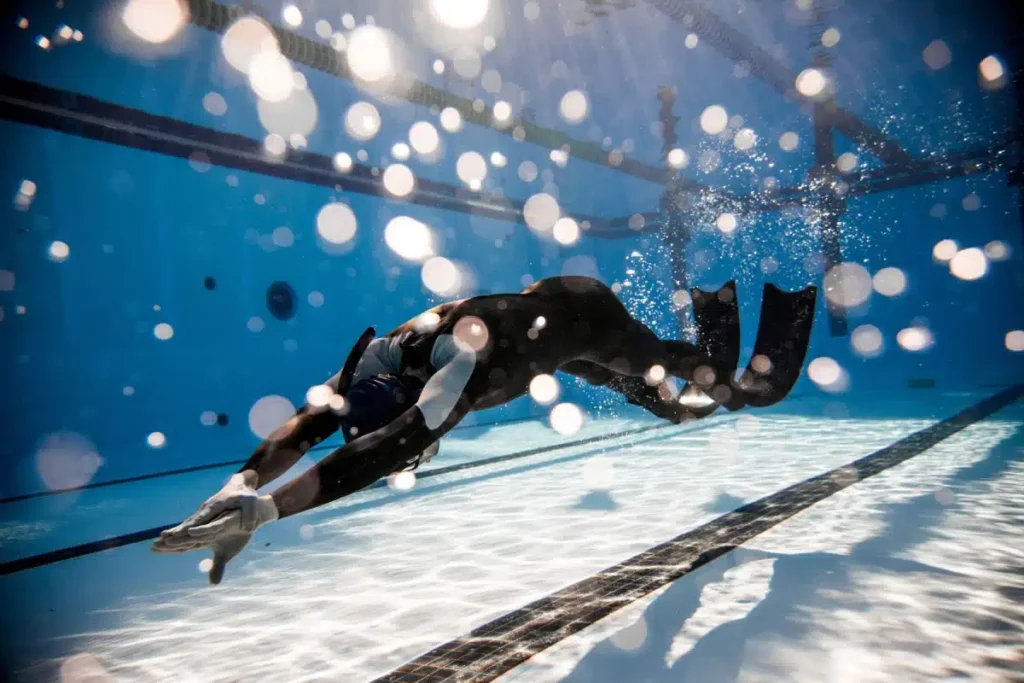
Dynamic apnea involves swimming horizontally underwater, usually in a swimming pool.
It can be performed with fins or without fins.
Dynamic training develops several skills that transfer directly to open-water freediving:
- Streamlining
- Finning technique
- Movement efficiency
- Relaxed underwater swimming
- Pace control
- Turns
- Body awareness
Because distance is easy to measure in a pool, dynamic apnea also provides a controlled environment for evaluating technique.
Beginners should focus on efficient movement instead of chasing distance.
Open-Water Freedive Training
Open-water training introduces depth, pressure and changing buoyancy.
Training usually takes place using a vertical dive line attached to a buoy or platform.
Depending on the course and training level, a session may include:
- Duck dives
- Proper descent technique
- Equalization
- Free immersion
- Constant-weight dives
- Streamlining
- Turns
- Controlled ascents
- Surface recovery
- Buddy safety procedures
Open-water freediving introduces variables that do not exist in a swimming pool, including waves, current, visibility, water temperature and depth.
For that reason, training conditions should always be considered when deciding how challenging a session should be.
Equalization Training for Freediving
Equalization is one of the most important technical elements of freediving.
As a diver descends, increasing water pressure compresses the air spaces in the middle ears and sinuses. Equalization adds air to these spaces to balance the increasing external pressure.
Freedivers generally need to equalize more frequently during descent than many beginner divers initially expect.
Why early equalization is important
Waiting until you feel pain or strong pressure makes equalization more difficult.
A better approach is to equalize gently and frequently before discomfort develops.
If equalization stops working:
- Stop the descent.
- Move slightly shallower if necessary.
- Relax.
- Try again gently.
- End the dive if comfortable equalization cannot be restored.
Pain should never be treated as something that must be pushed through.
Common equalization techniques
Many beginning freedivers initially use the Valsalva technique, but deeper freediving commonly requires more efficient techniques such as Frenzel equalization.
Advanced freedivers may later learn techniques such as mouthfill for deeper diving.
These techniques are best learned with a qualified instructor because small changes in tongue, throat and airway position can make a large difference.
Breathing and Relaxation in Freedive Training
Many beginners assume that the secret to freediving is taking extremely large or rapid breaths before entering the water.
It is not.
Controlled, natural breathing and relaxation are much more important than aggressive breathing routines.
DAN specifically warns against hyperventilation because lowering carbon dioxide can suppress the urge to breathe without preventing oxygen levels from falling. This can increase the risk of losing consciousness underwater.
Good training focuses on calm preparation rather than excessive ventilation.
Relaxation techniques may include:
- Comfortable diaphragmatic breathing
- Releasing tension from the shoulders and jaw
- Relaxing facial muscles
- Slowing unnecessary movement
- Mental visualization
- Developing a repeatable pre-dive routine
The goal is to begin a dive calm rather than overstimulated.
Freedive Training and the Mammalian Dive Response
Humans have physiological responses that help conserve oxygen during immersion and breath-holding.
Collectively, these responses are often called the mammalian dive response.
During immersion and apnea, the body can respond through mechanisms including changes in heart rate and peripheral circulation.
Freedive training does not give a person a completely new physiology. Instead, regular training helps the diver become more comfortable with breath-holding sensations and more efficient in the way the available oxygen is used.
This is one reason relaxation and technique can make such a large difference.
Pool Training vs. Open-Water Training
Both environments are useful, but they serve different purposes.
| Pool Freedive Training | Open-Water Freedive Training |
|---|---|
| Controlled environment | Real depth and pressure |
| Good for static apnea | Essential for depth adaptation |
| Ideal for dynamic apnea | Develops vertical technique |
| Easy to measure distance | Develops equalization under pressure |
| Usually no current or waves | Conditions may vary |
| Useful for technique practice | Includes buoyancy changes |
| Accessible year-round in many places | Often influenced by weather |
A balanced freediving program usually incorporates both.
Pool training develops efficiency and control, while open-water training teaches the skills required for depth.
What to Expect From a Beginner Freediving Course
A professional freediving course should involve far more than attempting a long breath hold.
Typical courses include:
Theory
Students learn about subjects such as:
- Freediving physiology
- Pressure
- Equalization
- Breathing
- Buoyancy
- Equipment
- Safety
- Rescue
- Dive planning
Confined-water training
Pool or shallow-water sessions introduce skills such as:
- Relaxation
- Static apnea
- Dynamic apnea
- Buddy procedures
- Recovery breathing
- Rescue techniques
Open-water training
Students then practice depth-related skills including:
- Duck diving
- Equalization
- Descent technique
- Free immersion
- Constant weight
- Turning at depth
- Controlled ascent
- Surface procedures
PADI describes its Freediver program as including knowledge development plus confined- and open-water sessions. Its current FAQ notes that a full beginner course may take approximately two to three days or longer, depending on the student, with a recommended course duration of about 15 hours.
The exact structure and certification requirements vary among training organizations.
Freediving Course vs. Training Yourself
Online videos can be useful for understanding terminology and reviewing technique, but they should not replace professional instruction.
| Self-Directed Learning | Professional Freedive Training |
|---|---|
| Useful for theory | Includes direct technique correction |
| Convenient | Includes safety procedures |
| Can supplement training | Provides supervised water sessions |
| Limited feedback | Instructor observes mistakes |
| No professional rescue supervision | Includes structured buddy training |
| Easy to develop poor habits | Builds standardized procedures |
One of the most valuable parts of an in-person course is feedback.
An instructor may immediately notice problems with body position, finning, equalization or relaxation that the student does not recognize.
Freedive Training Equipment
You do not need the most expensive freediving equipment to begin training.
Basic equipment normally includes:
Low-volume mask
A low-volume freediving mask requires less air for equalization at depth than many large scuba masks.
Snorkel
A simple snorkel allows relaxed surface breathing before recreational dives.
Freediving fins
Long fins can provide efficient propulsion when used correctly.
Beginners should remember that good technique is more important than fin stiffness or price.
Wetsuit
A wetsuit provides thermal protection and contributes to buoyancy.
Thickness should match the local water temperature.
Weight belt
Weights may be used to compensate for wetsuit buoyancy.
Correct weighting is an important safety consideration. DAN notes that excessive weighting can create additional risk, particularly if a diver experiences a loss of consciousness.
Dive computer
Many freedivers use computers capable of tracking:
- Depth
- Dive time
- Surface interval
- Water temperature
- Number of dives
Buoy, line and lanyard
Structured depth training normally uses a dedicated freediving buoy and vertical line.
Depending on the training environment and discipline, a safety lanyard may also be used.
How Often Should You Do Freedive Training?
Training frequency depends on experience, objectives, recovery and access to water.
Beginners generally benefit more from consistent technical practice than from frequent maximum attempts.
A balanced week might include:
- Swimming or technique practice
- Mobility work
- General strength or conditioning
- Equalization practice
- Supervised pool freediving
- Supervised open-water sessions
- Adequate rest and recovery
Not every training session needs to be difficult.
Technique-focused sessions often provide significant long-term benefits because they help reduce unnecessary oxygen consumption.
Strength, Mobility and Fitness for Freediving
Freedivers benefit from general physical conditioning, but freediving training should not become a competition to build maximum strength.
Useful supporting activities include:
- Swimming
- Core training
- Mobility
- Yoga or stretching
- Moderate cardiovascular conditioning
- Shoulder mobility
- Hip mobility
- Ankle flexibility
Better ankle mobility can help improve fin position, while good thoracic and shoulder mobility can improve streamlining.
General cardiovascular fitness may also make surface swimming and recovery from physical effort more comfortable.
Best Time of Year for Freedive Training
There is no single worldwide freediving season.
The best time depends on your training destination and whether you are practicing in a pool, ocean, lake or freshwater cavern system.
| Environment | Best Conditions | Seasonal Considerations |
|---|---|---|
| Indoor pool | Year-round | Usually consistent |
| Tropical ocean | Calm seas and good visibility | Rain, storms and wind may affect conditions |
| Temperate ocean | Warmer months | Water temperature may limit sessions |
| Lakes | Stable weather | Visibility and temperature may change seasonally |
| Cenotes / freshwater systems | Often possible year-round | Conditions vary by site and rainfall |
| Offshore depth sites | Low wind and manageable swell | Marine weather is critical |
For a training trip, calm conditions are usually more valuable than simply choosing the hottest month.
Lower waves and current allow divers to focus more effectively on relaxation, equalization and technique.
Weather and Water Conditions for Freedive Training
Several environmental factors can influence a freediving session.
Wind
Strong wind can create surface chop and make buoy sessions uncomfortable.
Waves
Large swell can increase physical effort and complicate surface supervision.
Current
Current may require additional swimming and can move divers away from the training line or exit point.
Visibility
Clear water can make depth training psychologically easier for some divers because the line, buddy and surroundings remain visible.
Water temperature
Cold water increases thermal stress.
Appropriate exposure protection helps maintain comfort and reduces unnecessary tension.
Depth
Not every dive site provides suitable depth close to shore.
Dedicated freediving training areas usually provide easy access to sufficient depth combined with manageable conditions and a safe surface setup.
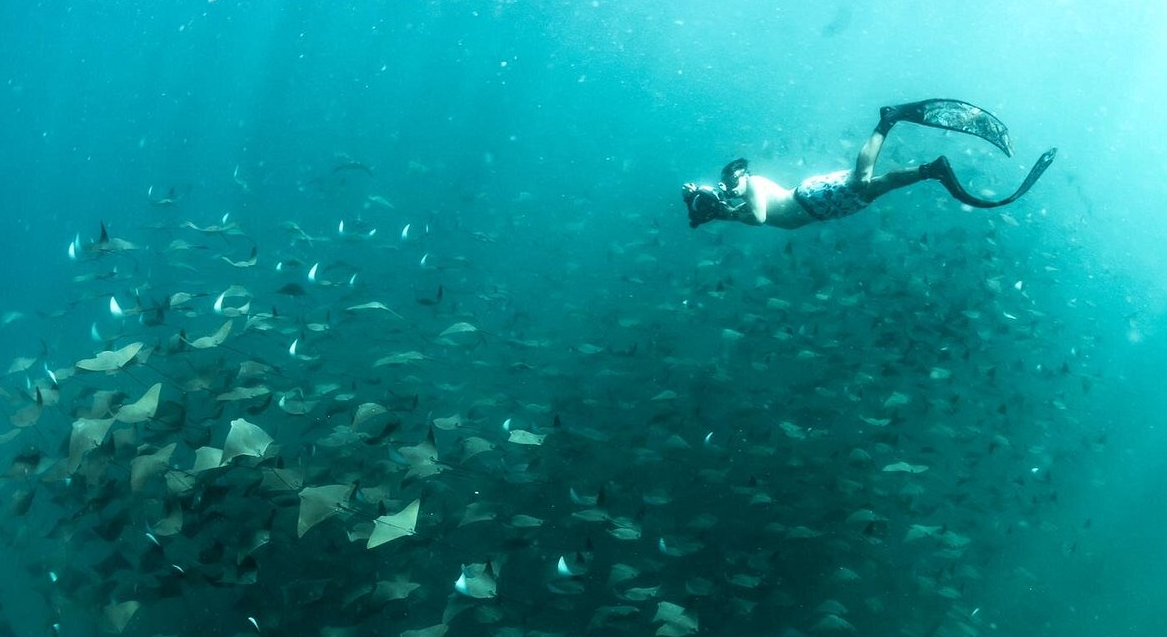
Freedive Training and Marine Life
For many people, training is not only about performance.
Better freediving skills can completely change the experience of observing marine life.
A relaxed freediver can move more quietly and naturally through the water than someone constantly struggling with buoyancy or inefficient kicking.
Depending on the destination, recreational freedivers may encounter:
- Reef fish
- Sea turtles
- Rays
- Eagle rays
- Barracuda
- Dolphins
- Schooling fish
- Reef sharks
- Whale sharks
- Manta rays
- Sea lions
Wildlife encounters vary enormously by region and season and can never be guaranteed.
Freedivers should also remember that wildlife photography and observation create additional task loading.
A camera should only be introduced when the diver already feels comfortable managing buoyancy, equalization, depth and buddy communication.
Marine life should be observed without chasing, touching or interfering with natural behavior.
Freedive Training in Tropical Destinations
Warm-water destinations are especially popular for freedive training because they often combine comfortable temperatures, good visibility and access to depth.
Areas with coral reefs, deep coastal drop-offs or freshwater sinkholes can offer very different training experiences.
For example, tropical ocean training may combine depth sessions with reef exploration, while freshwater environments can offer exceptionally calm conditions.
When planning a freediving trip, consider:
- Distance to the training site
- Maximum available depth
- Water temperature
- Visibility
- Boat requirements
- Current
- Marine traffic
- Instructor availability
- Emergency planning
- Weather reliability
A beautiful destination is not automatically a good training location. Safety infrastructure and suitable conditions should come first.
How to Choose a Freedive Training Center or Instructor
A professional instructor should do more than help students reach a target depth.
Look for training that emphasizes:
- Recognized certification
- Small groups
- Clear safety procedures
- Buddy skills
- Rescue practice
- Conservative progression
- Proper equipment
- Individual feedback
- Local knowledge
- Transparent medical requirements
Ask how many students will be in the water with each instructor.
For depth training, also ask about:
- Dive-line setup
- Safety divers
- Lanyards
- Emergency oxygen
- Boat support
- Communication
- Emergency procedures
The quality of the training environment can be just as important as the beauty of the destination.
Practical Freedive Training Tips for Beginners
Focus on technique before depth
A technically efficient 10-meter dive can be more valuable than an uncomfortable attempt at a greater depth.
Equalize early
Do not wait until pressure becomes painful.
Do not force a dive
A failed equalization or uncomfortable descent is a reason to turn around, not a reason to push harder.
Train with qualified buddies
A person simply watching from the beach or boat is not a substitute for an active freediving safety buddy.
DAN recommends direct buddy supervision throughout breath-hold dives.
Avoid hyperventilation
Hyperventilation can delay the urge to breathe without maintaining adequate oxygen.
Give yourself time to recover
Freediving is not about completing as many dives as possible.
Adequate recovery and surface intervals are an important part of training.
Stay warm
Cold can create tension and increase discomfort.
Maintain your equipment
Check masks, fins, weight systems, lanyards, lines and buoys before training.
Keep a training log
Recording sessions can help identify progress.
Useful information may include:
- Training type
- Depth or distance
- Conditions
- Equalization quality
- Comfort level
- Technique observations
- Instructor feedback
Progress should be evaluated through consistency and comfort, not only numbers.
Common Freedive Training Mistakes
Many beginning freedivers make similar mistakes.
Chasing depth too quickly
Depth should result from improved technique, equalization and comfort.
It should not be the only objective.
Comparing yourself with other divers
Freediving progression varies considerably between individuals.
Someone may develop breath-hold comfort quickly while another person progresses faster with depth or equalization.
Ignoring equalization problems
Repeatedly forcing uncomfortable equalization can cause injury.
Buying advanced gear before developing technique
Expensive carbon fins cannot compensate for poor body position or inefficient kicking.
Training alone
This is one of the most serious mistakes a freediver can make.
Breath-hold diving in water should always have appropriate direct supervision.
Treating every session as a maximum attempt
Frequent attempts to reach personal limits can interfere with technical development.
Relaxed technical sessions often produce better long-term progress.
What Does Freedive Training Feel Like?
For many beginners, their first professional session is surprising.
Freediving frequently feels less aggressive than people expect.
Instead of fighting against the need to breathe, students learn to relax and observe physical sensations.
Instead of kicking as hard as possible, they learn efficient movement.
Instead of forcing themselves deeper, they learn to recognize when a dive feels comfortable and when it is better to turn.
The progression can become almost meditative.
Many recreational freedivers eventually value the feeling of quiet movement underwater as much as depth or breath-hold performance.
Is Freedive Training Good for Underwater Photography?
Yes, particularly when the photographer already has strong diving and safety skills.
Freediving allows photographers to move without tanks, regulators or bubbles, which can make certain wildlife encounters feel more natural.
Training can improve:
- Body control
- Buoyancy
- Finning
- Approach technique
- Comfort underwater
- Positioning for photographs
- Awareness of depth and time
However, underwater photography should never distract a diver from safety.
Your buddy remains responsible for actively supervising the dive, and the photographer must remain aware of depth, conditions and their own limits.
Do You Need Experience Before Starting Freedive Training?
Usually not.
Beginner freediving programs are specifically designed to introduce people to the sport.
You should, however, be comfortable in the water and meet the swimming and medical requirements established by the training organization.
For example, PADI currently requires students in its standard Freediver course to demonstrate basic water skills, including an untimed 200-meter/yard swim or a 300-meter/yard swim using mask, fins and snorkel.
Exact entry requirements can differ among organizations and locations.
Frequently Asked Questions About Freedive Training
How long does it take to learn freediving?
Basic skills can be introduced during a multi-day beginner course, but becoming a skilled freediver takes continued practice.
Equalization, relaxation and efficient movement improve gradually.
Do I need to hold my breath for several minutes before taking a course?
No.
Beginner freediving courses are designed to teach breath-hold technique rather than expecting students to arrive with exceptional breath-hold ability.
Is freediving harder than scuba diving?
The two activities require different skills.
Scuba diving focuses heavily on equipment use, buoyancy and breathing compressed gas, while freediving places greater emphasis on relaxation, breath-holding, equalization and movement efficiency.
Can I practice freediving in a swimming pool?
Yes. Pool sessions are commonly used for static and dynamic apnea training.
They still require appropriate safety supervision.
How deep do beginners freedive?
There is no depth that every beginner should achieve.
Progress depends on equalization, comfort, technique, training organization and individual ability.
Comfortable technique should come before depth.
Can I learn freediving from YouTube?
Online resources can support your education, but they cannot replace professional water-based instruction, direct feedback and rescue training.
Do freedivers need scuba certification?
No. Freediving is a separate discipline with its own training systems and certifications.
Is freediving dangerous?
Freediving involves real risks, particularly loss of consciousness caused by hypoxia, pressure-related injuries and environmental hazards.
Professional training, appropriate buddy supervision and conservative diving practices are essential parts of managing those risks.
Start Freedive Training With Technique, Not Numbers
The most productive approach to freedive training is not to ask, “How deep can I go?”
A better question is:
How efficiently, comfortably and safely can I dive?
Depth and breath-hold performance usually improve as relaxation, equalization, body position and technique become more efficient.
Good freediving training gives you more than the ability to stay underwater longer. It provides the skills to understand your body, move efficiently underwater, explore marine environments with greater confidence and develop safer habits for every future dive.
Whether you want to explore coral reefs, photograph marine life, experience cenotes, improve your underwater abilities or progress into deeper freediving, professional instruction provides the foundation.
Start with proper technique. Train with qualified buddies and instructors. Progress gradually.
The depth can come later.
