

Learn Freediving: How to Start Exploring Underwater on One Breath
Maybe you have watched someone disappear beneath the surface with nothing more than a mask and a pair of long fins and thought, There is absolutely no way I could do that.
That is how a lot of people begin.
Then they learn freediving and discover that it is much less about having superhuman lungs than they expected.
Freediving is about learning how to relax, move efficiently, equalize pressure, understand your body and stay safe underwater. You do not need to arrive holding your breath for four minutes or casually diving 30 meters below the surface.
You start where you are.
For some people, that means becoming comfortable swimming underwater for the first time. For others, it means turning years of snorkeling into a new skill. And for travelers, learning freediving can completely change how they experience destinations such as the Mexican Caribbean.
Instead of floating above that beautiful blue water wondering what is underneath, you finally get to go look.
What Is Freediving?
Freediving is underwater diving performed while holding your breath rather than using a scuba tank or another underwater breathing system.
That simple definition does not quite explain why people become obsessed with it.
Freediving combines swimming, relaxation, breathing awareness, body control and underwater exploration. Some freedivers eventually focus on depth or competition. Others never care about records at all.
They simply want to explore reefs, swim beneath the surface, photograph marine life or experience the unusual calm that comes from being underwater without bubbles and heavy scuba equipment.
PADI describes freediving as a distinct underwater discipline rather than simply snorkeling deeper. Formal freediving training teaches breath-hold skills and diving techniques that allow divers to gradually increase their comfort, time and depth underwater.
That means you do not need to be trying to break records to call yourself a freediver.
You can learn because you love the ocean.
That is a perfectly good reason.
Can Anyone Learn Freediving?
Most healthy people who are comfortable in the water can begin learning freediving, although individual course requirements and medical considerations vary.
You do not need previous freediving experience to take many beginner courses. PADI, for example, offers entry-level freediving training without requiring previous snorkeling or freediving experience.
You should, however, have basic swimming ability and feel reasonably comfortable around water.
Being an Olympic swimmer is unnecessary.
Knowing which side of the pool is up is considerably more useful.
If you have certain medical conditions or concerns, a training organization or instructor may require medical clearance before participating.
Do You Need to Hold Your Breath for a Long Time to Learn Freediving?
This is probably the biggest misconception beginners have.
No.
You are learning how to freedive partly because you do not yet know how to use your breath efficiently.
Beginners often assume their current breath-hold time tells them how good they will be at freediving. It does not.
Relaxation, technique, movement and understanding your body’s response to breath-holding all influence the experience.
PADI specifically identifies poor breath-hold ability as a common concern among new students and notes that proper training can produce surprisingly different results from simply testing yourself without instruction.
Your first goal should not be:
How long can I hold my breath?
A better question is:
How relaxed and comfortable can I become underwater?
Depth and longer breath holds can come later.
How Do You Learn Freediving?
A beginner freediving course generally combines theory with practice in controlled water and eventually open water.
For example, PADI’s freediving pathway includes knowledge development, confined-water sessions and open-water training. Its current course information describes learning about the body’s response to breath-holding and pressure before practicing those skills with an instructor.
A typical learning process looks something like this:
| Stage | What You Learn |
|---|---|
| Teoria | Breathing, pressure, safety and how your body reacts underwater |
| Relaxation | How to reduce unnecessary tension and energy use |
| Confined water | Breath-hold exercises and movement in controlled conditions |
| Equalization | Managing increasing pressure as you descend |
| Duck diving | Entering the water efficiently from the surface |
| Open water | Applying techniques while descending vertically |
| Buddy skills | Watching and assisting another freediver |
| Rescue skills | Recognizing and responding to problems |
| Continued practice | Gradually improving comfort, technique and depth |
Notice that “dive really deep immediately” is missing from the list.
There is a reason for that.
Learn Freediving Safety Before Chasing Depth
The minimalist nature of freediving can make it look deceptively simple.
Mask. Fins. One breath. Down you go.
But proper safety training is one of the most important reasons to take a course instead of trying to teach yourself.
Breath-hold diving carries a real risk of loss of consciousness when oxygen levels fall too low. Divers Alert Network emphasizes that freedivers should receive formal training and should never practice breath-hold diving alone. A trained buddy needs to actively supervise the diver and be capable of responding if something goes wrong.
This applies in the ocean. It applies in cenotes and yes, it also applies in the swimming pool.
“I was only practicing for a minute” is not a safety system.
A good freediving course teaches you not only how to descend but also how to look after another freediver.
That may be one of the most valuable skills you learn.
Why You Should Never Learn Freediving Alone
There are plenty of hobbies where YouTube University works surprisingly well.
Freediving should not be one of them.
You can certainly read about the sport, learn terminology and understand the basic concepts online. But actual breath-hold training in water requires appropriate supervision.
Divers Alert Network identifies diving alone or with an untrained buddy as unacceptable practice and stresses the importance of direct buddy supervision during dives.
A trained instructor can also spot things you probably cannot.
Maybe your body position is wasting energy.
Maybe you are kicking too much, maybe you are struggling with equalization because of technique rather than physiology, maybe you are trying far too hard because you think freediving is supposed to feel like an underwater CrossFit class. It is not.
Good freediving often looks effortless because efficiency is the point.
Learn Freediving Breathing and Relaxation
People hear “breath-hold sport” and naturally assume freediving is mostly about taking one enormous breath.
There is much more happening.
A large part of beginner training is learning how to relax before and during a dive.
If your shoulders are tense, your legs are working harder than necessary and your brain is screaming WE ARE UNDERWATER every three seconds, you are using more energy.
Good freediving teaches you to slow the process down.
Breathing preparation should also be taught correctly. Excessive ventilation before a breath hold can reduce carbon dioxide levels and interfere with your body’s normal warning signals. DAN specifically warns against hyperventilation before freediving and recommends proper training and dedicated buddy supervision.
So the goal is not to inhale and exhale wildly until you feel ready to conquer the Mariana Trench.
It is quite the opposite.
Calm is useful.
Learn How to Equalize Before Going Deeper
For many beginners, breath-holding is not actually the first thing limiting depth.
Their ears are.
As you descend, water pressure increases. Freedivers need to equalize the pressure in their middle ears as they go down. If you have ever felt your ears become uncomfortable while diving to the bottom of a swimming pool, you have already experienced why this matters.
During a freediving course, your instructor can introduce appropriate equalization techniques and help you practice them progressively.
The key word is progressively.
Pain is not a sign that you are almost there.
It is a sign to stop descending.
Trying to force depth while your ears refuse to cooperate is an excellent way to turn an otherwise relaxing adventure into a very annoying vacation story.
What Equipment Do You Need to Learn Freediving?
One of the attractions of freediving is that the equipment list is relatively short.
Basic freediving equipment can include:
Mask
Snorkel
Freediving fins
Wetsuit or exposure protection when needed
Weight belt and appropriate weights
Freediving buoy and line for depth training
Lanyard in certain training situations
Beginners do not necessarily need to buy everything immediately.
In fact, waiting until you have taken a few lessons can be smart because you will have a much better idea of what equipment fits you and what type of freediving you enjoy.
MExplor, for example, lists equipment options as part of several of its freediving training experiences in the Mexican Caribbean.
There is no need to arrive for lesson number one dressed like you are attempting a world record.
Freediving Fins vs. Regular Snorkeling Fins
One piece of equipment beginners notice immediately is the fins.
Freediving fins are typically longer than ordinary snorkeling fins. The longer blade helps transfer energy efficiently through the water, which can make vertical movement easier when used with proper technique.
That does not mean longer is automatically better.
Very stiff fins can exhaust a beginner quickly, while softer fins may feel much more comfortable.
Your ideal choice depends on your strength, technique and how you plan to use them.
This is another good reason to try equipment before spending money.
Your first pair of fins should help you swim.
They should not feel like two pieces of patio furniture strapped to your feet.
What Does Your First Freediving Class Feel Like?
Probably calmer than you expect.
A proper first session should not begin with someone pointing at a very deep section of water and saying, “See you at the bottom.”
You will usually spend time learning basic principles first.
Then you begin practicing.
You might work on relaxation, breath-hold techniques or swimming efficiently in confined water before progressing into vertical dives.
PADI’s Basic Freediver training, for example, starts with core principles and breath-hold practice in a pool or confined-water environment.
When open-water training begins, depth should increase gradually based on your comfort and ability.
The surprising part for many students is how quickly their perception changes.
Before training, five meters can sound deep.
After learning how to descend comfortably, equalize and stay relaxed, those same few meters can feel completely different.
How Long Does It Take to Learn Freediving?
You can learn the foundations in a few days.
You can spend years getting better.
Both statements are true.
Entry-level certification programs are often structured over several sessions. PADI’s current FAQ describes approximately 15 hours of recommended training, commonly taking two to three days or longer depending on the student and schedule.
But finishing a course does not mean you have finished learning.
Freediving improves through repetition.
You develop better body awareness.
Equalization becomes easier.
Movement becomes smoother.
You become more comfortable reading your own body rather than constantly wondering if every unusual sensation means your lungs are about to resign.
Progress is usually gradual.
That is part of what makes the sport interesting.
Learn Freediving in a Pool, Ocean or Cenote?
Eventually, you may train in all three.
Each environment offers something different.
| Environment | Main Advantage | Good For |
|---|---|---|
| Pool | Controlled environment | Breath-hold and swimming technique |
| Ocean | Real open-water conditions | Depth, marine life and exploration |
| Cenote | Clear freshwater and protected conditions | Technique, depth and unique scenery |
Pool Freediving
Pools are useful for learning because the environment is predictable.
There are no waves or currents, and instructors can focus on technique.
You may practice static breath holds, horizontal swimming and buddy skills.
Ocean Freediving
The ocean adds the adventure.
You begin working with real open-water conditions while also gaining access to reefs and marine life.
It feels less like training and more like exploring.
Sometimes it feels like both.
Cenote Freediving
Mexico offers another option entirely.
The Yucatán Peninsula is famous for its cenotes, freshwater sinkholes connected to extensive underground geological systems.
Selected cenotes can provide clear water and protected settings for specialized freediving training.
MExplor currently offers cenote freediving training that includes supervised vertical dives and work on techniques such as equalization, descent and buoyancy control. Some of its dedicated cenote sessions require previous freediving experience, so the correct location and program need to be selected according to the student’s level.
For travelers, cenote freediving also has one major advantage:
It looks spectacular.
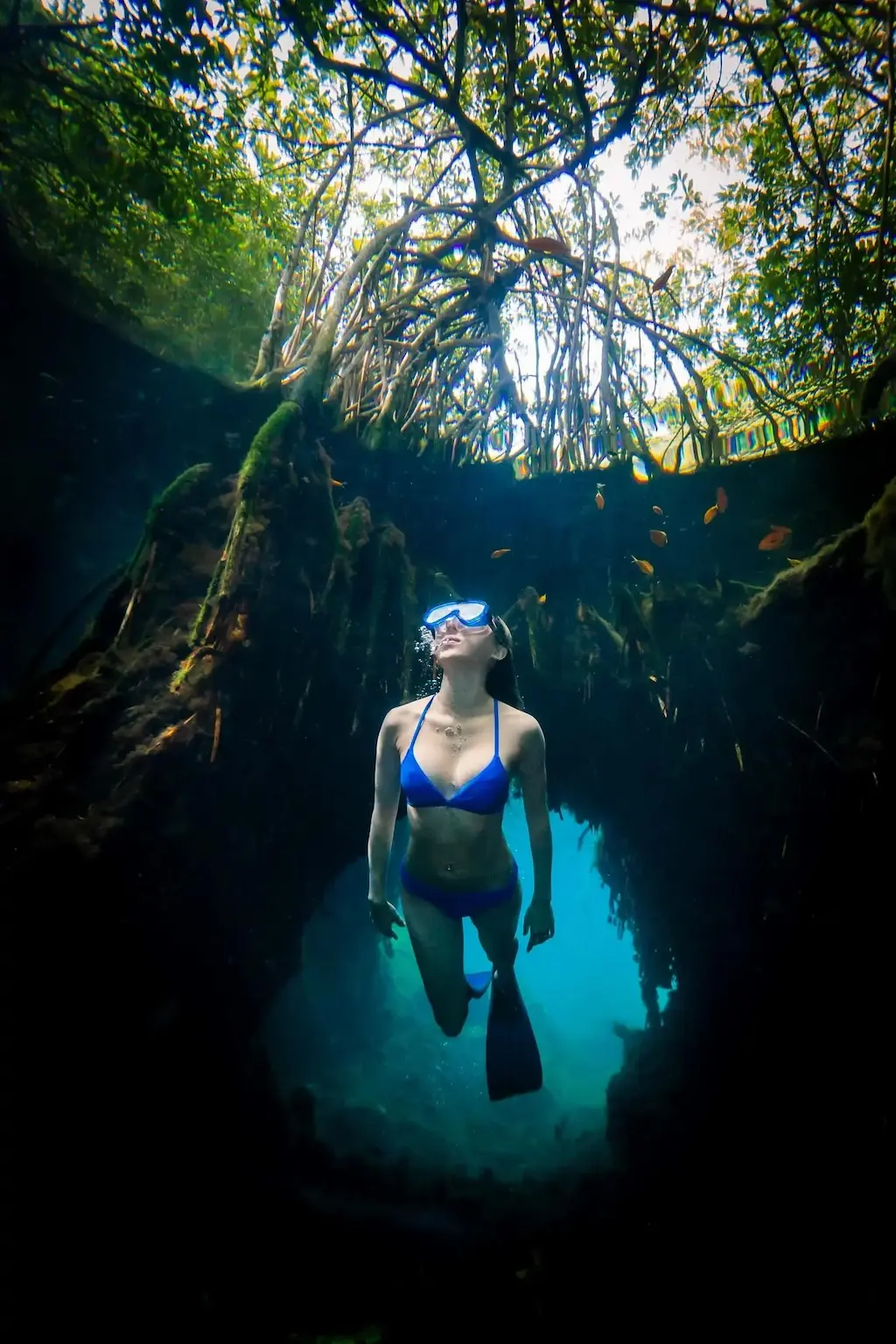
Crystal-clear water, limestone formations, shafts of natural light and almost surreal visibility make it very different from ordinary pool training.
Why Learn Freediving in Mexico?
If you are going to learn something new, doing it somewhere beautiful certainly does not hurt.
The Mexican Caribbean offers a useful combination of training environments.
You can start with controlled-water practice and progress toward open water or suitable cenotes depending on your course and skill level.
Destinations such as Tulum, Playa del Carmen, Puerto Morelos and the surrounding region also make it easy to combine freediving with snorkeling, scuba diving, cenote trips, beaches and other outdoor adventures.
MExplor operates freediving activities in this region, including a dedicated freediving location in Tulum as well as cenote training experiences.
That creates an interesting option for travelers who would rather build learning into a vacation than spend several days staring at the same swimming-pool tiles back home.
Marine Life Makes Learning Freediving Even More Rewarding
Technique is important.
But eventually you probably want to use it for something.
For recreational freedivers, that “something” is often exploring the underwater world.
In tropical water, freediving skills can allow you to move quietly around reefs while observing fish, rays, turtles and other marine life depending on the destination and season.
That is when all those pool drills begin making sense.
Your duck dive becomes the way you slip beneath the surface.
Better fin technique lets you move without wasting energy.
Better relaxation lets you spend more time simply looking around.
You stop practicing freediving.
You start using freediving to explore.
That transition is one of the best parts.
What Is the Best Time to Learn Freediving in the Mexican Caribbean?
Freediving training is possible during much of the year, but your preferred season depends on the type of experience you want.
| Season | Conditions and Experience |
|---|---|
| December–April | Popular travel season with generally comfortable Caribbean weather |
| May | Warm conditions before the wetter summer period |
| June–September | Hotter and wetter, with seasonal marine-life opportunities |
| October–November | More variable weather and fewer peak-season travelers |
| Year-round | Selected pool and cenote training may provide alternatives to ocean sessions |
Weather always matters for open-water training.
Wind, waves and local conditions can change plans even during an otherwise beautiful week.
One advantage of training in a destination with pools, ocean and cenotes is having more than one possible environment available.
Beginner Freediving Mistakes to Avoid
Most beginners are not doing anything wrong intentionally.
They are usually just trying too hard.
Common problems include:
Trying to increase depth too quickly
Focusing entirely on breath-hold time
Forcing equalization
Buying advanced equipment before taking a course
Using unnecessary muscle effort
Comparing yourself with experienced freedivers
Practicing breath holds without trained supervision
The last one is the important one.
The others might make your freediving frustrating.
Ignoring safety can make it dangerous.
Freediving vs. Snorkeling: What Changes When You Learn?
Snorkeling keeps you mainly on the surface.
Freediving teaches you to comfortably explore beneath it.
Imagine seeing a turtle swimming several meters below you while snorkeling.
You watch from above.
Once you have learned freediving, you may be able to descend calmly, observe from a respectful distance and return to the surface comfortably.
Same ocean.
Completely different experience.
That is why many people who love snorkeling eventually decide to learn freediving.
They do not necessarily want to become competitive athletes.
They simply want access to more of the underwater world.
Freediving vs. Scuba Diving
Freediving and scuba diving are not rivals.
They are two different ways to experience water.
| Freediving | Buceo |
|---|---|
| One breath | Breathing underwater |
| Minimal equipment | More equipment |
| Short individual dives | Longer continuous dives |
| Strong focus on relaxation | Strong focus on dive procedures and equipment |
| Quiet movement underwater | Bubbles and breathing equipment |
| Easy to combine with swimming | Excellent for extended reef exploration |
Many divers enjoy both.
Scuba lets you stay underwater longer.
Freediving gives you simplicity and freedom of movement.
The Mexican Caribbean happens to be a very good place to refuse to choose.
What Happens After Your First Freediving Course?
Hopefully, you want to get back in the water.
From there, you can decide what part of freediving interests you most.
Maybe you want deeper training.
Maybe you prefer reef exploration.
Maybe cenotes become your obsession.
Maybe you want to combine freediving with underwater photography.
Or maybe you discover that casually dropping beneath the surface while traveling is all you ever wanted from it.
Formal training systems offer progressive levels for divers who want to continue developing their skills. MExplor currently lists multiple freediving options, including introductory and more advanced training through its freediving program.
There is no requirement to turn every hobby into a race toward the next level.
Learn enough to be safe.
Then decide what makes being underwater fun for you.
Frequently Asked Questions About Learning Freediving
Is freediving difficult to learn?
The basic concepts are approachable for many people, but becoming comfortable requires practice. Beginners often find relaxation and equalization more challenging than simply holding their breath.
Do I need to be a strong swimmer to learn freediving?
You do not need competitive swimming skills, but you should have adequate swimming ability and feel comfortable in the water. Specific requirements vary between training programs.
Can I teach myself freediving?
You can learn theory from books and online resources, but in-water breath-hold practice should be done with properly trained supervision. Formal training teaches essential buddy and rescue procedures.
How long does it take to learn freediving?
A beginner course can often be completed over several days, but developing strong freediving skills takes continued practice. PADI recommends approximately 15 hours for its entry-level Freediver training, although students progress at individual speeds.
Do I need my own freediving equipment?
Not necessarily. Many schools provide or rent equipment for beginner courses. Check what is included before buying your own fins, mask or wetsuit.
Can beginners learn freediving in cenotes?
Certain cenote environments may be suitable for training, while others require previous experience. Always choose a site and program appropriate to your level and train with qualified supervision.
How deep will I go during my first freediving lesson?
That depends on the course, your comfort, your ability to equalize and your progress. Your first goal should be learning safe technique rather than reaching a particular number.
Is freediving safe?
Freediving involves risks, including hypoxic blackout. Proper instruction, conservative progression and direct supervision by a trained buddy are essential safety practices.
Learn Freediving and Discover a Different Side of the Ocean
You do not need extraordinary lungs to begin.
You do not need to be an athlete.
And you definitely do not need to arrive ready to dive into the deep blue.
You need curiosity, comfort in the water and a willingness to learn the right techniques.
Once you learn freediving, even familiar places can begin to look different. A reef is no longer something you only observe from above. Clear water becomes an invitation to explore. A cenote becomes more than a beautiful swimming hole.
And every meter you descend becomes part of the experience rather than simply a number.
If you want to learn in the Mexican Caribbean, MExplor offers freediving training and experiences around destinations including Tulum and the cenotes of Quintana Roo. Contact MExplor to ask about beginner courses, current training options and the best experience for your level.
Your first freedive does not need to be deep.
It just needs to be the first one.
Also you are interested

Transporte desde Playa del Carmen a Puerto Morelos
Transporte desde Playa del Carmen a Puerto Morelos Puerto Morelos ¿A donde está ubicado Puerto Morelos? Puerto Morelos es un pueblo ubicado a 37 km

Cenotes en Yucatan: A Complete Guide to Mexico’s Natural Underground Wonders
One of the most appealing aspects of the cenotes en Yucatan is their consistent water temperature, which averages around 24–25°C (75–77°F) year-round. This makes them
Explore Cabo Pulmo diving Underwater Paradise: Essential Tips and Must-See Sites
Discover Cabo Pulmo Diving: An Underwater Paradise Awaiting Your Adventure Have you ever wondered what secrets lie beneath the waves of the world’s oceans? In
