

Competitive Freediving Categories: A Beginner-Friendly Guide to Pool and Depth Disciplines
Freediving can look wonderfully simple from the outside.
Take one breath. Go underwater. Come back up.
Then you discover competitive freediving and suddenly everyone is speaking in abbreviations: CWT, CNF, FIM, DYNB, DNF, STA.
At first, it looks less like a sport and more like somebody dropped a bowl of alphabet soup into a swimming pool.
Fortunately, the basic structure is much easier to understand than the abbreviations suggest.
Most competitive freediving categories — more accurately called disciplines by organizations such as AIDA and CMAS — fit into two broad groups:
Pool disciplines, where athletes compete for time or horizontal distance, and depth disciplines, where athletes descend vertically along a line and try to reach a declared depth.
There are also differences between the two major international organizations, AIDA International and CMAS, particularly in the pool events they recognize and how competitions are organized. AIDA’s current athlete rankings and competitions include the familiar STA, DYN, DYNB, DNF, CWT, CWTB, CNF and FIM disciplines, while CMAS also runs speed-apnea events in its indoor competition program.
This guide breaks everything down without requiring you to memorize a rulebook before reaching the second paragraph.
Competitive Freediving Categories vs. Disciplines: What Is the Correct Term?
You will often hear people talk about competitive freediving categories, but there is an important distinction.
A discipline describes what type of freediving performance the athlete is doing.
For example:
Static apnea
Dynamic apnea with bifins
Constant weight
Free immersion
A category can also describe who is competing, such as men, women, juniors, seniors or masters.
CMAS, for example, currently organizes competitors into Juniors, Seniors and Masters at its indoor world championships, while its disciplines describe the actual type of performance.
For SEO purposes, people commonly search for competitive freediving categories, so we will use that phrase throughout this guide — just remember that disciplines is usually the more precise sporting term.
The Two Main Types of Competitive Freediving
The easiest way to understand competitive freediving is to divide it into two worlds.
| Competition Type | Main Goal | Typical Environment |
|---|---|---|
| Pool Freediving | Maximum time or horizontal distance | Swimming pool |
| Depth Freediving | Maximum vertical depth | Ocean, lake or deep-water site |
The physical and mental demands are quite different.
Pool athletes may spend months refining turns, streamlining and movement efficiency.
Depth athletes need to manage equalization, pressure, descent speed, buoyancy and the psychological challenge of moving vertically into deep water.
Some freedivers specialize heavily.
Others compete in both.
Pool Competitive Freediving Categories
Pool competitions remove most of the environmental variables found in open water.
There are no currents.
No waves.
No dramatic thermocline waiting somewhere below you.
No fish casually appearing while you are trying to remain focused.
Instead, the challenge becomes extremely controlled: how efficiently can you manage oxygen while remaining relaxed and technically precise?
The main AIDA pool disciplines are Static Apnea, Dynamic With Fins, Dynamic With Bifins and Dynamic Without Fins. AIDA’s 2026 pool competition listings continue to use these four disciplines.
Static Apnea — STA
Static Apnea (STA) is probably the easiest discipline to explain and one of the strangest to watch if you have never seen competitive freediving before.
The athlete remains face-down at the surface of the water while holding their breath for as long as possible.
No distance.
No depth.
No swimming.
Just time.
The athlete is normally supported and closely monitored by a safety team throughout the attempt.
The result is measured in minutes and seconds rather than meters.
Static apnea depends heavily on:
Relaxation
Mental control
Breath-hold tolerance
Managing rising carbon dioxide
Remaining calm during contractions
Surface recovery afterward
From the outside, absolutely nothing appears to be happening.
Inside the athlete’s mind and body, quite a lot is happening.
STA is recognized by both AIDA and CMAS as a competitive pool discipline.
Dynamic Apnea With Fins — DYN
Dynamic Apnea With Fins (DYN) is a horizontal distance discipline.
The athlete swims underwater on a single breath and attempts to cover the greatest possible distance.
AIDA lists DYN separately from its dedicated bifins category, DYNB.
The athlete needs to balance speed and efficiency.
Go too slowly and you spend additional time underwater.
Go too quickly and you burn oxygen unnecessarily.
That makes DYN an interesting combination of:
Streamlining
Fin technique
Relaxation
Pace
Turns
Oxygen management
The winner is not necessarily the athlete who looks as though they are swimming hardest.
In freediving, looking dramatically athletic can occasionally be evidence that you are wasting energy.
Dynamic Apnea With Bifins — DYNB
Dynamic With Bifins (DYNB) is similar to DYN, but competitors specifically use separate bifins rather than treating all fin propulsion as one discipline.
The athlete still travels horizontally underwater on one breath and tries to cover the greatest distance.
AIDA currently maintains DYNB as its own ranked discipline, while CMAS also holds Dynamic Apnea With Bi-Fins as a separate championship event.
This category rewards efficient kicking and clean body position.
A strong athlete can waste a surprising amount of energy with poor technique.
A technically efficient athlete can travel much farther while appearing almost suspiciously relaxed.
Dynamic Apnea Without Fins — DNF
Now remove the fins.
Dynamic Without Fins (DNF) requires the freediver to travel horizontally underwater using only the body’s own swimming movements.
No fins.
No propulsion device.
The movement often resembles a modified breaststroke, with long glide phases between strokes.
DNF is considered one of the purest tests of swimming efficiency because every movement has to justify the oxygen it consumes.
AIDA and CMAS both contest Dynamic Without Fins in pool competition.
DNF requires excellent:
Streamlining
Timing
Glide efficiency
Body awareness
Relaxation
Turn technique
If you love equipment, this category removes your excuses.
It is just you and the pool.
CMAS Speed Apnea and Endurance Categories
This is one of the biggest differences beginners notice between AIDA and CMAS.
CMAS indoor freediving also includes speed-apnea events in which athletes complete fixed distances as quickly as possible while alternating underwater apnea lengths with recovery at the wall.
The 2026 CMAS indoor world championship program includes events such as 2×50 m, 4×50 m and 8×50 m Speed Apnea, alongside STA, DYN, DYN-BF and DNF.
Traditional dynamic freediving asks:
How far can you go on one breath?
Speed apnea asks something closer to:
How quickly can you repeatedly complete underwater lengths while managing your recovery?
It creates a much more obviously athletic race format.
There is less peaceful floating around contemplating your relationship with carbon dioxide.
Things happen quickly.
Quick Comparison of Pool Freediving Categories
| Discipline | Abbreviation | Goal | Equipment |
|---|---|---|---|
| Static Apnea | STA | Longest breath hold | No swimming |
| Dynamic With Fins | DYN | Maximum horizontal distance | Fins |
| Dynamic With Bifins | DYNB / DYN-BF | Maximum horizontal distance | Bifins |
| Dynamic Without Fins | DNF | Maximum horizontal distance | No fins |
| Speed Apnea* | Various | Complete fixed distance fastest | Fins |
*Speed-apnea formats are particularly associated with CMAS competition.
Depth Competitive Freediving Categories
Depth competition adds pressure.
Literally.
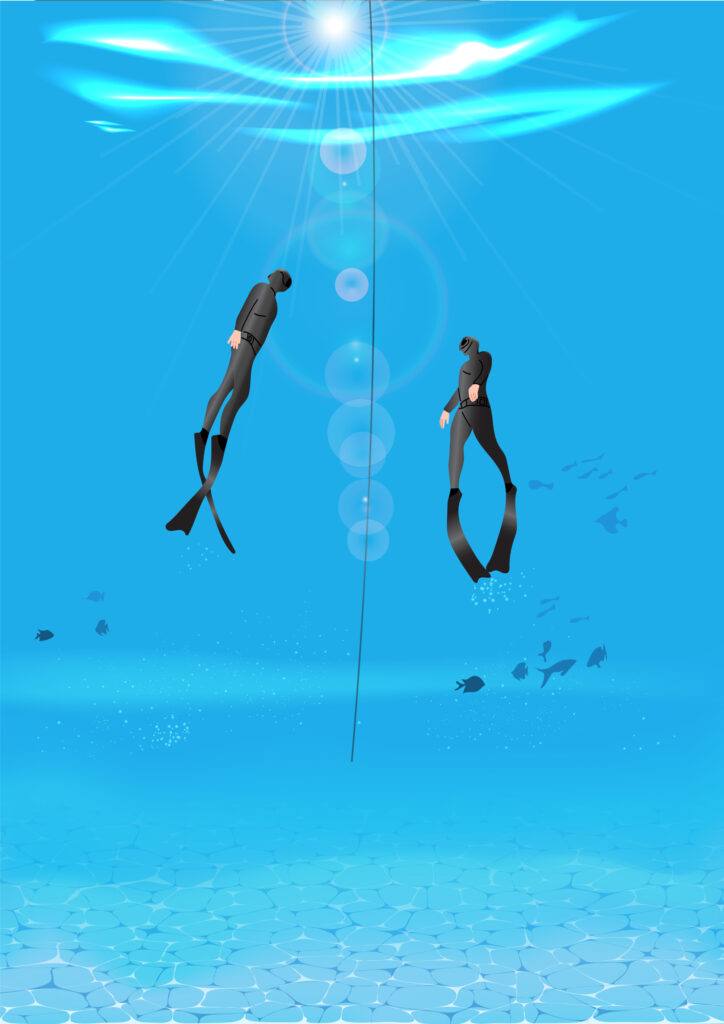
Instead of moving horizontally through a pool, the athlete descends vertically along a competition line.
The freediver announces a target depth before the attempt, descends to that point and returns to the surface on one breath.
At current AIDA competitions and CMAS depth world championships, the main competitive disciplines include Constant Weight, Constant Weight With Bifins, Constant Weight Without Fins and Free Immersion.
These categories differ mainly in how the athlete is allowed to move.
Constant Weight — CWT
Constant Weight (CWT) is one of the most recognizable forms of competitive depth freediving.
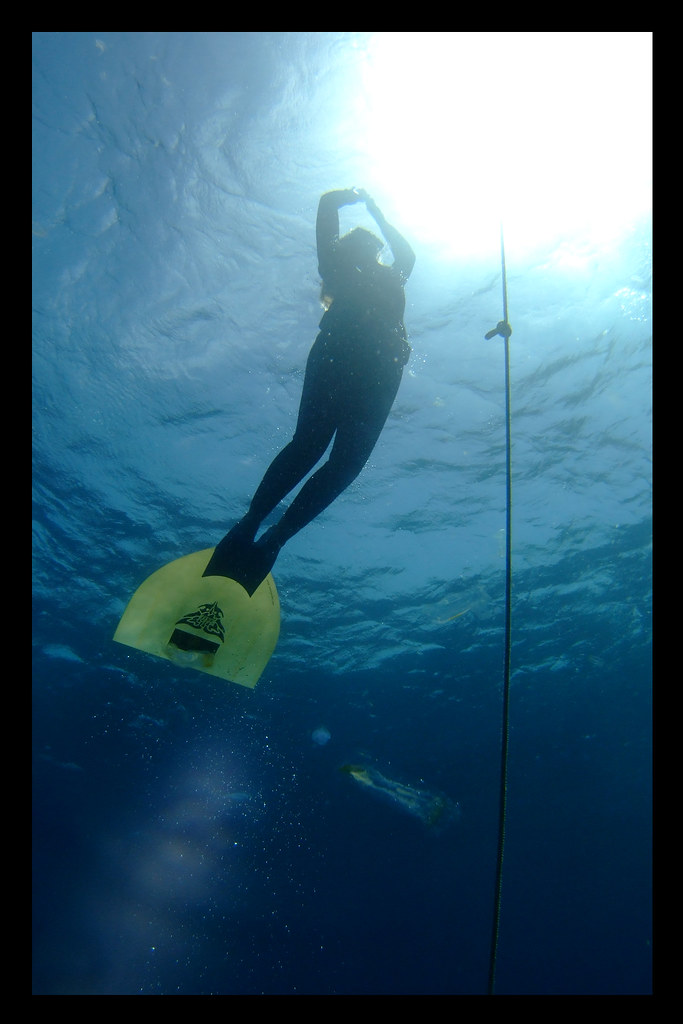
The athlete descends and ascends under their own power while using fins and following a vertical dive line.
The word constant refers to the athlete maintaining essentially the same ballast during the performance rather than using a heavy sled to descend and abandoning weight at depth.
CWT requires a mix of:
Efficient finning
Equalization
Streamlining
Proper weighting
Relaxation
Depth adaptation
Strong ascent technique
At depth, the athlete also experiences increasing pressure and changing buoyancy.
The descent may eventually begin feeling easier as the diver becomes negatively buoyant.
The trip back up is where the ocean politely requests repayment.
Constant Weight With Bifins — CWTB
Constant Weight With Bifins (CWTB) separates bifin diving into its own competitive discipline.
Instead of using another fin configuration, the athlete competes specifically with two fins.
AIDA maintains a dedicated CWTB ranking, and CMAS included Constant Weight With Bi-Fins as a separate event at its 2026 Depth World Championship in Roatán.
This allows athletes who specialize in bifin technique to compete directly against others using the same general propulsion method.
CWTB involves more than simply putting on two fins.
Efficient kicking mechanics become incredibly important at depth because wasted movement costs oxygen.
Constant Weight Without Fins — CNF
Constant Weight Without Fins (CNF) removes propulsion equipment entirely.
The athlete descends and ascends using swimming movements.
No fins.
No pulling continuously on the dive line.
This makes CNF one of the most physically demanding competitive freediving categories.
The athlete needs to generate every meter through movement while also dealing with pressure, equalization and changing buoyancy.
CNF rewards:
Efficient stroke technique
Excellent body position
Relaxation
Strong equalization
Precise weighting
Controlled pacing
AIDA and CMAS both recognize CNF in depth competition.
Many freedivers consider it one of the purest depth disciplines.
It is also an excellent way to discover how long twenty meters can suddenly feel.
Free Immersion — FIM
Free Immersion (FIM) looks very different from the other depth categories.
Instead of using fins or swimming strokes, the athlete pulls along the vertical dive line using their hands.
The athlete pulls down.
Turns at the target depth.
Then pulls back toward the surface.
FIM is currently contested by both AIDA and CMAS.
Many freedivers enjoy FIM because the movement can feel slow, controlled and meditative.
It also provides a useful environment for working on equalization because the athlete can adjust descent speed very precisely.
FIM still requires substantial physical effort, especially during ascent.
“Just pulling on the rope” becomes considerably less casual when the rope extends deep into the ocean.
Quick Comparison of Depth Freediving Categories
| Discipline | Abbreviation | How You Move | Fins? |
|---|---|---|---|
| Constant Weight | CWT | Fin propulsion | Yes |
| Constant Weight With Bifins | CWTB | Bifin kicking | Bifins only |
| Constant Weight Without Fins | CNF | Swimming strokes | No |
| Free Immersion | FIM | Pulling on the dive line | No fins required |
These four disciplines formed the current CMAS 2026 Depth World Championship program in Roatán, Honduras.
What About Variable Weight and No Limit?
If you start exploring freediving records, two other abbreviations appear:
VWT — Variable Weight
NLT — No Limit
AIDA continues to list world records for both disciplines.
These are different from the standard CWT-style competitive formats.
Variable Weight — VWT
Variable Weight allows the athlete to use additional weight to assist the descent before ascending using their own effort under the discipline’s rules.
AIDA still recognizes VWT records and held a dedicated VWT world-record attempt in Sharm El Sheikh in May 2026.
No Limit — NLT
No Limit historically allows specialized equipment to assist descent and ascent and has produced some of the deepest performances associated with freediving.
AIDA still lists NLT in its world-record records system.
However, when most people discuss modern competitive depth events, they are generally talking about CWT, CWTB, CNF and FIM rather than building a typical championship around VWT or NLT.
AIDA vs. CMAS Competitive Freediving Categories
Two organizations appear repeatedly once you enter competitive freediving.
AIDA International
AIDA — the International Association for the Development of Apnea — has organized freediving competitions and records since the 1990s.
Current AIDA rankings include:
STA
DYN
DYNB
DNF
CWT
CWTB
CNF
FIM
Its records system also lists VWT and NLT.
CMAS
CMAS — the World Underwater Federation — organizes international freediving championships and maintains separate rules for pool and depth competition.
CMAS currently operates world and continental championships and states that its competitive freediving disciplines are open to men and women.
Its depth program closely resembles the major AIDA competitive depth disciplines, while its pool program adds speed-apnea formats not normally associated with the standard AIDA pool lineup.
AIDA vs. CMAS at a Glance
| Area | AIDA | CMAS |
|---|---|---|
| Static Apnea | Yes | Yes |
| Dynamic With Fins | Yes | Yes |
| Dynamic With Bifins | Yes | Yes |
| Dynamic Without Fins | Yes | Yes |
| Constant Weight | Yes | Yes |
| Constant Weight With Bifins | Yes | Yes |
| Constant Weight Without Fins | Yes | Yes |
| Free Immersion | Yes | Yes |
| Speed/Endurance Apnea | Not part of standard AIDA pool lineup | Yes |
| VWT/NLT records | Yes | Rules/record systems differ |
The basic skills transfer between organizations, but competitors need to learn the exact rules of whichever federation sanctions their event.
Tiny procedural differences become very important when the performance is being judged.
Competitive Freediving Age Categories
This is where the word category becomes more literal.
CMAS currently divides international freedivers into age groups.
At its recent world championships, the main groups have been:
Juniors: 15–17
Seniors: 18–49
Masters: 50+
CMAS further divides Masters into:
M1: 50–59
M2: 60–69
M3: 70+
Masters can also choose to compete in the Senior category under current CMAS rules.
That is worth knowing because competitive freediving is not limited to athletes in their twenties.
Experience, technique, relaxation and efficiency can remain extremely valuable later in life.
Freediving is one of the few sports where becoming calmer may occasionally be more useful than becoming louder and faster.
Men’s and Women’s Competitive Categories
Official freediving competitions normally separate men’s and women’s rankings and awards.
CMAS states that all of its freediving disciplines are open to both men and women, and its current depth championship schedules run separate men’s and women’s events.
AIDA also maintains separate women’s and men’s world-record and ranking tables.
The disciplines themselves remain fundamentally the same.
The athlete still performs under the technical rules of that event.
How Does a Competitive Depth Dive Work?
Competitive depth diving is not simply:
“Tell us how deep you think you can go and good luck.”
The process is highly structured.
An athlete normally announces a target depth before the dive.
Competition organizers then position the depth marker or tag at the appropriate point on the line.
At the athlete’s official start time, the attempt begins.
The freediver descends along the line, reaches the target area, obtains the required marker when applicable, turns and returns to the surface.
Safety freedivers meet the athlete during the final section of the ascent.
After surfacing, the athlete must complete the organization’s required surface procedure correctly for the performance to be accepted.
AIDA competition result pages show how announced performance, realized performance, cards, penalties and disqualifications are recorded officially.
That means reaching the target depth is not the only thing that matters.
You still need to finish correctly.
What Are White, Yellow and Red Cards in AIDA?
At AIDA competitions, results commonly appear with one of three card outcomes.
White Card
A valid performance with no penalty.
This is the one everyone wants.
Yellow Card
The performance is accepted but receives a penalty.
For example, an athlete may return from less than the announced depth or miss a required element depending on the situation and rules.
Red Card
Disqualification.
AIDA competition results visibly record white, yellow and red decisions alongside the athlete’s result.
So competition day is not only about achieving a personal best.
It is about performing the dive within the rules.
What Is the Surface Protocol?
After a breath hold, the performance is not necessarily finished the instant your airway clears the water.
Competition organizations require athletes to demonstrate sufficient control at the surface through a specific finishing procedure.
This allows judges to confirm that the diver has completed the attempt properly.
The exact protocol and time limits depend on the organization’s current rules, so athletes should train according to the federation under which they will compete.
This part matters enormously.
A beautiful dive followed by an incorrect surface finish can change the entire result.
The judges are unfortunately unmoved by the argument:
“But the dive itself was amazing.”
How Are Competitive Freediving Performances Scored?
Scoring depends on the discipline.
Static Apnea
Performance is based on time.
Dynamic Disciplines
Performance is based primarily on horizontal distance.
Depth Disciplines
Performance is based on achieved depth.
Competition points, penalties and rankings are then calculated according to the federation’s rule system.
AIDA event results, for example, show announced performances, realized performances, points and judge decisions together.
The important point for beginners is simple:
You are not racing the person beside you in most freediving disciplines.
You are trying to produce the strongest valid individual performance.
Which Competitive Freediving Category Is Best for Beginners?
There is no universal answer.
Your natural preferences matter.
Try STA if:
You enjoy relaxation, mental challenges and breath-hold work.
Try DYN or DYNB if:
You like swimming with fins and want a controlled pool environment.
Try DNF if:
You enjoy technical swimming and simplicity.
Try FIM if:
You want to explore depth progressively while controlling your descent speed carefully.
Try CWTB if:
Bifins feel natural and you enjoy depth.
Try CNF later if:
You love technique and want a more physically demanding form of depth diving.
You do not need to decide permanently.
Many freedivers train several disciplines before discovering the one where their body and brain seem to agree most easily.
Pool Freediving vs. Depth Freediving for Beginners
Pool competitions are usually easier logistically.
You need a suitable pool, trained safety partners and proper instruction.
Depth adds additional variables:
Equalization
Pressure
Buoyancy changes
Water temperature
Current
Visibility
Dive-line systems
Greater safety logistics
That does not mean beginners should avoid depth.
It means they should learn it progressively with qualified instruction.
The ocean is not the ideal place for improvising because you watched an impressive dive online the night before.
Equalization in Competitive Depth Freediving
For most new depth freedivers, oxygen is not the first limitation.
Equalization is.
Pressure increases as you descend, requiring the athlete to equalize the middle ears and other air spaces.
As depth increases, techniques that worked easily near the surface may become more difficult.
Competitive freedivers spend significant time developing equalization because the deepest physical capability in the world is useless if your ears decide the dive ends at fifteen meters.
This is why depth progression should be gradual.
Never force equalization to chase a competition number.
The announced depth can wait.
Your ears should come home with you.
Equipment Changes Between Competitive Freediving Categories
One of the interesting things about competitive freediving categories is how much the equipment changes the style of the performance.
| Discipline | Main Equipment Difference |
|---|---|
| STA | Primarily breath-hold setup |
| DYN | Fin propulsion |
| DYNB | Separate bifins |
| DNF | No fins |
| CWT | Fin-based depth |
| CWTB | Bifins only |
| CNF | No propulsion fins |
| FIM | Dive line used for pulling |
Other equipment may include:
Mask or fluid goggles
Nose clip
Wetsuit
Weight system
Dive computer
Lanyard
Competition line systems
Exact equipment requirements vary by discipline and organization.
Read the current rules before competing.
Competition is an extremely inconvenient place to discover that your favorite piece of equipment is not legal for the category you entered.

Why Safety Is So Structured in Competitive Freediving
Competitive freediving takes place under controlled safety systems.
Depth competitions use trained safety freedivers, organized dive lines, judges and emergency procedures. AIDA event listings, for example, require organizers to publish detailed safety plans, and current world-record attempts can involve multiple safety freedivers, counterballast systems, oxygen and medical support.
CMAS likewise publishes separate international safety guidelines for depth and pool competitions alongside its 2026 competition rules.
This is important because competitive freediving is not simply recreational breath holding with someone keeping score.
Safety systems are part of the sport.
The lesson for recreational freedivers is equally straightforward:
Do not train breath-hold diving alone.
What Happens If a Freediver Blacks Out in Competition?
A loss of consciousness means the athlete has not completed a valid performance and requires immediate intervention from the safety team.
Competition safeties are positioned specifically to respond during the most vulnerable stages of a dive.
A blackout is not a clever strategy for squeezing out two additional meters.
A good competitive program is built around producing repeatable, controlled performances rather than repeatedly arriving at the edge of consciousness.
Competition rewards numbers.
Longevity in the sport requires something more boring but much more useful:
Good judgment.
Do Competitive Freedivers Always Try for Personal Bests?
No.
A competition attempt is a strategic decision.
Athletes consider:
Recent training
Recovery
Equalization
Conditions
Previous competition dives
Fatigue
Safety
Confidence
The points required
Sometimes the smartest announced performance is below a personal best.
A controlled dive that earns a valid result can be much more useful than announcing an unrealistic depth and returning without a score.
Competitive freediving contains more strategy than outsiders often realize.
Pool Competitions vs. Depth Competitions: Which Is Harder?
That depends on the athlete.
Pool competition can be brutally precise.
Every kick matters.
Every turn matters.
Every unnecessary movement uses oxygen.
Depth competition adds environmental and pressure-related complexity.
Neither is inherently easy.
| Pool Competition | Depth Competition |
|---|---|
| Controlled environment | Open-water variables |
| Horizontal movement | Vertical movement |
| No major pressure increase | Pressure increases with depth |
| Turns matter | Equalization matters heavily |
| Easy to measure distance | Dive-line logistics required |
| Available in many cities | Requires suitable deep water |
Some athletes are extraordinarily strong in pools and relatively uninterested in depth.
Others look at a 50-meter swimming pool and would rather disappear into the ocean.
Fortunately, freediving provides enough categories for both personalities.
Where Are Competitive Freediving Events Held?
Pool competitions can take place almost anywhere suitable swimming facilities exist.
Depth events require appropriate deep-water locations and much more specialized infrastructure.
Current CMAS calendars illustrate how international the sport has become, with recent 2026 depth competition activity in destinations including Roatán, Honduras; Camotes, Philippines; Mytikas, Greece; and Dahab, Egypt.
AIDA’s competition calendar likewise lists pool and depth events across Europe, Asia, the Americas and other regions.
For freedivers who love travel, competition can become a very effective excuse to visit somewhere with unusually deep blue water.
There are worse reasons to book a flight.
Does Water Temperature Affect Competitive Freediving?
Absolutely.
Water temperature changes:
Wetsuit choice
Weighting
Comfort
Relaxation
Surface preparation
Recovery
Cold water can increase physical stress.
Very warm water may require thinner exposure protection.
Depth athletes may also encounter thermoclines, where water temperature changes noticeably at depth.
This is why serious freedivers usually train in conditions similar to those they expect during competition.
Learning your weighting the morning of the event is not ideal.
Does Visibility Matter in Competitive Freediving?
Technically, athletes can follow the competition line even when visibility is limited.
Psychologically, however, clear water can feel very different.
Some divers love seeing the line disappearing deep into blue water.
Others would prefer not to know.
Visibility can also affect safety operations, photography and the overall competition environment.
Experienced athletes learn to perform despite changing visual conditions.
The ocean has never promised good lighting for your personal best.
How Do You Start Competitive Freediving?
Do not begin by entering a world championship.
Begin with training.
A sensible path usually looks more like:
Complete formal freediving education.
Build strong safety and buddy skills.
Develop comfortable pool or depth technique.
Train consistently.
Learn the rules of your federation.
Attend or watch a local competition.
Enter a beginner-friendly event.
Choose conservative announcements.
Learn from the experience.
Gradually increase performance.
Your first competition should teach you how competition feels.
It does not need to prove anything to anybody.
Do You Need a Freediving Certification to Compete?
Requirements depend on the organizer, federation and level of competition.
High-level international championships can have federation, membership, medical, performance and registration requirements.
For example, CMAS international championships require athlete registration under CMAS procedures, and current championship information includes medical, federation and performance documentation.
Local competitions may have different entry requirements.
Always read the event information before registering.
“Someone on Instagram said it was fine” is not official documentation.
Competitive Freediving Training in Mexico
Mexico is particularly interesting for freedivers because training can combine pools, open water and cenotes.
The Yucatán Peninsula offers clear freshwater cenotes as well as Caribbean access, making it possible to work on very different aspects of diving during one trip.
Cenotes can provide environments for:
Equalization practice
Line diving
Technique work
Relaxation
Depth progression
Body-position training
Ocean sessions add variables such as waves and open-water conditions.
For freedivers interested in eventually competing, training in several environments can help build confidence and adaptability.
Cenote Training for Competitive Freediving
Cenotes can be especially useful for controlled depth practice because some locations offer clear water and protection from ocean surface conditions.
That does not make every cenote a competition-training location.
Depth, access, overhead areas and site restrictions vary significantly.
Training should always take place at an appropriate site with professional supervision and proper safety systems.
For a competitive freediver, the appeal is obvious.
Less surface movement means more attention can be placed on:
Equalization
Descent technique
Turns
Streamlining
Relaxation
There is also something psychologically useful about extremely clear water.
You can actually see how far away the bottom is.
Whether that makes you feel better is another question.
Can Recreational Freedivers Benefit From Learning Competition Disciplines?
Definitely.
You never have to compete.
Training competitive techniques can still improve recreational freediving.
DYN can improve fin efficiency.
DNF develops body awareness.
FIM improves control.
CWTB sharpens kicking technique.
CNF develops efficiency and coordination.
STA can teach relaxation when practiced under proper supervision.
The competitive categories are simply structured ways of developing different freediving skills.
You can borrow the training without ever caring about a medal.
Frequently Asked Questions About Competitive Freediving Categories
What are the main competitive freediving categories?
The main categories, usually called disciplines, include STA, DYN, DYNB, DNF, CWT, CWTB, CNF and FIM. CMAS also includes speed-apnea disciplines in its indoor competition program.
What are the four main depth freediving disciplines?
The major modern competitive depth disciplines are Constant Weight (CWT), Constant Weight With Bifins (CWTB), Constant Weight Without Fins (CNF) and Free Immersion (FIM). All four were contested at the 2026 CMAS Depth World Championship.
What are the main pool freediving disciplines?
AIDA pool competition commonly includes Static Apnea (STA), Dynamic With Fins (DYN), Dynamic With Bifins (DYNB) and Dynamic Without Fins (DNF).
What is the easiest competitive freediving category?
There is no universal easiest discipline. Beginners often start with static or pool dynamics because conditions are controlled, while depth athletes may initially find Free Immersion useful for learning controlled vertical movement.
What is the hardest freediving category?
That depends on the athlete. CNF is physically demanding because no fins are used, while deep CWT and CWTB require advanced equalization and depth adaptation. Static can be mentally challenging despite involving no swimming.
What is the difference between CWT and CWTB?
CWT is a fin-based constant-weight discipline, while CWTB specifically separates performances done using bifins into their own category.
What is the difference between DYN and DNF?
DYN allows fin propulsion, while DNF requires the athlete to swim horizontally without fins.
Is Free Immersion a competitive category?
Yes. FIM is a standard depth discipline in both AIDA rankings and CMAS depth championships.
Are Variable Weight and No Limit still recognized?
AIDA currently lists both VWT and NLT in its world-record system and continued sanctioning VWT record activity in 2026.
Does CMAS have age categories?
Yes. Recent CMAS world championships use Junior (15–17), Senior (18–49) and Masters (50+) categories, with Masters further separated into M1, M2 and M3 groups.
Can someone over 50 compete in freediving?
Absolutely. CMAS maintains dedicated Masters categories, and athletes over 50 may also elect to compete in the Senior category under current rules.
Do you have to compete to train competitive freediving disciplines?
No. Recreational freedivers frequently train techniques from pool and depth disciplines because they improve efficiency, relaxation, equalization and overall water skills.
Competitive Freediving Is More Than Going Deeper
At first, competitive freediving categories can look like a collection of confusing abbreviations.
Once you understand the system, each discipline is really asking a different question.
STA: How long can you remain relaxed on one breath?
DYN: How efficiently can you travel underwater with fins?
DYNB: How far can you go using bifins?
DNF: How efficiently can your body move without fins?
CWT: How deep can you descend and return using fin propulsion?
CWTB: How efficiently can you do it with bifins?
CNF: How deep can you go using only your body?
FIM: How controlled and efficient can you be using the line?
That variety is what makes competitive freediving so interesting.
Someone who loves pool dynamics may have completely different strengths from an athlete who excels at depth.
You do not have to master every discipline.
You just have to find the one that makes you want to take another breath and try again.
Train Your Freediving Skills With MExplor
If you want to move beyond recreational snorkeling and begin developing real freediving skills, MExplor can help you train in Mexico through freediving instruction, open-water experiences and cenote sessions.
Whether your goal is becoming more comfortable underwater, improving equalization, developing better technique, exploring depth disciplines or eventually preparing yourself for competitive freediving, training should begin with strong fundamentals and proper safety.
You can also build freediving into a Custom Camp, combining training with cenotes, Caribbean adventures, photography, snorkeling and other experiences around the Mexican Caribbean.
Contact MExplor to create a freediving experience built around your current level, your goals and the disciplines you want to explore.
Also you are interested
Best Places to Stay in Tulum for Couples
Best Places to Stay in Tulum for Couples If you’re searching for the best places to stay in Tulum for couples, you’re already on the

Experience the Thrill: Best Free Diving Spots in Mexico Revealed
Exploring the Depths: Mexico’s Best Free Diving Adventures Have you ever wondered what it’s like to glide through crystal-clear waters, exploring a world beneath the
Bird Watching Club
Bird Watching Club Become Part of Our Bird Watching Club Imagine starting your day surrounded by the sounds of nature, spotting vibrant birds in their
